

Their best work, Vallulv notes, has been in Sandby borg, a fortified settlement on the island of Öland, off the east coast of Sweden, that dates back more than a millennium. There, Fabel found 1,600-year-old human remains buried five feet deep.
“This is the site [where] we’ve done most of our work,” Vallulv says. “It’s also where we test a lot of new ideas.” For instance, she tracks Fabel’s movements with GPS to record locations he’s checked. That measure helps because the ever-curious dog moves so quickly she cannot keep up with him.
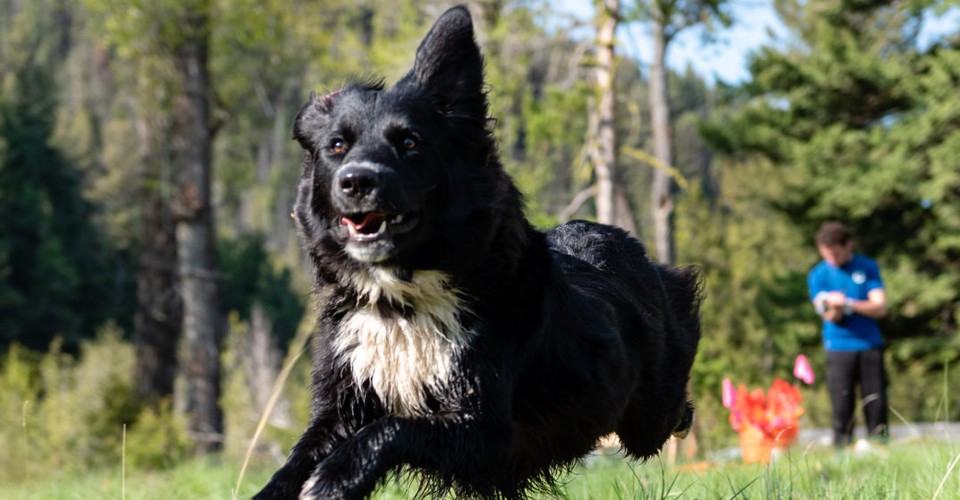
Meanwhile, in North America, another project is pushing archaeology-dog detection even further into the past. In 2018, anthropologist Lauri Travis, at the time at Carroll College in Montana, teamed up with student Hannah Decker to see if a 12-week-old border collie and Australian shepherd mix named Dax could be trained to detect the bones of mammals that humans hunted and consumed in the past.
“I want to find out what Native peoples [in Montana] ate during two important droughts: one 8,000 years ago and one 2,000 years ago,” Travis explains. Dax could help.
Decker spent much of her senior year of college training Dax (named after an intrepid Star Trek character). “Dogs have always been a passion of mine,” she says, “and I would not be who I am today without working with them.”
During training exercises held first indoors, then outside, Decker used properly dated real bones from nonhuman mammals. In some cases, she used gloves when handling the samples to avoid any direct contact that might contaminate them. “I started by grinding bones into powdered dust,” she explains, “since that allows more surface area and more odor.”
Decker paired bone dust with a toy and left it on the ground for Dax to discover. Later, she simply hid the bone dust, and finally she buried whole bones a few inches underground. Dax learned to signal that she had found something with a series of barks.
By the time training ended, Dax could find bones buried 10 months earlier as deep as six inches. In one such experiment, she found animal bones that were more than 3,500 years old. By August 2019, the dog was finding complete mammal bones in the ground, and Travis reports that more recently Dax found a 5,000-year-old bone that was buried 12 inches deep.
Travis now cares for Dax full time. She works with the dog to identify archaeological sites of interest that could contain ancient mammal bones—from animals such as bison, deer, elk, or rabbit that may have been part of the diet of Indigenous peoples at the time. “We’re always looking for new tools to help us in our jobs,” Travis says, “and I think scent dogs may prove really useful in the future.”
Picture it—a hardy, happy archaeology dog skidding across Montana’s snow and ice to sniff out the shards of an ancient ungulate from unimaginable eons ago.
This post appears courtesy of Sapiens.
We want to hear what you think about this article. Submit a letter to the editor or write to [email protected].







