

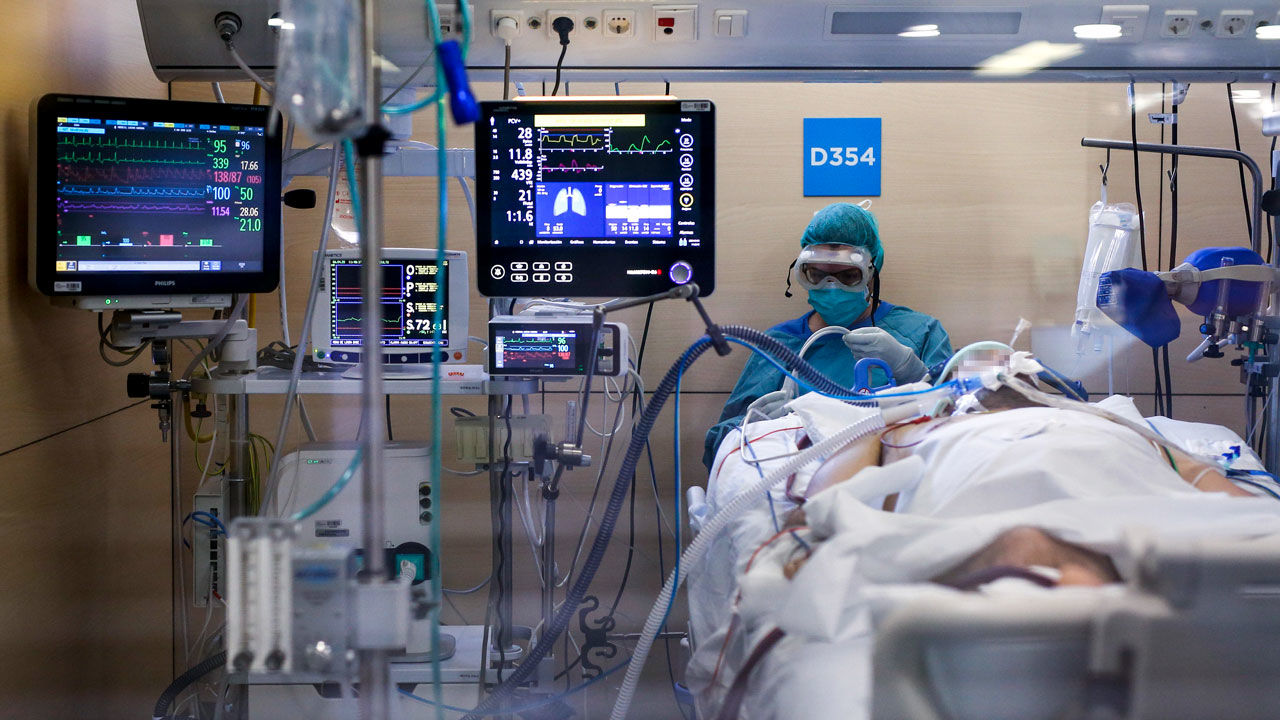

A World Health Organization–led global trial of treatments for COVID-19 was slow to enroll coronavirus-infected people, like this one in a Spanish intensive care unit, whereas a large trial in the United Kingdom quickly produced results for three treatments.
PAU BARRENA/AFP via Getty Images
Science’s COVID-19 reporting is supported by the Pulitzer Center.
On 29 June, University of Oxford clinical scientists Martin Landray and Peter Horby changed how physicians around the world consider treating COVID-19—for the third time in little more than 3 weeks. The principal investigators of a U.K. megatrial called Recovery, which has been testing existing drugs as therapies for the new infection, the pair had just finished reviewing data from 1596 patients who had received a combination of lopinavir and ritonavir, two antivirals known to curb HIV, and 3376 patients who had received only standard care. In a press release, they and their Recovery colleagues announced there had been no significant difference in the death rate between the two groups. “This could have worked. And it was a bust,” says Eric Topol, director of the Scripps Research Translational Institute. “It was really important to clarify that.”
Earlier the same month, and again through press releases, Recovery (Randomised Evaluation of COVID-19 therapy) delivered widely accepted verdicts on two other treatments. It revealed that dexamethasone, a cheap steroid, reduced deaths by one-third in patients on a ventilator and showed that hydroxychloroquine, the antimalarial drug controversially touted for COVID-19, did not benefit hospitalized patients. A run on dexamethasone ensued as physicians in the United Kingdom and elsewhere quickly made it part of their standard of care for the sickest patients, whereas many other studies of hydroxychloroquine now looked futile and were halted.
Related
“It’s very, very rare that you announce results at lunchtime, and it becomes policy and practice by tea time, and probably starts to save lives by the weekend,” Landray told Science at the time of the steroid result.
Large, randomized trials are the gold standard to test a drug’s efficacy. But they have been scarce so far in the COVID-19 pandemic. “Everybody has the first part about “randomized,” but they omitted the “large” part, says Ana-Maria Henao Restrepo, a medical officer at the World Health Organization’s (WHO’s) Emergencies Programme. “Every clinician, every researcher wants to help and then they end up having a trial with 300 or 400 patients that cannot come up with conclusive evidence.” In a sea of small, single institution studies, Recovery, with 12,000 patients and hundreds of participating hospitals, stands out—and offers lessons for the few other megatrials, organized by WHO and other bodies, which have been slow off the mark. “I think the three Recovery trials are the best trials that have been performed to date,” Topol says.
One reason Recovery has done so well is that it was backed by the United Kingdom’s centralized National Health Service (NHS), involving 176 of its hospitals. In the United States, where the health care system is fragmented, the National Institutes of Health has only begun a few large trials so far and completed just one, a trial of Gilead Sciences’s antiviral compound remdesivir that showed those given the drug recovered from COVID-19 faster. The dearth of results from a country that has seen more cases of COVID-19 than any other is “surprising and a bit disappointing,” says John-Arne Røttingen, who heads the steering committee of Solidarity, WHO’s attempt to evaluate repurposed drugs as possible COVID-19 therapies.
In contrast, the United Kingdom’s own bungled public health response to the new virus, which has led to Europe’s largest outbreak, has been taken advantage of by Recovery. “They have been able to recruit well, because they have had a lot of hospitalized patients,” Røttingen says. (The United Kingdom has had more than 43,000 deaths, surpassed only by the United States and Brazil, far more populous countries.)
In a letter to all NHS hospitals, the United Kingdom’s five most senior doctors urged health care workers to enroll patients in Recovery and two other important trials. “Use of treatments outside of a trial, where participation was possible, is a wasted opportunity to create information that will benefit others,” the doctors, including Chris Whitty, chief medical officer for England, wrote. Because of that coordination, “One in every six COVID-19 patients that come into the U.K. hospitals go into the trial,” Landray says.
Organizers also kept Recovery simple, allowing any NHS hospital to participate. Inspired by trials that his Oxford colleague Richard Peto and others did in the 1980s on treating heart attacks, Landray says they radically cut down on the data health care workers need to collect, with only a few questions asked at enrolment and at only one more data collection point: when the patient dies, is discharged, or 28 days after enrollment. Clinical trials have become excessively cumbersome in recent years, he argues. “It’s actually quite hard to make them really simple.”
WHO’s Solidarity trial has a similarly straightforward design, but its more international nature has proved a challenge. The trial, designed to test four treatments—hydroxychloroquine, lopinavir/ritonavir, interferon beta plus lopinvir/ritonavir, and remdesivir—was announced on 20 March and enrolled its first patient in Norway 1 week later. But rolling out the trial in dozens of countries has meant getting approval from dozens of regulatory agencies and ethics boards as well. “That has taken a surprisingly long time in many jurisdictions, including in Europe,” Røttingen says, and recruitment in Europe slowed over time as the epidemic subsided. “When countries were ready to sort of start, the epidemic was under control in many ways,” he notes.
A European trial called Discovery, coordinated by the French research institute INSERM and partnered with Solidarity in testing the same drugs, also fell short. The goal was to enroll 3200 patients across the continent, but although the study almost met its goal of 800 participants in France, it barely managed to recruit patients elsewhere. Though France funded its part of the trial, it expected partner countries to pick up the tab for their own trials. “One of the issues was that not all the countries had funding,” says Yazdan Yazdanpanah, head of infectious diseases at INSERM.
Meanwhile dozens of small trials competed for patients in many countries, most of them focusing on the same drugs, such as hydroxychloroquine. “I don’t understand why everyone was looking at the same thing,” Yazdanapanah says. “I think we can do better.” Susanne Herold, an expert on pulmonary infections at the University of Giessen, agrees. “There needs to be more coordination both within countries and across borders,” she says.
Another problem has been the widespread use of treatments outside of randomized trials. Landray notes that tens of thousands of COVID-19 patients in the United States have been given convalescent plasma, for instance, but not alongside a control population receiving a placebo. “We’ll know what happened to those patients, but we won’t know whether they would have been better off actually, if they hadn’t got the convalescent plasma. Partly it is about convincing clinicians that there is still an open question,” Henao Restrepo says. “I have talked to about 2000 clinicians all over the world in the process of establishing Solidarity, and some of them are convinced they know which drugs work.”
Henao Restrepo still has high expectations for the Solidarity trial. “The preparatory work is paying off,” she says. Its recruitment pace has picked up as more countries have joined, many with surging cases, including Iran and countries in Latin America. So far, 31 countries have joined and 60 more are in the process. “One of the advantages of such a global trial is that you can follow the pandemic as it evolves,” Røttingen says.
With recruitment running at about 500 patients per week now, Solidarity’s three remaining treatment arms—it stopped the hydroxychloroquine one—are likely to yield answers soon, raising the question of what drugs to test afterward. Some repurposed drugs such as camostat mesylate or favipiravir are still being discussed, but increasingly the attention is turning to monoclonal antibodies, designed to target the virus.
Henao Restrepo thinks the international nature of the effort makes its results more generalizable. “The feeling that all kinds of patients and hospitals participated is an important part of accepting the findings,” she says. And the global effort “gives the people all over the world, clinicians all over the world the possibility to contribute.”
Herold adds that the Discovery trial will also contribute, because it is designed to gather more detailed data than Recovery and Solidarity. Started in an effort to supplement Solidarity, it collects not only basic data on mortality, but also information on viral levels and certain blood parameters. Those data can indicate not just which drugs are effective, but also how they work and at what stage of the disease, Herold says, crucial to informing follow-up research or trials.
Work on the Recovery trial continues, with Landray, Horby, and the rest of their team scrambling to publish full results. Some researchers have criticized its practice of releasing important results as press releases; so far, it has given details for only one of the three headline findings, on dexamethasone, in a preprint posted 6 days after the release. The researchers are also continuing to collect data on the antibiotic azithromycin, an antibody called tocilizumab, and the antibody-rich plasma collected from recovered patients.
Results on those therapies are likely months away, Landray says. But he cautions he has been wrong before. On the morning of 4 June, he had predicted the first results from Recovery would likely come in early July. A few hours later, the chairperson of the trial’s data monitoring committee called him to say there was enough patient data to declare a verdict on hydroxychloroquine.







