
GLOBAL RESEARCH SYNDICATE
No Result
View All Result
  • Login
  • Latest News
  • Consumer Research
  • Survey Research
  • Marketing Research
  • Industry Research
  • Data Collection
  • More
    • Data Analysis
    • Market Insights
  • Latest News
  • Consumer Research
  • Survey Research
  • Marketing Research
  • Industry Research
  • Data Collection
  • More
    • Data Analysis
    • Market Insights
No Result
View All Result
globalresearchsyndicate
No Result
View All Result
Home Survey Research

National tick surveillance survey identifies gaps to be filled

globalresearchsyndicate by globalresearchsyndicate
June 27, 2020
in Survey Research
0
National tick surveillance survey identifies gaps to be filled
0
SHARES
1
VIEWS
Share on FacebookShare on Twitter

New Cornell-led research shows that inadequate funding is the main barrier to better surveillance and control of ticks, including the blacklegged tick, which spreads Lyme disease, the No. 1 vector-borne illness in the country.

Insufficient infrastructure, limited guidance on best practices and lack of institutional capacity also are impediments to improved tick monitoring, the researchers found.

Their report, “A Survey of Tick Surveillance and Control Practices in the United States,” published June 17 in the Journal of Medical Entomology. The lead author is Emily Mader, program manager of the Northeast Regional Center for Excellence in Vector-Borne Diseases (NEVBD) and a member of the lab of Laura Harrington, professor of entomology, NEVBD director and a co-author of the study.

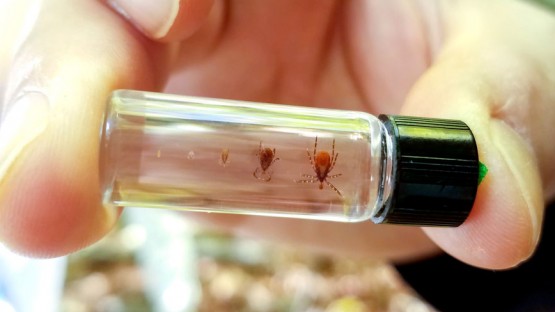
Three life stages of the blacklegged (deer) tick suspended in a vial.

The study identifies what methods public health agencies use to track ticks, the barriers they have and what aid they might need. The study also generated a directory of tick surveillance programs, which did not exist previously.

Aside from Lyme disease, multiple tick species can infect people and animals with a wide variety of other pathogens. Public health and medical professionals have seen a dramatic rise in these tick-borne illness over the last 15 years.

“Vector-borne diseases are only going to become an increasing threat in the world, [including] the United States,” Mader said, “and we really don’t know how to address that threat unless we study it.”

Mader and colleagues surveyed 140 vector-borne disease professionals who work in state, county and local public health and vector control agencies. The survey addressed: tick surveillance programs; pathogen testing methods; tick control practices; how data is communicated; and barriers to developing and operating programs.
Cornell impacting New York State

The results showed that close to half of the respondents were engaged in active tick surveillance, meaning they collect ticks from the environment. Nearly two-thirds engaged in passive surveillance – a kind of crowdsourcing where members of the public send in tick samples.

Active surveillance costs more as it requires trained personnel, transport and storage costs, but it offers more detailed location and ecological information that informs risk compared to passive surveillance. Some programs conducted no tick surveillance.

“If you want to know how the public health threat of ticks is changing from year to year, you need to have the data,” Mader said. “We found that [surveillance] programs just weren’t able to be sustained across time.”

Lack of access to pathogen testing services for many programs was another major barrier to getting better information about the public health threat of ticks in an area.

The survey also found that partnerships between tick surveillance programs within state health or agriculture departments often relied on academic partners. Universities may absorb some costs, provide diagnostic services and provide labor with student interns.

“The most prevalent barrier to developing and sustaining a tick surveillance program across time is just lack of funding,” Mader said. County programs often rely on funding from county taxes, while state programs receive state budget appropriations or federal grants.

Many existing programs are in areas where blacklegged ticks live; these communities may have a long history of tick-borne illness.

 The survey has already provided important information to bridge knowledge gaps, Mader said. One of the biggest barriers for effective tick surveillance has been lack of standardized guidelines on how to survey the environment for certain tick species, each of which behave uniquely, live in varying habitats, and are collected in different ways.

In response this need, the Centers for Disease Control and Prevention (CDC) recently issued two documents on collecting ticks from the environment.

NEVBD will work to identify more such gaps and provide the knowledge or resources that people need, Mader said.

Co-authors included researchers from Texas A&M University; the University of Florida, Gainesville; the University of California, Davis; the University of Illinois, Urbana-Champaign; and the CDC.

The study was funded by the five Regional Centers of Excellence in Vector-Borne Diseases.

Related Posts

How Machine Learning has impacted Consumer Behaviour and Analysis
Consumer Research

How Machine Learning has impacted Consumer Behaviour and Analysis

January 4, 2024
Market Research The Ultimate Weapon for Business Success
Consumer Research

Market Research: The Ultimate Weapon for Business Success

June 22, 2023
Unveiling the Hidden Power of Market Research A Game Changer
Consumer Research

Unveiling the Hidden Power of Market Research: A Game Changer

June 2, 2023
7 Secrets of Market Research Gurus That Will Blow Your Mind
Consumer Research

7 Secrets of Market Research Gurus That Will Blow Your Mind

May 8, 2023
The Shocking Truth About Market Research Revealed!
Consumer Research

The Shocking Truth About Market Research: Revealed!

April 25, 2023
market research, primary research, secondary research, market research trends, market research news,
Consumer Research

Quantitative vs. Qualitative Research. How to choose the Right Research Method for Your Business Needs

March 14, 2023
Next Post
Consumer Spending Rebounded Last Month — but Threats to the Economy Remain

Consumer Spending Rebounded Last Month — but Threats to the Economy Remain

Categories

  • Consumer Research
  • Data Analysis
  • Data Collection
  • Industry Research
  • Latest News
  • Market Insights
  • Marketing Research
  • Survey Research
  • Uncategorized

Recent Posts

  • Ipsos Revolutionizes the Global Market Research Landscape
  • How Machine Learning has impacted Consumer Behaviour and Analysis
  • Market Research: The Ultimate Weapon for Business Success
  • Privacy Policy
  • Terms of Use
  • Antispam
  • DMCA

Copyright © 2024 Globalresearchsyndicate.com

Welcome Back!

Login to your account below

Forgotten Password?

Retrieve your password

Please enter your username or email address to reset your password.

Log In
This website uses cookies to improve your experience. We'll assume you're ok with this, but you can opt-out if you wish. Cookie settingsACCEPT
Privacy & Cookies Policy

Privacy Overview

This website uses cookies to improve your experience while you navigate through the website. Out of these cookies, the cookies that are categorized as necessary are stored on your browser as they are essential for the working of basic functionalities of the website. We also use third-party cookies that help us analyze and understand how you use this website. These cookies will be stored in your browser only with your consent. You also have the option to opt-out of these cookies. But opting out of some of these cookies may have an effect on your browsing experience.
Necessary
Always Enabled
Necessary cookies are absolutely essential for the website to function properly. This category only includes cookies that ensures basic functionalities and security features of the website. These cookies do not store any personal information.
Non-necessary
Any cookies that may not be particularly necessary for the website to function and is used specifically to collect user personal data via analytics, ads, other embedded contents are termed as non-necessary cookies. It is mandatory to procure user consent prior to running these cookies on your website.
SAVE & ACCEPT
No Result
View All Result
  • Latest News
  • Consumer Research
  • Survey Research
  • Marketing Research
  • Industry Research
  • Data Collection
  • More
    • Data Analysis
    • Market Insights

Copyright © 2024 Globalresearchsyndicate.com




