

Guiding regeneration
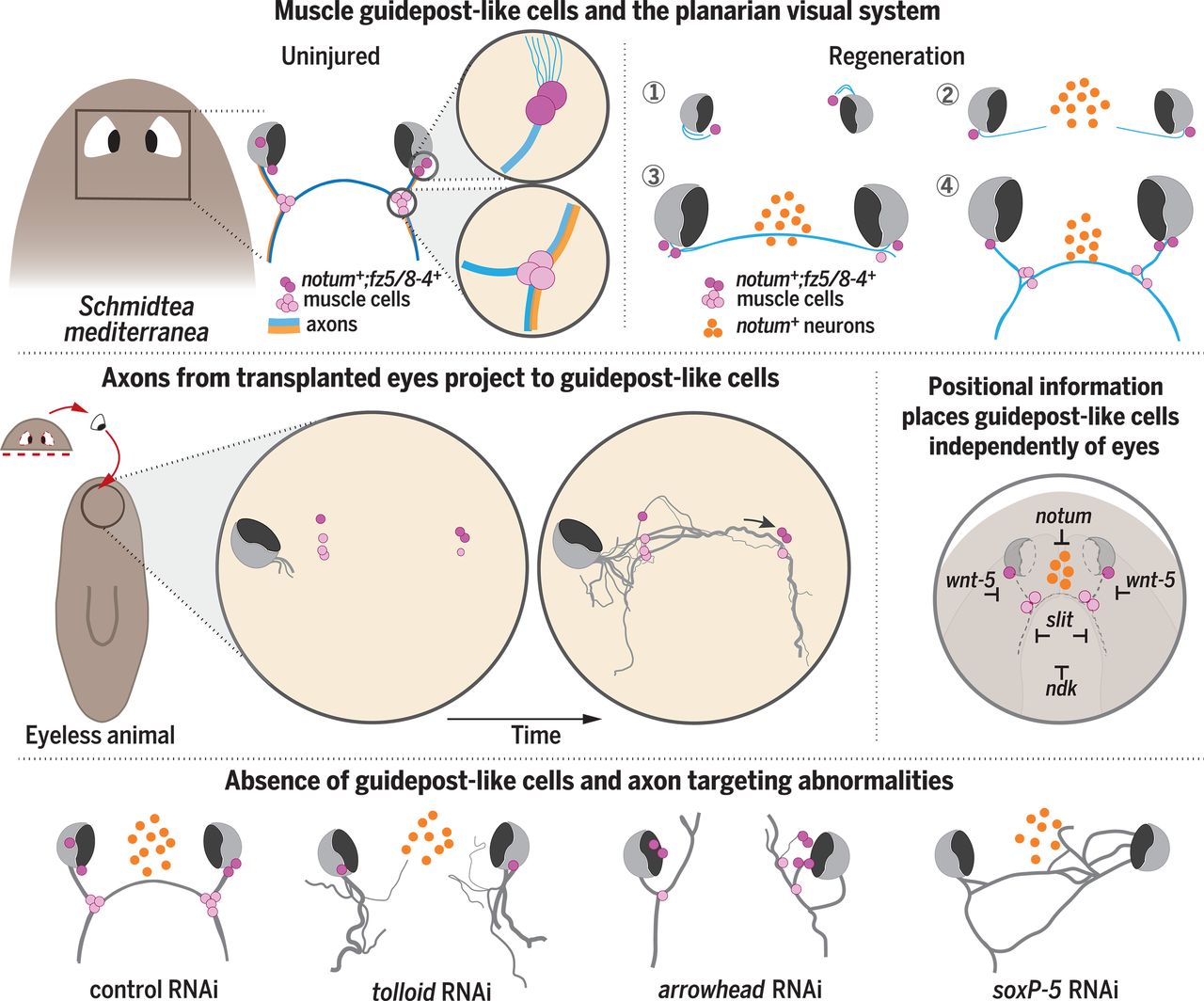
Many adult organisms can regenerate neural circuits after injury. However, it is not clear which guidance mechanisms operate to promote axon path finding in the adult. Scimone et al. addressed this question by investigating regeneration of the planarian visual system (see the Perspective by Roberts-Galbraith). Distinct muscle cell populations were found in close association with photoreceptor axons that, together with a neuron class, facilitated visual system assembly after diverse injuries or eye transplantations. These cells exhibited features similar to embryonic guidepost cells and were specified independently of eyes in precise locations by the action of adult positional information cues. Absence of these guidepost-like cells was associated with defective neuronal wiring in regeneration.
Structured Abstract
INTRODUCTION
Multiple strategies exist to promote precise wiring of developing neuronal circuits. One strategy involves guidepost cells, which exist transiently in embryos. Guidepost cells can act as intermediate guidance targets for axons or by providing a scaffold that facilitates axonal targeting. Most guidance mechanisms become dispensable once the circuit is assembled. Loss of guidance mechanisms creates a potential limitation on regeneration of neuronal patterns—yet some animals are capable of functional regeneration of their nervous system.
RATIONALE
Assuming some adult animals have the ability to regenerate functional neuronal circuits, they must possess mechanism(s) for de novo repair of neuronal patterns. In this study, we aimed to characterize such mechanisms by studying regeneration of the planarian visual system after diverse injuries.
RESULTS
We identified a rare subset of muscle cells (notum+; frizzled 5/8-4+) concentrated at two precise anatomical locations and in tight association with photoreceptor axons. The first group of these cells was found near the eye, where visual axons project and fasciculate to form a bundle. The second group of these cells was found near choice points, where sorting of contralateral and ipsilateral axons occurs. Both groups of muscle cells were formed during regeneration of the visual system and were always tightly associated with axonal projections, consistent with a possible role in attraction to facilitate visual system assembly. In addition, we found that a notum+ set of neurons, located at the adult anterior brain commissure, regenerated before axonal midline crossing and was associated with optic chiasm regeneration.
We reasoned that if the photoreceptor axon–associated notum+; frizzled 5/8-4+ muscle cells have a guidepost-like function, their formation should be independent of eye cells. Eyes transplanted to ectopic anatomical locations did not result in the formation of notum+; frizzled 5/8-4+ muscle cells. Furthermore, animals that were unable to generate eyes [ovo RNA interference (ovo RNAi) animals] were still capable of specifying these muscle cells at the right locations. In addition, we predicted that if these muscle cells were indeed guidepost-like cells, visual axon trajectories should be associated with them after eye transplantation into eyeless heads. In all instances, axons from transplanted eyes projected toward notum+; frizzled 5/8- 4+ muscle cells and often adjusted their trajectories after encountering them.
We found that an array of signaling cues, which provide positional information essential for planarian patterning, was required for dictating the precise location of these guidepost-like cells. This provides a visual system–extrinsic mechanism for placing guidepost-like cells in the adult.
Finally, with single-cell RNA sequencing and fluorescent in situ hybridization screening, we identified molecules and transcription factors expressed in these cells. RNAi studies reduced or eliminated muscle or neuronal guidepost-like cell subsets and resulted in aberrant patterns of visual axonal trajectories.
CONCLUSION
Adult molecular and cellular strategies for regenerating neuronal pattern in the absence of embryo-specific contexts must exist to overcome damage or loss after injury. Understanding these mechanisms might provide important insights for regenerative medicine. Here, we found adult guidepost-like cell populations, extrinsic to the visual system and placed by adult positional information, that promote normal visual system regeneration in planarians.

Muscle and neuron guidepost-like cells are present at key locations near the planarian visual system and are formed independently of photoreceptor axons. Regenerating and transplanted eyes target projections to guidepost-like cells. Positional information cues provide an eye-extrinsic mechanism to place guidepost-like cells in the adult. Loss of guidepost-like cells is associated with visual system disruption. wnt-5, slit, and ndk are involved in positional control of guidepost-like cell placement. fz5/8-4, frizzled 5/8-4.
Abstract
Neuronal circuits damaged or lost after injury can be regenerated in some adult organisms, but the mechanisms enabling this process are largely unknown. We used the planarian Schmidtea mediterranea to study visual system regeneration after injury. We identify a rare population of muscle cells tightly associated with photoreceptor axons at stereotyped positions in both uninjured and regenerating animals. Together with a neuronal population, these cells promote de novo assembly of the visual system in diverse injury and eye transplantation contexts. These muscle guidepost-like cells are specified independently of eyes, and their position is defined by an extrinsic array of positional information cues. These findings provide a mechanism, involving adult formation of guidepost-like cells typically observed in embryos, for axon pattern restoration in regeneration.







