

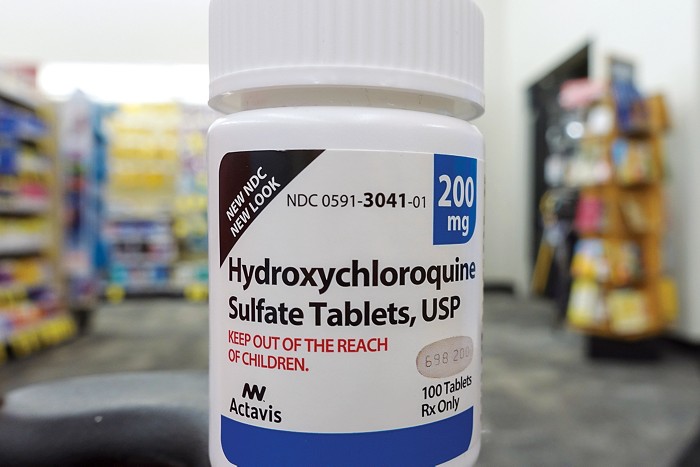
Clinical studies continue to suggest that the antimalarial drugs chloroquine and hydroxychloroquine do not help treat or prevent COVID-19. One high-profile study published in the Lancet even concluded that the drugs may increase the risk of death. Those results prompted several groups, including the World Health Organization (WHO) and the pharmaceutical company Sanofi, to suspend or terminate trials of the drugs.
But soon after its May 22 publication, the Lancet study came under criticism and the authenticity of its data was called into question. That led WHO to resume its trials. The study was ultimately retracted on June 5. That same tumultuous week, two other groups announced negative results from large hydroxychloroquine studies.
Researchers at the University of Minnesota conducted a study of 821 people to see if hydroxychloroquine could prevent sickness in those who were recently exposed to someone with COVID-19. Among those who received the drug, 11.8% became sick, versus 14.3% who received a placebo. The difference was not statistically significant (N. Engl. J. Med. 2020, DOI: 10.1056/NEJMoa2016638).
Benjamin Rome, a primary care physician at Brigham and Women’s Hospital, applauds the trial’s rigor. “This is exactly the sort of evidence we need,” he says, adding that the results suggest that hydroxychloroquine is unlikely to protect against COVID-19. “If there is any benefit, it would have to be quite small to not be picked up by this trial.”
In the UK, investigators announced preliminary results from a study involving more than 4,600 people hospitalized with COVID-19. In the study, called the RECOVERY Trial, 25.7% of 1,542 people who got hydroxychloroquine died after 28 days, compared with 23.5% of 3,132 people who received standard care. Again, the difference was not statistically significant.
There are more than 130 active or planned clinical trials testing the ability of hydroxychloroquine or chloroquine to treat or prevent COVID-19. With negative results from two major trials, some scientists now wonder if the chloroquine craze is over. “RECOVERY is an excellent trial, and probably the best evidence we will have,” says Paul Glasziou, director of the Institute for Evidence-Based Healthcare at Bond University. “We need more trials on other treatments.”
Some researchers say there is no definitive proof that hydroxychloroquine is ineffective, however. Novartis and the US National Institutes of Health are both pushing ahead with independent placebo-controlled trials of the drug in people hospitalized with COVID-19.
Other groups say the Minnesota study is not the final word on prevention. They are continuing their own post-exposure studies to assess whether the drugcan help prevent infection in thousands of people recently exposed to the virus.
Researchers are also proceeding with even larger pre-exposure studies this summer, in which tens of thousands of healthyhealth-care workers will be given chloroquine or hydroxychloroquine to see if the drugs can prevent infection. Results are expected by late summer or early fall.






