


You have run out of free articles. You can support our newsroom by joining at our lowest rate!
Thanks for being a subscriber.
Sorry, your subscription does not include this content.
Please call (800) 762-6397 to upgrade your subscription.
Sign Up Today and Support Local Journalism
Enjoy more articles from Billings’ Most Trusted Information Source. Subscribers can log in for unlimited digital access
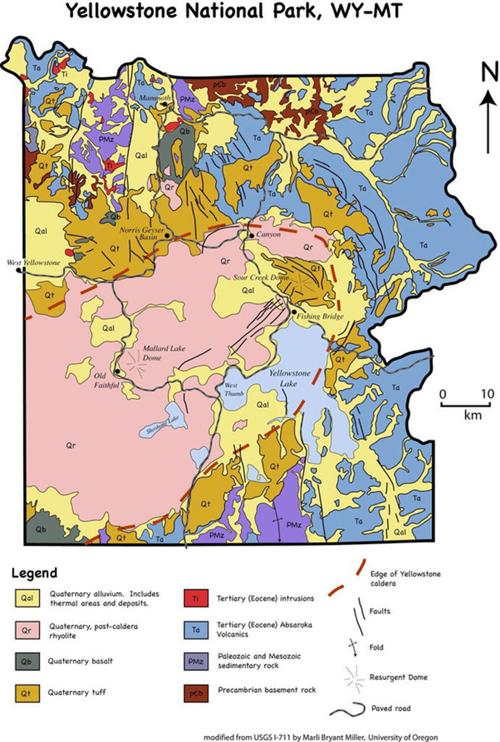
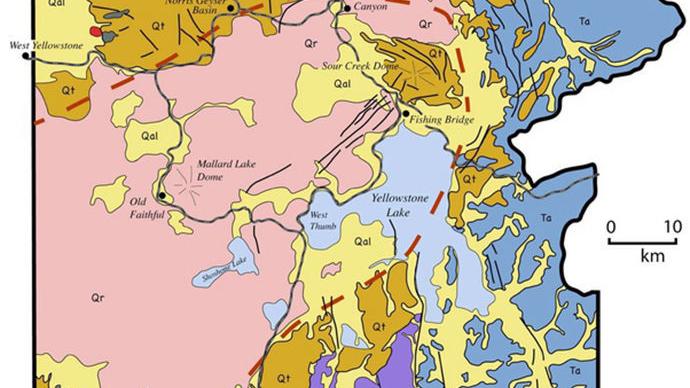
This simplified geologic map of Yellowstone shows all rock material resulting from the major caldera-forming eruptions. The dashed caldera boundary highlights the scale of these events. Older volcanic, sedimentary and metamorphic rocks are found outside of this boundary.
Brett French
Yellowstone Caldera Chronicles is a weekly column written by scientists and collaborators of the Yellowstone Volcano Observatory. This week’s contribution is from Madison Myers, in the Department of Earth Sciences, and Luke McKay, in the Department of Land Resources and Environmental Sciences and the Center for Biofilm Engineering, both at Montana State University.
Unlike most volcano observatories, Yellowstone is monitored by a consortium of institutions. The Yellowstone Volcano Observatory was founded in 2001 and at first only involved three organizations: Yellowstone National Park, the United States Geological Survey and the University of Utah. In 2013 it expanded to eight institutions. Now, in 2020, Montana State University has joined the group.
Montana State University is located in beautiful Bozeman, Montana, only 1.5 hours from the entrance to Yellowstone National Park. For years, researchers at Montana State have used Yellowstone as a natural laboratory to test important scientific hypotheses and to teach classes, focusing on the rich biodiversity, hydrothermal centers and of course, geology. Two of the main ways that Montana State currently helps to monitor the volcano are through assessment of the state of the hydrothermal centers and volcanic mapping of the main eruptive units.
Just like you and me, the Yellowstone volcano expresses itself in diverse ways. The heat, water, and gases released by the deep magma chamber seep upwards through geologic structures, finding their way through diverse subsurface environments and up to the surface where they encounter dynamic hydrological and topographical settings. What results is more than 10,000 surface expressions of the volcano, giving us hot springs, geysers, mud pots and fumaroles, all with unique thermal and geochemical characteristics.







