

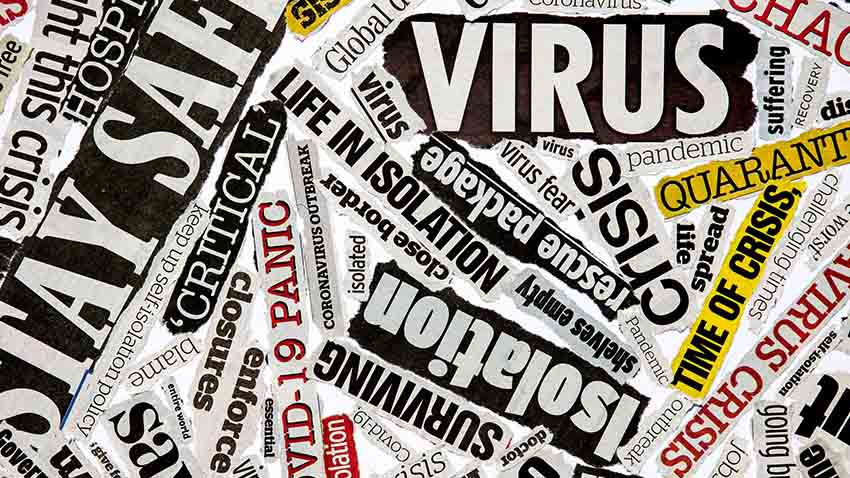
Sometimes it feels like trying to drink from a firehose. All those news headlines making new claims about coronavirus and COVID-19. All those social media posts debating this restriction or that reopening. All the worry about whether we overreacted, or didn’t do enough.It’s enough to make some people want to stop paying attention.
But the world needs people who can spot and share solid information about COVID-19, and call out misinformation and exaggeration. They’ll be key to the next phase of the pandemic, and to reducing suffering and death as the health crisis continues.
“It can be hard to wade through all the new information coming at us, especially when we’re under stress,” says Preeti Malani, M.D., chief health officer for the University of Michigan and a trained journalist as well as a physician. “But that makes it even more important for us to focus on sharing and acting on the most trustworthy and verified information.”
So how can you navigate this rapid-fire news environment, if you care about using science to steer us through the coming months?
Here are some tips:
1. Understand that science changes. That’s what it’s designed to do. Especially now.
This is still a new virus, even six months into the pandemic. Scientists have worked quickly to understand it, and what it does to people. They’re using advanced tools and data sources that weren’t even available a few years ago.
It feels like forever that the country has lived with COVID-related restrictions. But in scientific terms, six months is barely the blink of an eye. Studies take time, even when scientists clear the decks of every distraction to focus on a world health emergency, like many of them have for coronavirus.
Every time a COVID-19 scientific team shares new findings, they add to the information that’s available for other experts to use. And taken together, that information can help with decisions about everything from opening schools, to treating patients, to designing vaccines.
By nature, if they’re based on science, those decisions can and should change. The right thing to do three months ago, or even one month ago, might not be the right thing to do next month, as scientists discover more.
SEE ALSO: Everyone vs. COVID-19: How You Can Help Science Make Progress
So if someone says, “They just told us the opposite back in April!”, or complains that they just read a news story that contradicts another news story from a few weeks ago, it’s crucial to remind them that “Science happens!” and that scientists are doing their best to address a global emergency caused by a new virus.
2. Remember the old saying “Better safe than sorry.”
It sounds like something your grandmother might say. But it’s the guiding principle for most public health officials, and it’s gotten us this far.
Public health officials almost always focus on working to prevent something bad, or to address it early, rather than trying to stop it after it happens. Other old sayings also apply – you can’t put the genie back in the bottle, or for gardeners, it’s important to “nip things in the bud.”
So even as scientists discover new things about how the coronavirus spreads from one person to the next, or who is most at risk if they catch it, public health officials may stick to the advice they’ve given before. They won’t change course just because one study says something new. They’ll wait for the evidence to build up.
Experts call it the “precautionary principle.” And right now, it means wearing masks indoors, keeping distance from others, washing hands, and above all else, keeping sick people home, and protecting people who are older or have certain health conditions.
In the United States, where shortages of COVID-19 tests are just starting to ease, this is especially true.
American public health officials want to reach a point where they can test millions of people, and then zero in on each person who tests positive, even if they don’t have symptoms yet. Then we can keep them home or in the hospital until they’re better or the risk of getting sick has passed. And we can trace who they were in contact with in the days before they got sick, so those people can get tested and quarantined too. This “test and trace” approach has proved useful in many other disease outbreaks.
But unlike some other countries, the United States isn’t there yet. As a result, society must keep up the slow reopening.
So if someone you know shares a headline claiming masks aren’t needed, or says on social media that the whole COVID-19 thing is a hoax, remind them: Health experts are overly cautious for a reason. Those genies don’t go back into bottles, and they can do a lot of damage once they’re out. This one has already killed more than 110,000 Americans.
3. Handle “sneak peek” science and “fast science” with special care
Medical science usually moves slowly for a reason: to give other scientists a chance to critique the work and challenge the claims of their peers. This happens in lectures, at conferences, and in the anonymous review process for journal articles called “peer review.”
These checks and balances aren’t foolproof. But they’re designed to keep bad science from getting too far. And if faulty findings or exaggerated claims do see the light of day, scientists can criticize them through letters or tweets. They can call for corrections or even full-scale retractions, to un-publish a paper.
But the urgency that scientists feel about studying COVID-19 is driving many of them to consider publishing their papers as “preprints.” This “sneak peek” form of scientific publishing means new results become available online even before peer review happens.
The original idea was to invite other scientists to read and critique them openly, and to get new findings into the marketplace of ideas. But it also means that anyone, including reporters, can share them on social media or write stories about them. And that may lead people to draw conclusions that might be premature – especially when it comes to making decisions about prevention or treatment.
SEE ALSO: Fear Can Spread From Person to Person Faster Than the Coronavirus
Even if a COVID-19 paper makes it through a rapid form of peer review, and get published in a medical journal, the pressure to work at high speed could make it more likely that mistakes or overstatements sneak in.
Already in the first months of the pandemic, several studies that got massive news coverage and social media attention when they first came out as preprints or rapid-turnaround journal articles have been retracted or corrected. But by that time, the damage was done. Thousands of people took drugs that turned out to be more harmful than helpful, and false hopes were raised and then dashed.
Now, hundreds or even thousands of COVID-19 studies are working their way toward publication. The impatience with the slowness of scientific peer review may increase – and so might the use of preprints.
So, when reading COVID-19 news, stop for a moment and look for the source of the information. Is the article about a scientific paper published in a journal, or online as a preprint? If you can’t tell, it might be good to look to see if any other news organizations have covered the same study yet. Just because a reporter is the first one to cover a new piece of research doesn’t mean they’ve done the best job.
Reporters might mention the word “preprint” in their stories about new COVID-19 research. If they do, tread even more carefully.
If a news article doesn’t mention a preprint or research paper at all, be even more careful. A claim about something as important as COVID-19 care should be backed up with solid scientific evidence. Human lives are at stake.
4. Check, and double-check, before you share.
The age of social media, of self-published blogs and websites, and of “news organizations” that have a decided point of view, makes it harder than ever to know what information to trust.
Some efforts are fighting back against this situation. For instance, social media companies have started to label some types of news as more trustworthy than others, or to give “verified” status to the Twitter accounts of experts in certain COVID-related fields. Major news outlets are making their COVID-19 stories, written by experienced science and health reporters, available for free. And fact-checking sites and efforts have blossomed.
But for the most part, it’s easy for bad information to travel faster than good information. It can travel especially quick if it makes a claim that reinforces what people already believe, or what they want to be true.
So before sharing something online, or passing along something someone else shares, consider these questions:
- Have I ever heard of the website that this is from? It’s better to focus on stories and information from reputable news organizations, government agencies and health organizations.
- Who wrote it, and what do I know about them? Experienced reporters often have their biographies linked from their names, and experts who write columns usually list their titles.
- Can I find the same story on another site through a quick internet search? If it’s only on one website, wait a while and look again. The rush to be “first” with a piece of news can lead to errors and over-generalizations.
- If it’s about a study, does it say who did the study or paid for it, how many people were involved, or where the study is published? If it doesn’t, be careful.
- Who’s quoted, or credited as the source? Is it anyone from a national, state or local health agency, a major university or hospital, or a trustworthy non-profit organization? If not, ask yourself if the people quoted could stand to benefit in some way from their claims, such as selling a product.
- Does it contain any quotes from people who question the claim or sound a note of caution? This is a sign that a reporter has done some homework before publishing their story.
- If the claim is especially outrageous or surprising, can you fact-check it? For instance, it might be covered on a site like https://www.snopes.com/ or https://www.factcheck.org/ and you can share their post. Or it might be satire.
Want to learn more about picking apart health news? Visit websites like Health News Review, the BBC Academy’s “Beyond Fake News” page, and this guide to evaluating information online from California State University.
Like Podcasts? Add the Michigan Medicine News Break to your Alexa-enabled device or subscribe for updates on iTunes, Google Play and Stitcher.







