


More than 30 years ago, a former flight attendant and social worker turned educator started offering professional development programs for teachers at the North Carolina Museum of Natural Sciences (NCMNS). That educator, Mary Ann Brittain, strongly believed in the power of real experience in the natural world to transform teaching and learning.
Over my 16-year career at the museum, I’ve been steeped in that belief, and I’ve worked to keep nature-based experiential learning at the center of our Teacher Education programming. I’ve shied away from the ubiquitous use of technology in favor of observation-driven exploration. But what’s a luddite to do when the world shuts down and the only way to help is through technology?
My greatest privilege is being able to watch as a teacher steps into the role of a learner and examines the methodical habits of a caterpillar or marvels at the biodiversity of a North Carolina swamp. I knew that in transitioning to an online platform for educator workshops, we needed to hold on to the sense of wonder that comes from an authentic experience in nature. That’s exactly what I needed in an unprecedented and stressful time. And I heard the same thing from teacher friends: “We need professional development and resources, but we need to get away from our screens!”
It’s easy to feel awed by nature while watching a geyser erupt in Yellowstone National Park or listening to 40,000 pairs of snow goose wings beating at the same time. But as Aristotle wisely said, “In all things of nature there is something of the marvelous.” Nature in our backyards or local parks is a balm for the soul and a classroom for an inquisitive mind — and it’s the perfect thing to explore while we’re spending more time at home.
My team’s challenge was putting all of these things together: online learning + authentic experience + nature-at-home = virtual, experiential, backyard professional learning. Sounds like an oxymoron to me. But remote learning doesn’t have to mean we’re glued to a screen — if we use the natural world as a vehicle for exploring art, language, and science. That’s what NCMNS has tried to do with a new series of online workshops.
Each self-paced session starts with a topic that explores a facet of the natural world that is easy to come by in a backyard or local natural area. I love taking teachers to Great Smoky Mountains National Park and giving them the opportunity to participate in a salamander survey, but that’s not accessible while we’re all stuck at home. Instead, we’re focusing on broad subjects that most North Carolinians might have nearby — things like flowers, trees, and the critters that live under a rotten log.
To keep a level of “personal interaction,” each workshop includes a short video to introduce relevant background information or to demonstrate a quick how-to. This gives us a chance to guide the teacher-learner through the steps of an activity or explain a concept that’s difficult to convey on paper. Supporting materials, like diagrams and online field guides, provide a quick reference to reinforce concepts.
Observation-driven activities guide the learner in applying knowledge and skills through hands-on exploration. We’ve incorporated nature journaling into most of our activities as a tool to deepen observations and model scientific practices. Shared files provide a platform for a public product that can generate collaboration and conversation across time and space: even though teachers participate in workshops at their own pace and in isolation, they can share their work, then view and comment on the work of others.
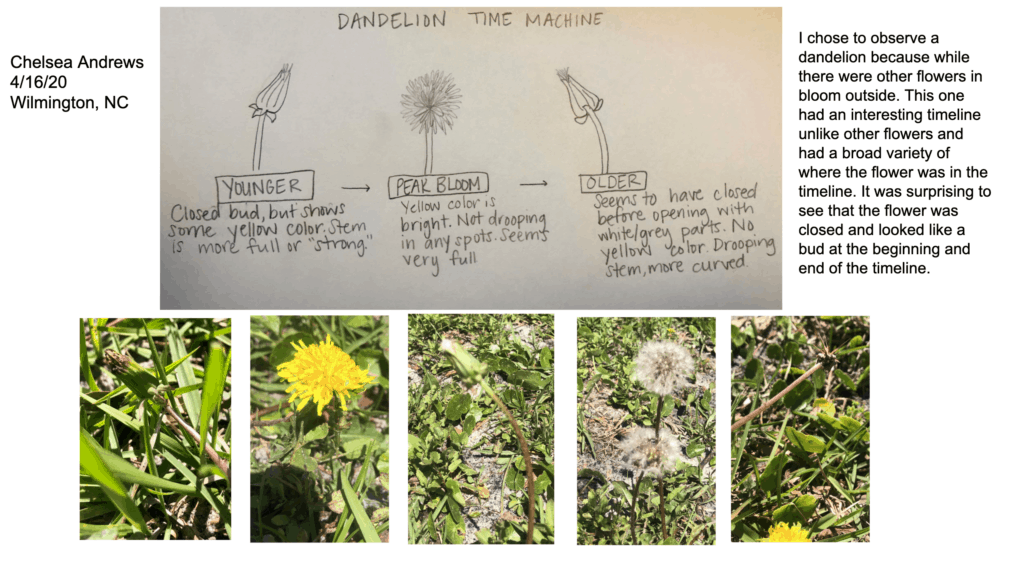
Each workshop finishes with reflection questions to cement learning and brainstorm ideas for adapting content to the real or remote classroom. Shared responses create dialogue and allow participants to learn from the experience of others.
All aspects of these workshops — videos, materials, activities, worksheets, even the step-by-step structure with which we’ve set up Google Classroom — are freely available to anyone to use and adapt for students. We’ve heard from participants that they’re doing just that.
“The most valuable component of this workshop is that I had everything I needed in my own backyard. I could easily replicate the activities with my students on our school grounds and with very little materials. In addition the activities demonstrated strong science content which makes them hands on and rigorous which is a double win for educators,” wrote a school administrator in Columbus County in response to a survey.
Just as importantly, in creating these workshops we hoped the opportunity to slow down and connect with nature would provide solace during a stressful time. That has perhaps been our greatest success, exemplified by evaluation comments like these: “It brought me peace during a time of such chaos,” and “It felt like a true workshop – even though I am at home and by myself.”
Mary Ann Brittain passed away a little more than a year ago. Some of the words from her obituary were: “She was full of gladness and cherished her deep connection to all living things from bugs to bears. And she thought daily… Wow! What a planet!”
I think she would appreciate the way her work lives on in this new virtual world. And as with the other programs she created and inspired, I hope it fosters new connections to the living things of this amazing planet.
Thank you to Megan Davis, the teacher education specialist at the North Carolina Museum of Natural Sciences, for her collaboration on this project.







