

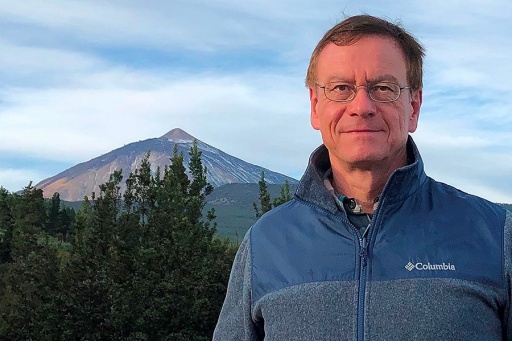
When German Chancellor Angela Merkel last year rhetorically asked researchers at the annual meeting of the Alexander von Humboldt Foundation what the modern world could learn from the group’s namesake, a 19th-century Prussian polymath, she quoted in response from an interview with UB history professor Andreas Daum.
Merkel’s 2019 keynote address was on the global role of science, but Humboldt’s keen wisdom, using Daum’s words, is especially relevant in light of the COVID-19 pandemic.
“Humboldt, too, suffered from the explosion of knowledge [and] therefore sought new strategies to cope with mastering knowledge. He created networks, communicated a lot with others, practiced a division of labor in his scientific research, promoted the new and coming generation ─ and learned from young people,” Merkel read, quoting from Daum’s writing. “These are modern strategies [that] can be a model for us today in science and research, as in politics, so that we can tackle common problems as common challenges with an awareness that they impact us all.”
Alexander von Humboldt was the world’s best-known scientist, naturalist and traveler before the arrival of Charles Darwin, according to Daum, who is currently in Europe as a Humboldt Research Prize recipient. Daum has now highlighted Humboldt’s take on pandemics around 1800 and what we can learn from it today ─ facing the COVID-19 crisis ─ in an essay for a leading German newspaper, the Süddeutsche Zeitung.
Humboldt spent five years traveling the Americas, from today’s Venezuela to Peru, Mexico, Cuba and the young republic of the United States. Upon his arrival in South America in July 1799, he began documenting his observations on infectious diseases, recording information on plagues of a magnitude that far surpasses the deadly reach and impact of the novel coronavirus.
When he returned to Europe, Humboldt began writing about this topic and integrated his findings in a multi-volume work on “New Spain,” most of which later became modern Mexico. Daum has pulled together these astute observations as he continues his research for a forthcoming book on Humboldt and his impact on globalization (Daum already authored a brief biography in 2019).
Early 19th-century practitioners knew little about the nature of illness and infections. Any notion of medicine as a science was still many decades away from escaping the constricting hold of romantic theories and dubious treatments derived from guesswork or theological speculation.
“It’s amazing how 200 years ago someone travelling with open eyes and open ears articulated these observations in such an imaginative way without knowing anything about bacteria and viruses,” says Daum, an expert in modern German and transatlantic history, and the history of knowledge.
“What Humboldt can tell us today is fascinating.”
Daum says three main arguments emerge from Humboldt’s writing that are relevant to the current global pandemic: comprehensive data collection, an awareness of the limits of human knowledge, and an understanding of societal factors.
“Humboldt visited hospitals, spoke with doctors and examined the archives. He documented the age of the afflicted, climate, ethnicity,” Daum says. “He understood the absolute necessity of collecting data and putting that information in a comparative perspective that blended conventional parameters with new parameters.”
But he recognized that the answers didn’t reside exclusively in data.
“He knew we needed to accept that our knowledge will always remain insufficient and up for corrections. Yet he didn’t give up on data, nor did he resort to ideologies or engage in protectionism,” Daum says. “He realized that the problem should never be handed over to anyone who claims to have the easy answer.”
Most importantly, he notes, is that Humboldt saw social inequality as a major factor that influenced how disease affected different segments of society.
“Disease was not something in quotation marks for Humboldt,” Daum says. “It can affect people globally but it’s not a global entity. It’s something that affects people in various ways, and we have to examine the nature and severity of those differences.”
Because Humboldt never wrote a monograph on infectious disease, his work on the subject is spread over many volumes. Obscured by the breadth of its distribution it took a lot of time to collect what Humboldt wrote, but the arguments, Daum says, were easily distilled once he had assembled the pieces.
“Humboldt was the epitome of curiosity unbound, always aware of the need to connect the dots and use our imaginations to make science useful for society,” he says. “Don’t give in to the demagogues touting simple solutions because there are no simple solutions.”
The complexity of the problem points to one of the challenges COVID-19 poses for us today.
“Unfortunately, we don’t have the ready-made answer immediately coming out of that complexity. We need to endure insecurity, which aside from the loss of life, is a particularly painful aspect of the pandemic.
“That’s why Humboldt is important to re-read today. It’s his call to endure, but not give up. To give curiosity its space and to push knowledge forward.”







