

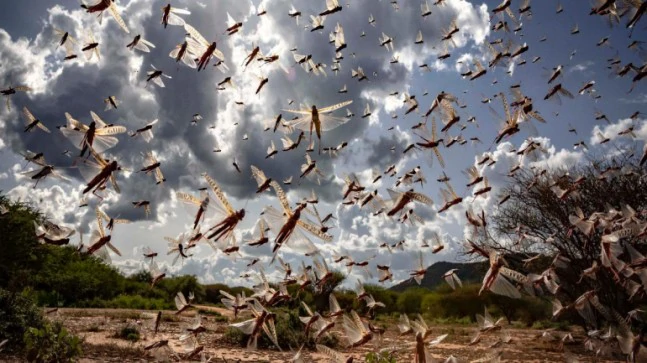
Swarms of the desert locust, which invaded India via Pakistan in April, have made their way to at least four states, leaving a trail of destruction in their wake. Desert locust move in large groups, called swarms, and can eat crops up to their own weight every day. When millions of locusts descend on a crop, they destroy everything.
The desert locust is considered the most destructive migratory pest in the world and a single swarm covering one square kilometre can contain up to 80 million locusts.
In December 2019, when the parts of Gujarat were invaded by locust, they had destroyed crops spread over 25,000 hectares of land. This time, the attack is more widespread.
Locust swarms entered India from Pakistan where they flew in from Iran last year. From Rajasthan, locusts entered Madhya Pradesh via Neemuch and have advanced to Ujjain and Dewas. The locust swarms have also made their way to Gujarat and Uttar Pradesh. Due to the proximity with Pakistan as well as rest of the affected areas, Punjab has also put its farmers on alert.
The video shared by news agency ANI shows a large swarm of locust destroying crops while farmers are trying to push them away.
#WATCH Madhya Pradesh: Swarms of locusts seen at a village in Chhatarpur district. pic.twitter.com/jcfnlGTuR2
— ANI (@ANI) May 25, 2020
In Rajasthan, locust attack has reached residential colonies of Jaipur. Unable to find crops to feed on, the locusts have started destroying trees.
#WATCH pic.twitter.com/PgDrKGtKmJ
— ANI_HindiNews (@AHindinews) May 25, 2020
Here’s a look at how states are battling with Locust Attack
Rajasthan
The desert locust attack has wiped out crops spread over 5,00,000 hectares in Rajasthan. The state has been battling with the locust menace for over three months now.
In Western Rajasthan’s Sri Ganganagar, Bikaner and Barmer districts, large groups of pink swarming locusts destroyed lush green fields laden with Rabi crops this year. Farmers in Jodhpur, Jhalawar, Karauli and Bundi have reported large infestations.
Several officials have been involved in clearing the locusts across the state. However, the problem seems far from over. Ministry of Agriculture officials are now spraying chemicals to neutralise the large swarm of locusts before they cause more destruction.
Farmers in various parts of the state have been using different tactics, including desperate measures — beating steel utensils during late afternoons and evenings, playing loud music at night, creating wood-fire and running the tractor inside their fields — to scare away the locusts.

Swarm of locusts in Jaipur (PTI photo)
However, none of the methods helped reduce the effect of menacing locusts on crops.
Jaskaran Singh, a farmer who owns 25 bighas of land in Anupgarh, told India Today TV earlier this year that he has been devastated due to the attack by the swarming locusts on his crops of wheat and peas.
“Had taken a loan of Rs 9,00,000 in my mother Amarjeet Kaur’s name, but now that the crop has been destroyed. I have no idea how the debt will be paid off,” he said.
Jaskaran, whose eyed teared up while speaking, requested the government to compensate him for the loss.
Gujarat
Gujarat has also been reeling under the locust problem for over five months now. The insects have wreaked havoc in several villages in Lodiya, Savarkundla, Khambha Jaffarabad and Botad of Amreli district in Gujarat. Before this, locusts caused havoc in Surendranagar and Bhavnagar districts of Gujarat.
The Amreli collector has formed 11 teams to survey the damage done to locust-affected farms in Amreli.
The Gujarat government has claimed that it is prepared to deal with the situation. According to the state government’s agriculture minister RC Faldu, state and district officials are in constant touch with the locust control team of the central government to control the menace.
The Gujarat government has set up control rooms in the locust-affected areas. Field staff is also being trained for locust control. A list of vehicles, sprayers, medicines, tankers and other equipment required to control locusts has been prepared.
Besides, medicines are also being provided for control in locust affected districts. The government has also talked to the pesticide companies for medicines, so that pesticide medicines are provided in time.

File photo of a man spraying pesticides to neutralise locusts in Gujarat’s Banaskatha district (Photo Credits: PTI)
Madhya Pradesh
Locust swarms have travelled from Iran to Pakistan to India’s Rajasthan and now have successfully crossed the state to enter Madhya Pradesh. The state has a massive locust problem at its hands as several districts have reported insect attacks on their crops.
Farmers in Hoshangabad, Sehore, Shivpuri, Niwadi, Khargone and Malwa have reported locust swarm attacks in Madhya Pradesh. The farmers worry that the insects will wipe out their moong beans crops, which are cultivated during summer.
The government is trying to deal with the problem by spraying chemicals via fire brigade and has advised farmers to make noise around farms to scare the locust away.
India Today TV team went to farms in MP’s Hoshangabad and found that farmers are staying up all night banging utensils to keep locust away from their crops.
Uttar Pradesh
Despite being further east, Uttar Pradesh has not been able to escape the locust attack. The state has reported sightings of swarms of locust in Jhansi, Agra and Delhi’s neighbouring Guatam Budhh Nagar.
As per the state government, the locusts are likely to affect crops in 17 districts – Jhansi, Mahoba, Hamirpur, Agra, Aligarh, Mathura, Bulandshahr, Hathras, Etah, Firozabad, Mainpuri, Etawah, Farrukhabad, Auraiya, Jalaun, Kanpur and Lalitpur.
Jhansi’s Babina region, which borders with MP, has been under a severe locust attack. The large swarm has forced people to stay indoors. While the wheat crop has been reaped in this region, locusts are attacking vegetable crops.
Earlier on Friday, the Jhansi district administration had directed fire brigade to keep its vehicle ready with chemicals following a sudden movement by a swarm of locusts. As per Deputy Director Agriculture Kamal Katiyar, a team has come from Kota (Rajasthan) to tackle the locusts.
Meanwhile, Agra administration has also issued an alert to combat locust problem. The DM and district agriculture officer have assured that the administration is prepared to handle the problem. To combat the problem, 205 tractors have been arranged, which will be used to spray chemicals depending on the size of the swarm.
Authorities have also set up a control room for locust attack in Gautam Budhh Nagar. Delhi’s neighbouring district has already spotted a few locusts, but the administration has said that so far the crops are safe. However, taking a preemptive action, the district authorities have arranged for chemical sprays and have started sensitising farmers on how to deal with the locust attack.
Punjab
Punjab has been reeling under a locust attack for several months now. A few months ago, locusts attacked fields in Roopnagar and Bareka villages in Fazilka district, bordering Pakistan. Some locusts were spotted in the Muktsar district in January this year.
On May 13, a big swarm of locusts had attacked three villages in Fazilka. But the worst is yet to come for Punjab.
The Food and Agriculture Organisation (FAO) has issued a warning that fresh hopper groups will move across the India-Pakistan border in June.
The state agriculture department has issued directions to Bathinda, Muktsar, Fazilka, Faridkot, Ferozepur, Amritsar, Tarn Taran and Gurdaspur districts.
The state government has asked district administrations to activate control rooms at the district headquarters, hold regular coordination meetings of revenue, agriculture and locust control officers, form teams for field surveys, conduct meetings of village heads to brief them about the serious forecasts of locust incursion and identify places in coordination with the BSF and other officials.
Worst locust attack in 27 years
The current locust invasion is the worst in India since 1993. India has not witnessed any full-blown locust cycles after 1962, however, the experts say, large-scale upsurges were observed during 1978 and 1993.
The locust forecasting officer at United Nation’s food and agriculture organisation said that the current locust outbreak is the biggest in 25 years in Ethiopia and Somalia, 27 years in India, 70 years in Kenya.
The scientists say that the locust attack was likely caused due to additional cyclones in the African region.
The outbreak originated from two cyclones (May and Oct 2018) that allowed three generations of breeding – from June 2018 to March 2019 — in the Arabian Peninsula, and caused an 8,000-fold increase in locust numbers.
The locusts currently attacking crops in India bread and matured in Iran and Balochistan in Pakistan. The swarms of locusts breeding in Horn of Africa are likely to reach India by next month.

Credit: FAO
Worst is not here yet
As per the FAO, the locust infestation is likely to get severe by next month. The desert locust invasion is expected to move from East Africa to India and Pakistan next month and could be accompanied by other swarms.
The FAO’s Senior Locust Forecasting Officer Keith Cressman said: “Everybody knows we’re facing one of the worst desert locust situations that we’ve probably had in a number of decades”.
“It’s obviously being focused at the moment on East Africa, where it’s extremely vulnerable in terms of livelihoods and food security but now in the next month or so it will expand to other areas and will move (towards)West Africa.
“And it will move across the Indian Ocean to India and Pakistan,” Cressman said during a virtual briefing last week on the FAO Desert Locust Appeal amid the new threat to Southwest Asia and Africa’s Sahel region.
Currently, the locust invasion is most serious in Kenya, Somalia, Ethiopia, southern Iran and in parts of Pakistan and starting in June, it will move from Kenya to throughout Ethiopia, as well as to Sudan and perhaps West Africa.
“The infestations in southern Iran, and in southwest Pakistan, they will move to India and Pakistan on the border areas. And those infestations in India and Pakistan could be supplemented by other swarms coming from East Africa, Northern Somalia,” he said.

A man attempts to fend-off a swarm of desert locusts in Kenya on February 21 (Reuters)
On what the UN is doing to help these countries as they face the locust invasion, Cressman said the FAO is working with the nations to upscale and intensify their monitoring and control operations.
India has proposed to Pakistan and Iran for a coordinated approach in dealing with the alarming threat of fast-increasing desert locusts in the region, official sources said on Thursday.
However, Pakistan is yet to respond to India’s proposal while Iran communicated its readiness for a joint approach to contain the desert locusts.







