

Researchers at the University of Melbourne have made new discoveries about how the immune system responds to severe acute respiratory syndrome coronavirus 2 (SARS-CoV-2) that could be important to consider in vaccine research.
Immunologic profiling among patients who had recovered from coronavirus disease 2019 (COVID-19) revealed that qualitative features of B and T cell immune responses to the SARS-CoV-2 spike protein could serve as informative biomarkers for the assessment of vaccines in upcoming trials.
The spike protein, which is the main structure the virus uses to access host cells, is a common target for neutralizing antibodies and, therefore, a central focus in vaccine development.
A pre-print version of the paper is available on the server medRxiv*, while the article undergoes peer review.
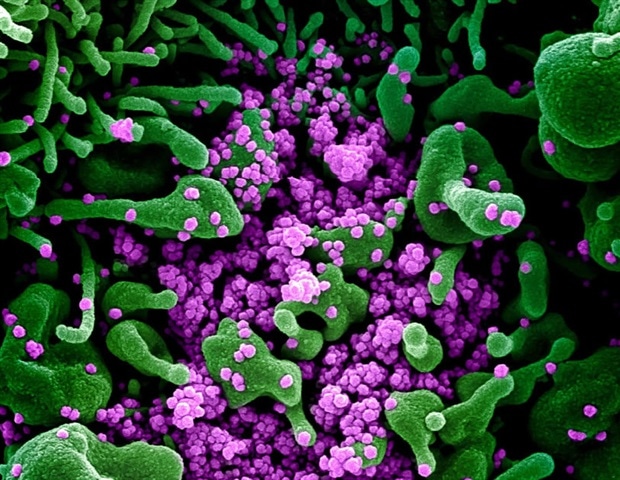
.jpg "Novel Coronavirus SARS-CoV-2 Colorized scanning electron micrograph of an apoptotic cell (green) heavily infected with SARS-COV-2 virus particles (purple), isolated from a patient sample. Image captured at the NIAID Integrated Research Facility (IRF) in Fort Detrick, Maryland. Credit: NIAID")
Novel Coronavirus SARS-CoV-2 Colorized scanning electron micrograph of an apoptotic cell (green) heavily infected with SARS-COV-2 virus particles (purple), isolated from a patient sample. Image captured at the NIAID Integrated Research Facility (IRF) in Fort Detrick, Maryland. Credit: NIAID
Efforts to accelerate vaccine development
Since the COVID-19 outbreak, caused by SARS-CoV-2, began in Wuhan, China, in December 2019, the continued rapid spread and risk to global public health have driven efforts to understand better how to accelerate the development and deployment of a vaccine.
The availability of modern recombinant technology has enabled scientists to respond quickly to the worldwide emergency, and more than 70 candidate vaccines are currently in different stages of development and testing. Almost all of them are based on the protective neutralizing antibody response triggered by the SARS-CoV-2 spike protein.
“There is understandably considerable scientific interest in predicting the biogenesis of protective immunity against SARS-CoV-2, of which neutralizing antibodies against S [spike] are likely to be consequential,” write Adam Wheatley and colleagues.
During infection, proteolytic cleavage of the spike protein yields two subunits, S1 and S2. A receptor-binding domain (RBD) within S1 binds to the peptidase domain of the host cell receptor angiotensin-converting enzyme 2 (ACE2), while S2 mediates fusion to the membrane.
An attractive target for vaccine-elicited antibody activity
The spike protein–ACE2 interaction is an attractive target for vaccine-elicited antibody activity against the virus, with potential mechanisms including direct blocking of the original interaction, blocking of the conformational changes in the spike protein that enable membrane fusion and the elimination of any free virus.
Previous studies of the human coronaviruses Middle East respiratory syndrome (MERS) and SARS-CoV have reported successfully neutralizing infection through blockage of fusion with the host cell membrane. A vaccine based on inactivated SARS-CoV-2 has also demonstrated promising results in animal models.
However, the immunogenic properties of the SARS-CoV-2 spike protein in humans are still poorly resolved, say, Wheatley, and team.
What did the current study involve?
Now, the researchers have comprehensively characterized aspects of humoral and cellular immune activity against the SARS-CoV-2 spike protein in people who had recovered from a mild-to-moderate infection.
Blood samples taken from 41 recovered adults a median of 32 days after they tested positive for infection were compared with those taken from 27 healthy controls who were recruited before the endemic had become widespread in Australia.
The researchers used an ELISA to measure the ability of antibodies to block the interaction between the RBD on S1 and ACE2.
Antibody responses correlated with neutralizing activity and inhibition of ACE2/RBD binding
The researchers found that serological antibody responses against both the spike protein and the RBD were consistently triggered following infection with SARS-CoV-2. They also found that the magnitude of the responses correlated with both antibody neutralizing activity and the capacity to inhibit ACE2/RBD binding.
In most recovered participants, spike-specific memory B cells represented a significant proportion of the memory B cells in circulation after infection. In contrast, RBD-specific memory B cells only represented a minor proportion. Measurement of circulating T follicular helper (cTFH) cells also showed that Spike -specific cTFH cells were readily detected among recovered patients, while the T cell response to RBD represented only a minor proportion.
Finally, multiple linear regression analysis showed that the relatively high plasma neutralization activity was associated with the magnitude of the spike-specific antibody responses and with the distribution of the spike-specific subpopulation of cTFH cells.
The authors say this suggests that both qualitative and quantitative aspects of the B and T cell immune response to the SARS-CoV-2 spike protein may serve as informative biomarkers for assessing the protective potential of candidate vaccines entering clinical trials.
“We propose B cell and cTFH frequencies and phenotypes constitute informative biomarkers of immune function for assessment of upcoming clinical trials of novel vaccines targeting S [spike protein],” concludes the team.
*Important Notice
medRxiv publishes preliminary scientific reports that are not peer-reviewed and, therefore, should not be regarded as conclusive, guide clinical practice/health-related behavior, or treated as established information.






