


Data has become the new currency now and when the new norm of the life will be push us more towards adoption of digital products, data will play crucial role in determining consumer behaviour and personalising the digital solution.
The demand for the digital products will grow day by day and the responsibility of a product manager will also increase, which will push them to learn new skills and technology. I will keep on sharing my experience and learning with fellow product professionals to solve consumers problem in a better way.
Let us start our journey with a brief understanding of machine learning. Machine learning is an application of artificial intelligence (AI) that provides systems the ability to automatically learn and improve from experience. Machine learning mainly focuses on the development of computer programs which can teach themselves to grow and change when exposed to new data.
Machine learning studies algorithms for self-learning to do stuff. The primary aim is to allow the computers learn automatically without human intervention.
Looking at the current business trends, all the companies, be it aviation, e-commerce, advertising, education, are trying to personalise the offering to their consumers. If we talk about only India, we have more than 600 million internet users and data is generating exponentially everyday, and it is impossible to analyse and find any pattern from these data manually, that’s where Machine learning comes into the action to help data scientists and product managers with valuable insights.
I will try to explain basics of ML algorithms which every product manager should know to personalise the user experience and work effectively to understand and solve the consumer and business problems. Although they do not need to go deeper into the coding and architecture of these algorithms, but they should know the basics so that they understand what are they building and how they are getting build.
Machine learning algorithms are broadly categorised as:
Supervised and Unsupervised
Supervised ML Algorithm
A supervised machine learning algorithm learns from labelled training data, helps you to predict outcomes for unforeseen data. For example, you want to train a machine to help you predict how long it will take you to drive home from your workplace. Here, you start by creating a set of labelled data, like:
-Weather conditions
-Time of the day
-Holidays
Supervised learning is where you have input variables (x) and an output variable (Y) and you use an algorithm to learn the mapping function from the input to the output.
Y = f(X)
Popular examples of supervised machine learning algorithms is “Linear Regression Analysis”.
Linear Regression Analysis
Linear regression analysis is a form of predictive modelling technique which investigates the relationship between a dependent and independent variable. Linear regression aims at finding a straight line which can accurately depict the actual relationship between the two variables. Regression technique predicts a single output value using training data.This can help predict sales for a company based on whether, previous sales, GDP growth or other conditions.
Linear Regression: Y = a + bX + u
Where:
Y = Variable that you are trying to predict
X = Variable that you are using to predict Y
a = the intercept
b = the slope
u = the regression residual
Unsupervised ML Algorithm
These are used when the information used to train is neither classified nor labelled. The system does figure out the right output, but it explores the data and can draw interference from datasets to describe hidden structures from unlabelled data.Unsupervised learning is where you only have input data (X) and no corresponding output variables.
The goal for unsupervised learning is to model the underlying structure or distribution in the data in order to learn more about the data.Unlike supervised learning there is no correct answers and there is no teacher. Algorithms are left to their own devises to discover and present the interesting structure in the data. All data is un-labelled and the algorithms learn to inherent structure from the input data.
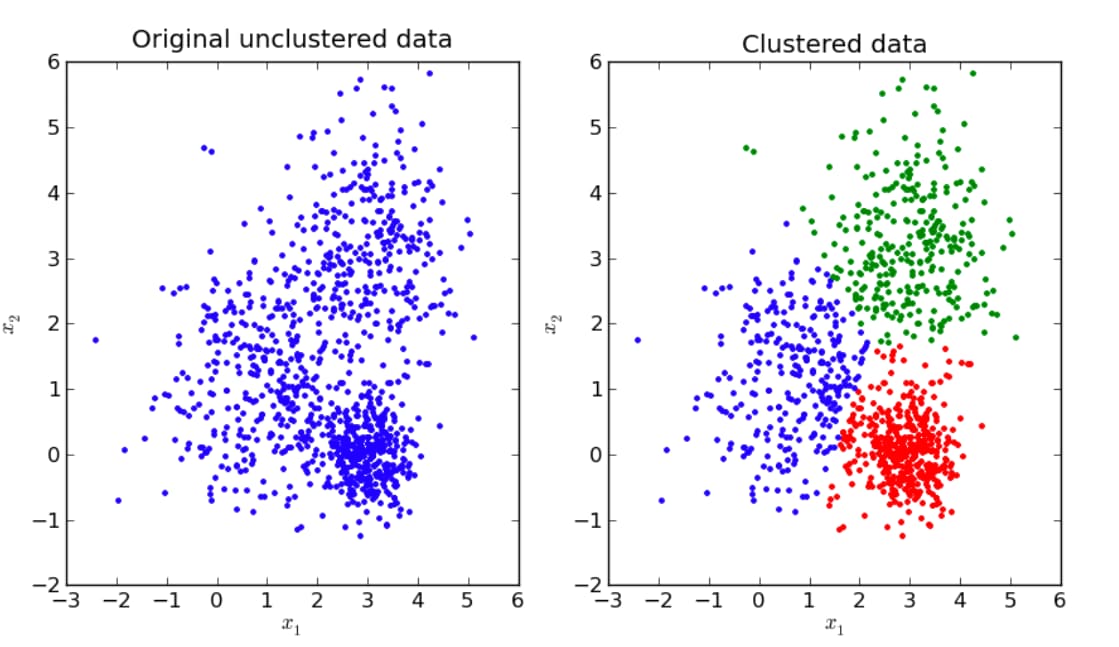
Popular examples of supervised machine learning algorithm is Clustering (K-means) algorithm.
Clustering(K-means) Algorithm
Clustering is one of the most important unsupervised learning algorithm, it deals with finding a structure in a collection of unlabelled data. Simplest way to understand, the process of organising objects into groups whose members are similar in some way”.
K-means algorithm is used to analyse unlabelled data, segregate it into groups with similar traits, and assign into clusters. It starts with estimating the centroids for clusters, the number (k) of which you define in advance. The second step consists in assigning data sets to the nearest centroid, based on the Euclidean distance. After that, the centroids for all clusters are recomputed.
The algorithm iterates between these two steps until a stopping criterion is fulfilled.This algorithm can be used for:
-Customer segmentation
-Recommendation engine development
-Social media analysis and
-Anomaly detection
Note – Views presented here is author’s person view.
About the Author: A technology and product leader, Rahul Kumar is Chief Product Officer with HT Media Group. He has been leveraging AI, ML and IOT to transform consumer behaviour and solving business problems across technology led startups and conglomerate.







