


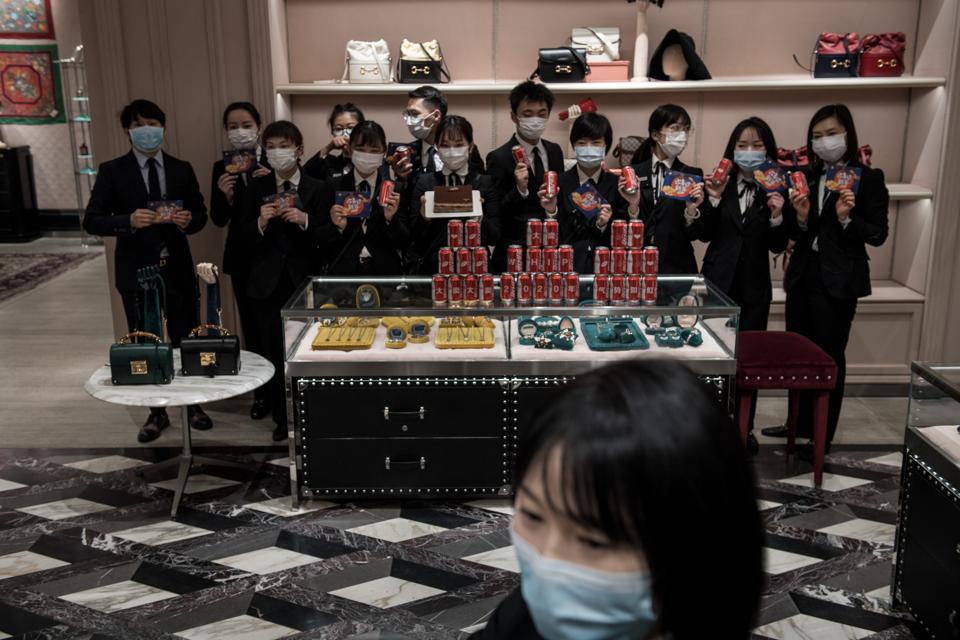
WUHAN, CHINA – MARCH 30 2020: Masked staff pose for a photo in a shop of luxury goods in a high-end … [+]
Barcroft Media via Getty Images
Since the 2008/2009 recession, China has effectively become the tail that wags the dog of the global luxury market.
That’s because China was largely unaffected by the economic downturn that battered the market throughout the rest of the world. Not only that, Chinese consumers, with their growing economic power, expressed a heady appetite for luxury brands that signaled status in a culture where that really mattered.
Now after the beating luxury brands have taken due to the coronavirus pandemic, which Bain and Company predicts will strike off 20% to 35% of the personal luxury goods market in 2020 and McKinsey is on record for sales to shrink as much as 35% to 39%, all eyes are on the Chinese to restore luxury brands’ fortunes.
In analyzing prospects for the luxury market’s recovery, Bain’s latest report takes a glass-half-full view of the industry’s future. It predicts the industry will recover by end of 2022 or early 2023 to 2019 sales levels of €281 billion ($304 billion).
And to do that, China is the industry’s only hope, says Claudia D’Aprizio, Bain partner and leader of its luxury goods practice.
All eyes on China
“The economy in China will be the one that will be least impacted by the long tail of this planetary crisis,” D’Aprizio told me. “For the luxury market, we think the recovery will be stronger and faster in China than in the U.S. and Europe.”
Already Bain reports the “best-performing brands” are registering year-over-year sales increases in China for the first four months of 2020. While store traffic remains down, consumers who visit are reportedly more inclined to buy and their level of spending has increased.
Having grown dependent on the Chinese market for growth – or more correctly addicted – luxury brands are going to have to keep the pressure on to reach that ambitious 2022/2023 recovery schedule.
In 2019 Chinese consumers alone accounted for 90% of the growth in the personal luxury goods market or some €19 billion ($21 billion) in sales. They also generated 35% of global luxury spending.
By comparison, American consumers generated only 22% of the industry’s sales and Europeans 17%, and their share of the market has declined from 27% and 30% respectively since 2000, while China’s share has grown from 2%.
Further, Bain expects that Chinese consumers will make more than half of luxury goods purchases by 2025 when global sales are expected to reach €320-330 billion ($346-357 billion). That means they would have to gain some 15% more market share in only five years, a pretty aggressive expectation.
D’Aprizio admits predicting the future for luxury coming out of this crisis is particularly problematic since it impacted not just consumers’ financial wellbeing, but their health and emotions. “It’s probably going to have more than double the impact that the industry had from 2007 to 2009,” she says.
What can get luxury brands off course in the post-coronavirus world, even if China rebounds as strongly as Bain expects? Plenty.
Travel to and from China will be stalled
First, nobody’s going anywhere, as the travel industry will be the very last to recover.
“About 40% of overall [global] sales are made when people are traveling, so that is something that will be slow to recover,” D’Aprizio shares, as she predicts “repatrization of purchases” in China will offset losses due to reduced travelling as the government is “pushing” for more local consumption.
On-the-go Chinese consumers have been big luxury shoppers. Luxury sales in mainland China made up only 11% of global sales in 2019, compared to Chinese consumers’ 35% total market share.
Reduced Chinese consumer spending power
Second, luxury brands are counting on Chinese consumers to have not just the same appetite for their pricey goods, but also the same spending power. That is to be determined.
The Chinese economy contracted 6.8% in the first quarter 2020, with industrial production down 1.1% and imports/exports off 6.4%.
Since China’s factories feed the rest of the world’s markets and the coronavirus shutdowns and resulting canceled orders didn’t happen until the second quarter elsewhere, it may be a long shot to achieve the expected 1.3% year-over-year growth in the second quarter.
Complicating matters further is rising Chinese unemployment. CNN Business reports that as many as 80 million Chinese workers are out of a job, while the official figure from government sources are far lower.
Calling “data from Beijing notoriously opaque,” CNN quotes economists at Société Générale reporting that nearly 10% of people in China are jobless.
Rising unemployment may hit luxury brand performance in China harder than in Western markets. “A lot of the luxury market depends on the aspirational drives of middle-income Chinese consumers. But if they lose that income, the luxury market will lose those customers,” Luxury Daily’s Mickey Alam Kahn shares.
Consider also that the U.S. has four-times more truly wealthy consumers than China, 18.8 million millionaires compared with 4.4 million in China.
Luxury retail post-coronavirus won’t give the same emotional kick
Third, what D’Aprizio calls the “selling ceremony,” which is so important to Chinese consumers, will be disrupted by social distancing measures required in the post-coronavirus world.
“There is an element of cautiousness and fear linked to the possibility of contagion which will reduce store traffic. The sanitary control measures required are not the best setting for luxury shopping which has a huge emotional element,” she says.
She also foresees fewer luxury store openings which will put more emphasis on e-commerce, as well as the need for greater marketing efforts.
“Luxury brands will have to pull all the marketing levers and make investments in the most efficient way,” which will likely result in a hit to brand’s profitability down the road.
Rising cultural tensions as localism gains ground
Fourth, and perhaps most importantly, the coronavirus is going to heighten “cultural sensitivities” in the luxury market.
“There is a lot of tension around inequalities, especially among the lower-income tiers of the population,” D’Aprizio shares. And it’s not just tension between the have’s and the have-not’s but also the tension between the East and West.
As Western luxury brands have focused on the Chinese consumers for growth, they have committed any number of mistakes reflecting gross cultural insensitivity, like the notorious Dolce & Gabanna campaign featuring a model eating pizza with chopsticks.
While D’Aprizio lauds the luxury industry as the “melting pot of creativity everywhere,” she also foresees the “danger of strongly increasing local sensitivites,” arising from the coronavirus pandemic, which originated in China and already is a point of sensitivity for the Chinese people.
“Brands really need to pay attention to elements of the monocultural reality and try to be relevant with authenticity around local cultures and local sensitivities,” she says.
It is important to note her emphasis on local cultures and sensitivities because both China and Hong Kong are important markets for luxury brands, yet they have cultural differences, challenging a one-size-fits-all-China approach to these markets.
Coronavirus is going to accelerate a trend that Bain defines as cultural relevance and local tribes.
“There has been a social strengthening of localism and nationalism,” she shares. “In particular the younger Chinese consumers are developing a stronger demand for Chinese products, local brands and local enterprises. This will probably accelerate and be a threat for European brands.”
To meet this shift, D’Aprizio calls on luxury brands to develop a “global framework that is large enough to accommodate all these differences and all the differing cultural needs,” she says, and continues, “Luxury brands will need to make room for more collaborations with local designers, artists, and creatives to gain relevance around this trend toward strong localization.”
Generational shift
In closing, D’Aprizio sees hope, and challenges, on the horizon not just in China but around the world coming from the next generational shift in the luxury market, from Baby Boomers and GenX consumers to Millennials and GenZ.
“These are both the luxury consumers of today and tomorrow. They are a wave shaping and creating luxury brands’ evolution in terms of messaging and purpose,” she concludes. “I see these consumers as a very positive underlying driver for success, as long as brands stay in tune with the next generations.”
“As long as” is an important qualifier in that statement and many brands have tripped up staying in tune with the aspirations and drives when generations shift.







