

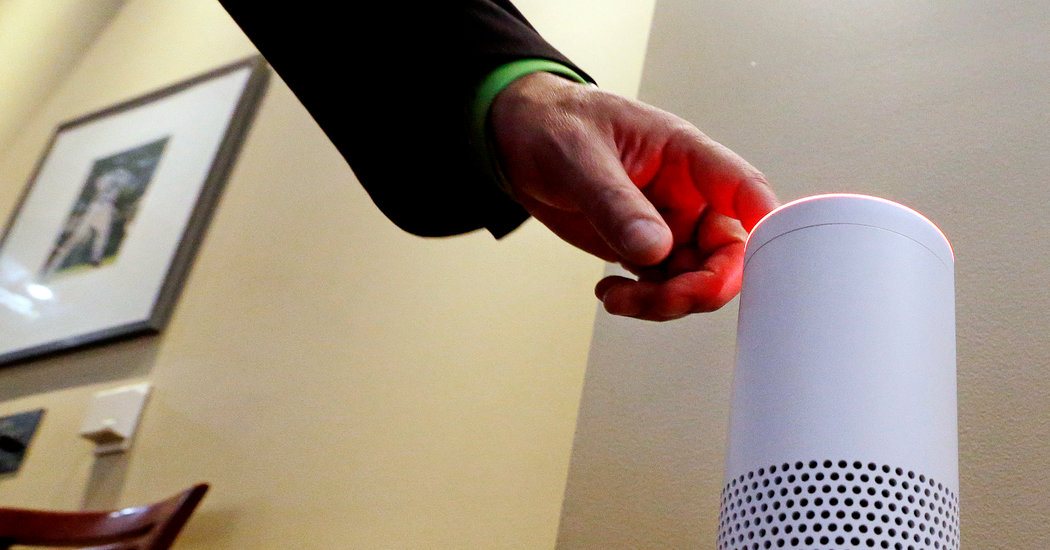
SEATTLE — One in four U.S. households have a smart speaker and 81 percent of adults own a smartphone. These devices might seem to be unlikely medical instruments, yet their computing capability, storage and sensor quality is often superior to the clinical-grade equipment used to monitor patients in an intensive care unit.
For example, the Philips X2 monitor, a monitoring system used to measure vital signs in I.C.U.s around the country, costs thousands of dollars. The smartphone in your pocket has a processing capability 20 times stronger; smart speakers are 10 times as powerful.
Hundreds of millions of smart speakers and phones in the U.S. (and billions worldwide) can be marshaled quickly as a key public health tool. Until universal testing for the coronavirus is in place, smart devices can identify patients for testing. Technology companies can contribute to the national effort to fight the coronavirus pandemic by enabling their platforms to passively collect, analyze and transmit health information.
To be sure, this type of home monitoring raises privacy concerns. Safeguards must be in place such that protected health information remains on the local device and that relevant information is communicated to public health authorities — securely and only when necessary.
Given the many abuses of big tech companies, this might be a hard idea to accept. But there is a way to do it ethically — by having strong C.D.C. oversight, not allowing tech companies to monetize any of the data and ensuring that companies can turn off these capabilities once the pandemic is over.
For the past six years, we have researched how smartphones and smart speakers can be used to passively identify diagnostic health indicators, including aberrations in breathing and cardiac arrest.
Smart devices are also equipped to perform passive sensing. For example, instead of “Alexa” or “Hey Siri,” a smartphone, smart speaker or watch could use an on-device “wake word” that is the sound of a dry cough — one of the most common presenting symptoms of Covid-19 infection.
If the cough is persistent, the speaker would present a coronavirus symptom survey and ask a patient about the presence of fever, shortness of breath and the existence of sick contacts. If the symptom screen is positive, the device would connect the individual to relevant public health guidance. All this can be done without any of the audio data ever leaving the user’s device.
Another passive sensing method involves using inaudible acoustic signals. This involves the speaker emitting high-frequency tones above the range of human hearing. The reflections, captured at the microphones, can track chest motion and extract information about a patient’s breathing rate — another important feature, when too fast, of coronavirus infection.
In this sonar scenario, audible speech is never recorded, a benefit for privacy. A smartphone or smart speaker could be placed on a bedside table and, without contact, monitor a person’s breathing and cough to predict the onset of viral respiratory infection. We are testing this hypothesis in 20 homes as part of the Seattle Flu Study. This data could be used to identify people for testing, track the spread of disease and identify where the next hot spot such as Seattle or New York might be, enabling an earlier response.
Importantly, this data should be anonymized and made available in real time to the medical and machine learning research communities. Access to this data set would allow researchers to identify who should be tested sooner, emerging hot spots of coronavirus infections and to generate more precise social distancing strategies that avoid the disruptions of sheltering in place.
Smart devices can also be used to combat misinformation. The Wireless Emergency Alert Program, run by the Federal Emergency Management Agency and responsible for Amber Alerts, could facilitate pushing N.I.H.-endorsed coronavirus guidelines to the nation.
Smart platform manufacturers must also do their part to make these devices available at an affordable cost to all. Differences in access to technology should not exacerbate health disparities.
Smart devices, which have connected us to family and friends during these difficult times, have an unrealized potential, and we should demand that platform providers and the government work to responsibly enable it.
Dr. Trevor Bedford, the Fred Hutchinson Cancer Research Center scientist who raised an early alarm about the coronavirus in the United States, framed our collective efforts to fight this disease as the “Apollo program of our times.”
He is right. If big technology companies work alongside public health professionals, and if privacy concerns are given credence, we might have a fighting chance.
Jacob Sunshine (@jesunshine) is an assistant professor at the University of Washington School of Medicine in the Department of Anesthesiology. Shyam Gollakota (@ShyamGollakota) is an associate professor in the Paul G. Allen School of Computer Science and Engineering at the University of Washington.
The Times is committed to publishing a diversity of letters to the editor. We’d like to hear what you think about this or any of our articles. Here are some tips. And here’s our email: [email protected].
Follow The New York Times Opinion section on Facebook, Twitter (@NYTopinion) and Instagram.







