

The concept of burnout among physicians has gained significant attention in the healthcare industry. There is extensive literature reflecting the magnitude and seriousness of this issue. Furthermore, it is unclear how personal and job dissatisfaction resulting from burnout can be transmitted to patient care and interpersonal relationships. Physicians are exposed to tremendous stressors which can contribute to increased burnout and suicide rates compared to the rest of the population.12x12Schernhammer, E and Colditz, G. Suicide rates among physicians: A quantitative and gender assessment (meta-analysis). Am J Psychiatry. 2004;
161: 2298–2302
Crossref | Scopus (361) | Google ScholarSee all References A national survey of 4,999 OBGYN residents found an overall burnout of more than 50%, and nearly one-third admitted to feeling depressed.3x3Morgan, H, Ford, A, Nguyen, A et al. Obstetrics and Gynecology Residents’ Perspective on Wellness – Findings from National Survey. Obstet Gynecol. 2019;
133: 552–557
Crossref | Scopus (3) | Google ScholarSee all References When it comes to active members of AAGL, in 2017 there was a 51% burnout among the respondents.13x13Moawad, G, Tyan, P, Gu, A et al. Burnout among members of the American Association of Gynecologic Laparoscopists. J Min Invas Gynecol. 2018;
: S77
Google ScholarSee all References These findings have been reproduced in multiple studies in different fields of medicine.2x2Kane, L. Medscape National Physician Burnout, Depression & Suicide Report 2019. Medscape. ; 2019https://www.medscape.com/slideshow/2019-lifestyle-burnout-depression-6011056. ()
Google ScholarSee all References
Additional studies have been conducted in order to identify etiologies and solutions. The development of a structured wellness curriculum or creation of a yoga course for OBGYN residents failed to show improvement and have not been able to improve burnout rates.5x5Tedrick, L, Lawrence, E et al. The Impact of a Structured Wellness Curriculum on Burnout Among Obstetrics and Gynecology Residents. Obstet Gynecol. 2018;
132: 44S
Crossref | Google ScholarSee all References, 6x6Babbar, S, Renner, K, and Williams, K. Addressing Obstetrics and Gynecology Trainee Burnout Using a Yoga-Based Wellness Initiative During Dedicated Education Time. Obstet Gynecol. 2019;
133: 994–1001
Crossref | Scopus (2) | Google ScholarSee all References In one case that focused on teaching wellness skills to residents, burnout actually worsened. The study concluded that this may have been a result of increased awareness of uncomfortable thoughts and feelings.7x7Fitzmaurice, L, Peterson, B, and Boehm, J. Teaching Wellness Skills: Effect of a Curriculum Designed to Increase Physician Resilience on Obstetrics and Gynecology Intern Burnout, Mindfulness and Self-compassion. Obstet Gynecol. 2018;
132: 44S
Crossref | Google ScholarSee all References
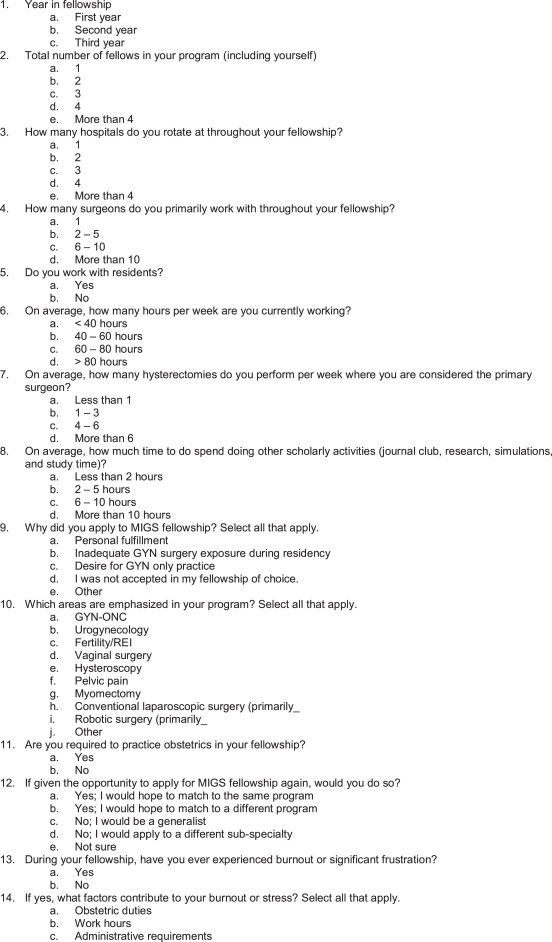
Our study demonstrated similar findings, with more than half of participants reporting burnout. This suggests that dissatisfaction and psychological issues do not resolve after completion of residency. In addition, there is poor access to support programs and individual counseling to 75% of participants who report these symptoms. It is unknown if the participants sought help or not, as previous studies have shown that many are reluctant to seek help due to concern that it could have a backlash in their training.14x14Shanafelt, TD, Hasan, O, Dyrbye, LN et al. Changes in burnout and satisfaction with work-life balance in physicians and the general US working population between 2011 and 2014. Mayo Clin Proc. 2015;
90: 1600–1613
Abstract | Full Text | Full Text PDF | PubMed | Google ScholarSee all References Although we have yet to determine the best type of support for burnout, the first step is not only acknowledging the problem, but also addressing it without the fear of professional stigma or retaliation.
In this investigation, certain factors were associated with burnout, depression, anxiety, and severe fatigue. Although there is no proven cause-effect relationship, and it is not our intention to assume that modifying these aspects during fellowship training might decrease these symptoms, it is reasonable to consider adjusting them. Many organizations and institutions have developed wellness programs to support their members or employees in order to remove the stigma of burnout.15x15Mayo Clinic. Program on Physician Well-Being. https://www.mayo.edu/research/centers-programs/program-physician-well-being/mayos-approach-physician-well-being/mayo-clinics-commitment-physician-well-being. Accessed June, 18th, 2019.
Google ScholarSee all References, 16x16Duval County Medical Society. Resources. https://www.dcmsonline.org/page/Resources?&hhsearchterms=%22burnout%22. Accessed June 18th, 2019.
Google ScholarSee all References Considering the magnitude of this issue and the potential negative impact it may have on physicians and their patients, AAGL should emphasize the importance of trainee wellness. Our study did not evaluate for possible solutions for management of burnout in FMIGS programs, but prior investigations have shown that the most effective interventions are those which are tailored to the specific work environment. For example, AAGL should consider implementing additional networking and social programs for fellows, and individual program directors should create a safe space where fellows can voice concerns and brainstorm options that would offload work-related stressors. Both changes are important to address the prevalence of burnout in this group. It is interesting that despite reporting symptoms of burnout and frustration, the majority of respondents is satisfied with their fellowship training and would pursue it again.
Although we believe one of the strengths of the study is a high response rate of 67.7%, it is possible that the results may be influenced by non-responders. Fellows who chose not to respond to the questionnaire may have busier clinical schedules, may have less interest in scholarly activities, and may be at increased risk for burnout. The main limitation of this study was the relatively small sample size, which resulted in a lack of power to detect differences between groups in certain factors. Therefore, the possibility of a type II error has to be considered when interpreting results.
In conclusion, it is clear that burnout is a real and very serious issue among training physicians in FMIGS. We should have a more proactive approach when addressing it. We firmly believe that part of the solution is to recognize the problem and create a culture, among individual fellowships and as AAGL as an institution itself, where people feel safe about seeking help without distress of negative consequences.







