
GLOBAL RESEARCH SYNDICATE
No Result
View All Result
  • Login
  • Latest News
  • Consumer Research
  • Survey Research
  • Marketing Research
  • Industry Research
  • Data Collection
  • More
    • Data Analysis
    • Market Insights
  • Latest News
  • Consumer Research
  • Survey Research
  • Marketing Research
  • Industry Research
  • Data Collection
  • More
    • Data Analysis
    • Market Insights
No Result
View All Result
globalresearchsyndicate
No Result
View All Result
Home Data Analysis

Neither first nor second biologic beneficial for many with JIA

globalresearchsyndicate by globalresearchsyndicate
March 25, 2020
in Data Analysis
0
Neither first nor second biologic beneficial for many with JIA
0
SHARES
7
VIEWS
Share on FacebookShare on Twitter

Lianne Kearsley-Fleet

Many patients with juvenile idiopathic arthritis see little benefit from treatment with their first or second biologic, according to data published in The Lancet Rheumatology.

The researchers also found no evidence that switching to a second non-TNF-inhibitor biologic was any more effective than a second TNF inhibitor.

“This study was the first observational study to report on the extent of multi-biologic switching in children and young people with JIA in the United Kingdom, and the first to compare the effectiveness of different biologics after the failure of a first biologic in this cohort,” Lianne Kearsley-Fleet, PhD, of the University of Manchester, told Healio Rheumatology. “It highlights that a significant proportion of children and young people with JIA struggle to find the most effective and tolerated therapy for their JIA.”

“Currently there are differing opinions on which biologic drugs, and in which order children should receive them, should methotrexate and their first biologic — often a TNF inhibitor — not be effective or tolerated,” they added. “In part, these differing opinions exist because of the lack of specific evidence to inform them and in this case, the lack of specific clinical trials.”

Many patients with juvenile idiopathic arthritis see little benefit from treatment with their first or second biologic

Many patients with juvenile idiopathic arthritis see little benefit from treatment with their first or second biologic, according to data.

To examine biologic switching patterns among children and adolescents with JIA, and compare the effectiveness of a second TNF inhibitor with a non-TNF inhibitor following the failure of a first TNF-inhibitor biologic, Kearsley-Fleet and colleagues analyzed participants in two parallel U.K. studies. These were the British Society for Pediatric and Adolescent Rheumatology Etanercept Cohort Study (BSPAR-ETN), established in 2004, and the Biologics for Children with Rheumatic Diseases (BCRD) study, initiated in 2010.

Focusing on 2,361 patients with JIA enrolled between Jan. 1, 2004, and April 11, 2019, the researchers assessed data on disease characteristics and DMARD therapy at the time of initiation of a first biologic, as well as 6 months, 1 year and annually thereafter. They analyzed changes in outcome variables at 6 months, compared with baseline, among participants who began their first biologic treatment on or after Jan. 1, 2004, were diagnosed with polyarticular-course JIA, and who had started a second biologic. They also compared the proportion of patients who achieved an American College of Rheumatology Pediatric 90 response and minimal disease activity at 6 months, based on the class of the second biologic.

Lastly, Kearsley-Fleet and colleagues compared changes in outcome variables at 6 months using linear regression or logistic regression, adjusted for propensity quintiles to account for confounding by indication.

According to the researchers, 1,152 participants began their first biologic on or after Jan. 1, 2010, with 91% starting their treatment with TNF inhibitors. The median follow-up was 2.2 years. During that time, 23% of the 1,152 patients were treated with a second biologic, while 5% started a third and 1% initiated a fourth. Among the 240 enrollees with polyarticular-course JIA, 81% began a second TNF inhibitor and 19% started a non-TNF-inhibitor drug after the initial TNF inhibitor failed.

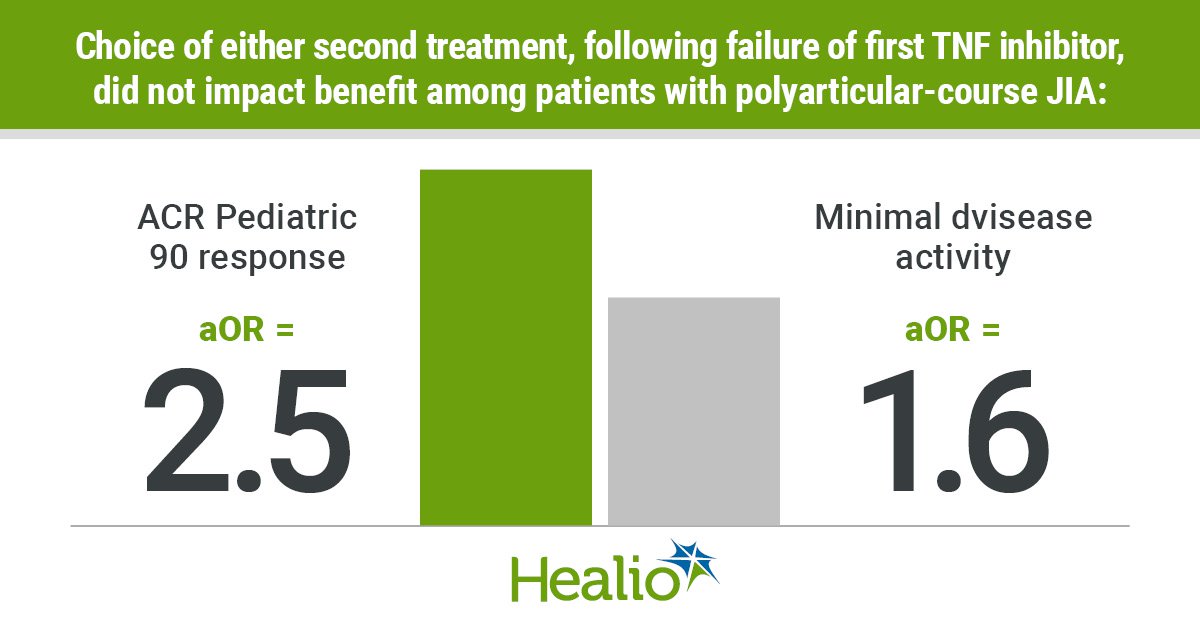
Choice of either second treatment did not impact the proportion of patients who achieved an ACR Pediatric 90 response (aOR = 2.5; 95% CI, 0.8-7.9) or minimal disease activity (aOR = 1.6; 95% CI, 0.6-3.8).

“Currently the data available do not offer evidence to support choosing an alternative class of biologic over a TNF inhibitor should a first TNF inhibitor not offer effective control of disease, or not be tolerated,” Kearsley-Fleet said. “These findings should reassure clinicians that working within the current NHS England biologic prescribing guidelines appears to still be an appropriate thing to do. However, it does emphasize the need to continue to recruit children into clinical studies so that a large evidence base can be generated to better inform practice for this relatively uncommon disease.” – by Jason Laday

Disclosure: Kearsley-Fleet reports no relevant financial disclosures. Please see the study for all other authors’ relevant financial disclosures.


Related Posts

How Machine Learning has impacted Consumer Behaviour and Analysis
Consumer Research

How Machine Learning has impacted Consumer Behaviour and Analysis

January 4, 2024
Market Research The Ultimate Weapon for Business Success
Consumer Research

Market Research: The Ultimate Weapon for Business Success

June 22, 2023
Unveiling the Hidden Power of Market Research A Game Changer
Consumer Research

Unveiling the Hidden Power of Market Research: A Game Changer

June 2, 2023
7 Secrets of Market Research Gurus That Will Blow Your Mind
Consumer Research

7 Secrets of Market Research Gurus That Will Blow Your Mind

May 8, 2023
The Shocking Truth About Market Research Revealed!
Consumer Research

The Shocking Truth About Market Research: Revealed!

April 25, 2023
market research, primary research, secondary research, market research trends, market research news,
Consumer Research

Quantitative vs. Qualitative Research. How to choose the Right Research Method for Your Business Needs

March 14, 2023
Next Post
Distribution Transformer Market 2020 Primary Research, Secondary Research, Growth Analysis, Size and Forecast by 2026

Distribution Transformer Market 2020 Primary Research, Secondary Research, Growth Analysis, Size and Forecast by 2026

Categories

  • Consumer Research
  • Data Analysis
  • Data Collection
  • Industry Research
  • Latest News
  • Market Insights
  • Marketing Research
  • Survey Research
  • Uncategorized

Recent Posts

  • Ipsos Revolutionizes the Global Market Research Landscape
  • How Machine Learning has impacted Consumer Behaviour and Analysis
  • Market Research: The Ultimate Weapon for Business Success
  • Privacy Policy
  • Terms of Use
  • Antispam
  • DMCA

Copyright © 2024 Globalresearchsyndicate.com

Welcome Back!

Login to your account below

Forgotten Password?

Retrieve your password

Please enter your username or email address to reset your password.

Log In
This website uses cookies to improve your experience. We'll assume you're ok with this, but you can opt-out if you wish. Cookie settingsACCEPT
Privacy & Cookies Policy

Privacy Overview

This website uses cookies to improve your experience while you navigate through the website. Out of these cookies, the cookies that are categorized as necessary are stored on your browser as they are essential for the working of basic functionalities of the website. We also use third-party cookies that help us analyze and understand how you use this website. These cookies will be stored in your browser only with your consent. You also have the option to opt-out of these cookies. But opting out of some of these cookies may have an effect on your browsing experience.
Necessary
Always Enabled
Necessary cookies are absolutely essential for the website to function properly. This category only includes cookies that ensures basic functionalities and security features of the website. These cookies do not store any personal information.
Non-necessary
Any cookies that may not be particularly necessary for the website to function and is used specifically to collect user personal data via analytics, ads, other embedded contents are termed as non-necessary cookies. It is mandatory to procure user consent prior to running these cookies on your website.
SAVE & ACCEPT
No Result
View All Result
  • Latest News
  • Consumer Research
  • Survey Research
  • Marketing Research
  • Industry Research
  • Data Collection
  • More
    • Data Analysis
    • Market Insights

Copyright © 2024 Globalresearchsyndicate.com



