


Shaili Patel examines material under a microscope in Salil Lachke’s lab during the summer of 2019. She graduated in 2014 with a degree in biological sciences and, after her undergraduate research experience inspired her to attend graduate school, she is now back at UD as a doctoral student.
Photos by Kathy F. Atkinson
March 17, 2020
UD’s Lachke leads a team to achieve success in the lab
Shaili Patel had long been fascinated by science and engineering, so when she enrolled as an undergraduate at the University of Delaware she knew she wanted to pursue a STEM major of some type.
All it took was a couple of biology classes to help her make up her mind and set her on a career path.
“The existence of life and how things developed from a single cell … I fell in love with it,” she said about deciding on a major in biological sciences.
She went looking for research opportunities and, like many other undergraduate and graduate students in UD’s Department of Biological Sciences, heard about Salil Lachke’s lab. The Alumni Distinguished Early Career Professor of Biology and associate professor and associate chair of biological sciences, Lachke is a developmental biologist who specializes in interdisciplinary genetic research involving the eye and its associated defects, specifically cataract, and has won numerous awards and grants for his work.

Salil Lachke is the Alumni Distinguished Early Career Professor of Biology and associate professor and associate chair of biological sciences at the University of Delaware.
“The undergrad research experience in Dr. Lachke’s lab molded me as a professional at a very early age,” Patel said. She completed a senior thesis based on the research she conducted in the lab, graduating in 2014, and landed a job as a research associate in a leading University of Pennsylvania biology lab.
Although she wanted to pursue graduate studies, Patel worried about her undergraduate grade point average (GPA). Then, Melinda Duncan, also a UD professor of biological sciences and then the graduate program director, stepped in. She told Patel that her excellent work in the lab seemed at odds with her GPA and suggested that she get tested for possible learning disorders.
It turned out that Patel had a reading disability, and with that diagnosis she also learned strategies to work around it. Today, she’s back at UD as a doctoral student, working with Lachke again and looking forward to an academic research career.
“I am currently a dual degree Ph.D.-MBA student with a GPA of 3.96, so it’s working quite well,” Patel said of her academic progress. “I freely share my experiences because I feel it may help others who may be in a similar position to not get discouraged and to keep working toward their goals.”
Patel’s story may be more complex than some, but her success as part of the Lachke team is not, his other students say. Undergraduates, graduate students and postdocs all contribute to the work while learning the ins and outs of research and, often, co-authoring research articles.

Shaili Patel, CAS14, (left) and Bailey Weatherbee, CAS19, work in Salil Lachke’s lab during the summer of 2019. Patel is a doctoral student at UD, and Weatherbee is now pursuing a doctorate at Cambridge University in England as a Gates Cambridge Scholar.
Two recent articles in leading international research journals illustrate the success that Lachke and his students routinely have.
Human Molecular Genetics recently published an original research article from Lachke’s lab examining the genetic control over a key gene whose mutation accounts for some 20 percent of two severe human eye birth defects, anophthalmia (no eye) and microphthalmia (small eye).
Research in Lachke’s lab, spearheaded by UD graduate alumni Soma Dash with contributions from Shaili Patel, discovered for the first time that a protein conserved between fish and mammals binds to the RNA of a gene known as SOX2 and controls its abundance in the developing eye. Disrupting this control results in the eye defects studied by the team, the researchers found.
The journal recently notified Lachke that it has selected an image from his team’s research to appear on its cover.

Working in Salil Lachke’s lab during the summer of 2019 are (from left) doctoral student Sanjaya Shrestha, undergraduate Francisco Hernandez and doctoral student Sandeep Aryal. Hernandez and Aryal are among the co-authors of a recent paper published in the journal “Human Genetics.”
A second original research article from Lachke’s lab, published in December 2019 in the journal Human Genetics, modifies and expands the use of a bioinformatics-based tool developed by Lachke and known as iSyTE (integrated Systems Tool for Eye gene discovery), which predicts the genes associated with eye development and defects, including cataract. The interactive tool is available to all clinicians, scientists and anyone who is interested in studying eye development and disorders.
The recent paper describes the first database on lens protein level expression data for iSyTE, which previously included only lens RNA level expression data.
The new approach allows researchers to better predict genes that are linked to the development of cataracts and, Lachke said, this approach can also be extended for tissues other than those in the eye, as long as protein data is available.
“Now including protein-level data in iSyTE makes it much more robust as a bioinformatics tool for identifying genes linked to eye defects,” he said.

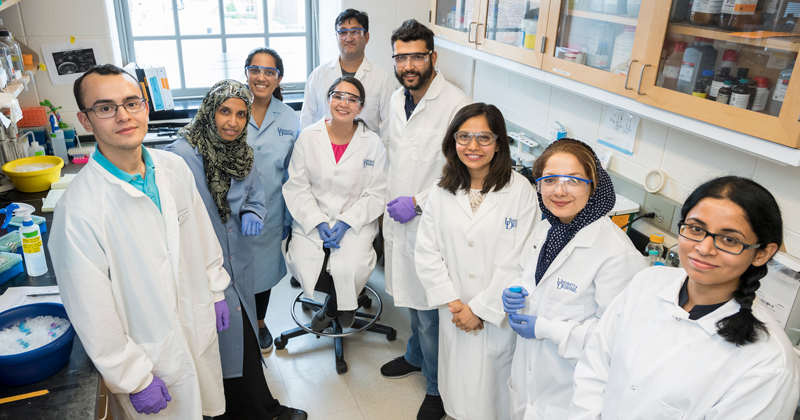
Students at different levels work in the research lab of Prof. Salil Lachke. “It’s a big responsibility — and a privilege — to do research and also take the opportunity to train people who will move on and continue to contribute to research independently,” Lachke said.
About the research team
Involving talented students at different levels of their education is key to a successful research program, Lachke said, noting the importance of fostering a collaborative culture.
“It’s a big responsibility — and a privilege — to do research and also take the opportunity to train people who will move on and continue to contribute to research independently,” he said.
The co-authors of the two recent papers, in addition to Lachke as a senior author, include:
-
In Human Genetics, UD biology doctoral student Sandeep Aryal was the first author, with UD co-authors Deepti Anand, a postdoctoral researcher; undergraduate Francisco G. Hernandez; former undergraduate Bailey A.T. Weatherbee; and Hongzhan Huang, associate professor of computer and information sciences. Other co-authors were researchers from Oregon Health and Science University.
-
In Human Molecular Genetics, Soma Dash, who earned her doctorate in biology in 2018 and is now a postdoc at the Stowers Institute for Medical Research, was the first author. Co-authors were Shaili Patel at UD and colleagues from the University of Iowa and Baylor College of Medicine.
“My doctoral research experience has been very fulfilling,” Aryal said. “Dr. Lachke has been training me to fulfill my career goal to be an independent research scientist … and has been directly involved in honing my skills in scientific thinking, experimental design, scientific presentation and scientific writing.”
Aryal said a highlight of his experience in the lab has been the opportunity “to work with smart and dedicated undergraduates” such as Weatherbee, Hernandez and Sabrina Luther, who has been assisting in the lab for about a year and will be a co-author on a paper now in preparation.
“They are always excited to work and learn more,” Aryal said. “The entire experience of working with them has enriched my teaching and mentoring skills.”
Weatherbee, who graduated in 2019 and is pursuing a doctorate as a Gates Cambridge Scholar at the University of Cambridge in England, said she is grateful for the opportunity she had to conduct research at UD.
“My undergraduate research experience in the Lachke laboratory was instrumental in my development as a scientist and student, and in my transition to graduate school,” she said. “I was so lucky to be surrounded by amazing colleagues.”
About Salil Lachke
Lachke focuses on genetic research related to organ development and disease, especially in the eye.
He earned his bachelor’s and master’s degrees at the University of Pune, India, his doctorate at the University of Iowa and did postdoctoral work at Harvard Medical School, where he also served as an instructor.
He joined the UD faculty in 2011. His innovative research has won many awards and he is a Gerard J. Mangone Scholar and a Pew Scholar in the Biomedical Sciences.
For his seminal contributions to cataract research, Lachke was recently selected by the National Foundation for Eye Research (NFER) as the recipient of the 2020 NFER Cataract Research Award. He was to be presented with the award at the annual meeting of the Association for Research in Vision and Ophthalmology, which was scheduled for May in Baltimore. However, the meeting was cancelled because of the coronavirus (COVID-19) situation.
This international award is considered a prestigious recognition in lens and cataract research and past awardees include world-renowned lens scientists such as Frank Lovicu (professor, University of Sydney, Australia), Steven Bassnett (professor, Washington University-St. Louis), Michael Wormstone (professor, University of East Anglia, United Kingdom), Paul Donaldson (professor and head, School of Medical Sciences, University of Auckland, New Zealand), Hiroshi Sasaki (professor, Kanazawa Medical University, Japan), Xiaohua Gong (professor, University of California-Berkeley) and Vasanth Rao (professor, Duke University), among others.
“I am humbled by this recognition and consider it a tremendous honor, which would not have been possible without the dedication and efforts of all my students over the years,” Lachke said. “It is truly their award.”







