


What is an audience?
In the sense of traditional marketing metrics, you’re probably thinking about building personas using demographic data like age, geographic location, gender, income level, etc.
But in search, we don’t always have access to that data for people landing on the site.
We instead turn to search data.
There is a user that lives behind every search query, and each search is driven by something.
It’s our job as search experts to understand that and to speak directly to their motivation.
With a bit of research, we can capitalize on the most important information a user could give us: the problem they are trying to solve with unedited insight into their needs.
Because remember: nobody lies to the search bar.
The search engine acts as a barrier between a site and a user.
A site must go through the engine to get to the user and the user has to go through the engine to get to the site.
Luckily, data provided by search engines can be a gold mine for search audience research.
So how do we, as SEO professionals, break down that barrier and truly understand our users’ needs to better reach and connect with our target audiences?
That’s what we are going to uncover by exploring the following topics:
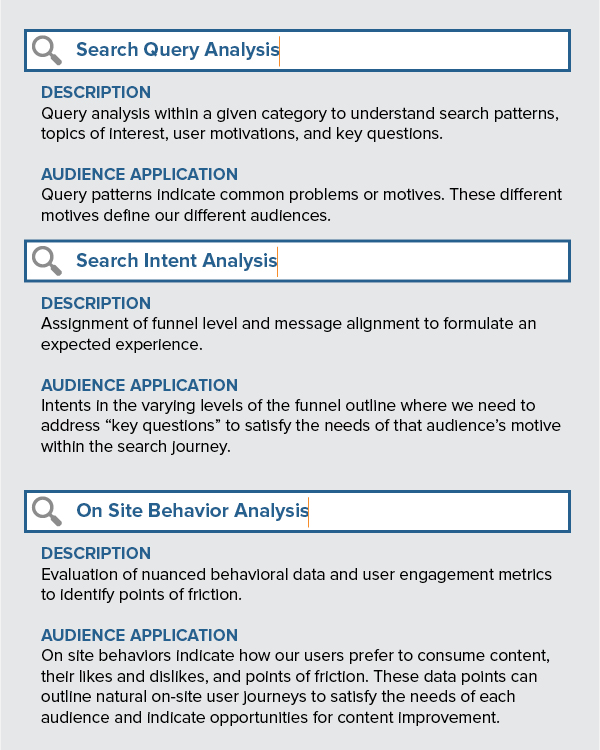
- The secrets that live in search queries.
- Search intent and how to leverage it.
- On-site behavior analysis.
So, let’s start with the only way to get through that barrier: search queries.
The Secrets That Live in Search Queries
Let’s jump in with the foundational element of building our search audiences: understanding what users are searching for, or our “landscape queries.”
Understanding users’ search queries in a given category, or “landscape,” begins with finding patterns within a large set of landscape queries.
To identify those patterns, try to look for verbs, adverbs, adjectives or nouns that appear in high frequencies that give insight into the user’s problem or need (the “motive” for search).
Query patterns can illuminate trends, uncover search behavior nuances, and gauge opportunity in a given category.
From those patterns we can further categorize our queries into buckets of interests specific to our target users.
With enough data, this categorization helps us create detailed topics and subtopics that we know interest our searchers.
As we learn from our search data, we can start to form “keyword insights.”
Keyword insights are more than just buckets of related keywords; they are the motivations behind the searches.
Our long-tail queries illuminate critical user needs and pain-points they may be experiencing in any given query landscape.
These critical user needs and pain-points can be translated into “key questions” that users need to answer prior to making a purchase decision or moving further down the funnel.
In other words, by evaluating landscape query patterns, we are in a sense able to use organic search market research to form consumer insights.
Here is an example of consumer insights derived from query patters in the pet food landscape:
Example:
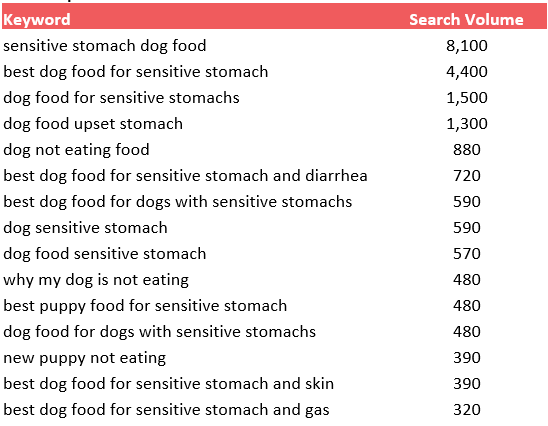
- Keyword Insight: Dog preferences are purchase or product switch motivators for target users.
- Consumer Insights:
- User Need: Customer’s dog has stopped eating their current food, broke out in a rash, or simply is not satisfied with their current diet and are looking to switch immediately.
- Actionable Solution: Provide success stories from the “Sensitive Stomach” customer review base. Showing common issues and possible fixes within ingredient lists can also help users problem solve. That way, shoppers can feel confident that they don’t have to experience the same scenario again.
- Key Questions:
- Awareness: Why is my puppy/dog ______? (not eating, have diarrhea, have gas, itchy skin, etc.)
- Interest: How do I treat ____? What is the best dog food for ______?
- Consideration: Has brand helped others with this problem?
Key Takeaway
The search industry can use keyword insights to understand the varying needs and pain-points of a user in the landscape, topic areas that will resonate most, build valuable consumer insights, and shape “key questions” that need to be answered in the path to conversion.
Search Intent & How to Leverage It
This brings us to our second key factor in building our search audience profiles: aligning intent and messaging.
Understanding the intent behind the query informs where in the funnel our searcher may be.
Intents commonly applied to queries include informational, navigational, and transactional, but intent breakdowns certainly can (and should) be customized to include mixed intents or account for industry nuances.
Building an intent-driven funnel allows us to take our strategy one step further, and we can begin to align the keywords and messaging that might resonate most to any given category or landing page.
By evaluating each page and keyword’s intent, we can select target keywords and on-page content that better aligns with users’ expectations and converts them down the funnel at a higher rate.
When our data provides the areas of interest (topics and sub-topics), needs, expected experience, and intent, we have all we need to start gleaning true search behavior insights.
Key Takeaway
Search intent can be used to evaluate funnel placement and messaging that might resonate most.
This information transforms our query data from buckets of interest, topic areas, and “key questions” into a searcher’s decision-making process on their path to decision/conversion.
On-Site Behavior Analysis
Hopefully, you’re beginning to see how much of a powerhouse query data really is.
By looking beyond the head terms and digging just a bit deeper, we can get in the heads of our target searchers.
Evaluating on-site behavior and engagement metrics can add another layer to our understanding of the user and problem areas impeding their conversion path.
A user will hit multiple “content touchpoints” in their conversion path both in search and on the website.
Each content touchpoint should service the need of the user and be aligned with what we know about their current funnel placement and key questions at that moment.
By better servicing each content touchpoint, we can better satisfy users’ needs and move them down the funnel more quickly.
Analysis of user engagement metrics (e.g., bounce rates, user page flow, pages per visit, etc.) allows us to understand where friction exists in a user’s journey on the website.
For example, a high organic bounce rate may indicate a landing page’s experience doesn’t align with the intent of the user’s search query.
Or, user page flow metrics show users demonstrating unexpected exit patterns or exiting quickly without ever navigating to lower funnel pages.
Once we’ve identified a clear point of friction, we can address it by re-evaluating the page experience.
- Does the content and messaging align with the intent and motivations behind the organic query that brought them there?
- Are we answering the user’s key questions (and are our answers trustworthy)?
- Can we improve the linking on the page to present the user with more/better options to continue their decision making?
Regularly asking these questions can ease friction and improve conversion.
Key Takeaway
On-site behavior analysis is the identification of pivotal on-site user patterns that highlight areas of friction or failure to meet a user’s needs.
Improving or adding content touchpoints that satisfy the identified user needs can reduce friction and improve conversion rate.
Address friction by evaluating messaging, site structure, linking, and content touchpoints on a page to ensure they meet the needs of your audience given their intent and funnel placement.
Build Your Audience
Any good strategist knows there is never a one-size-fits-all approach to content.
But, there are processes that help us create great strategies.
Search audience development is no different.
Just as our key data points build on one another to help us develop user insights, we can stack these user insights to build out a robust picture of our different search audiences.
Breaking Down the Search Engine Barrier
The web is becoming more personalized, so our organic search strategies should, too.
We may not always have reliable demographic data, but we have ample amounts of data that show us what’s most important to our users to shape search audience profiles.
By better understanding these audiences, we can:
- Create more effective content.
- Resonate better with users.
- Ultimately, drive stronger performance.
More Resources:
Image Credits
All screenshots taken by author, March 2020







