


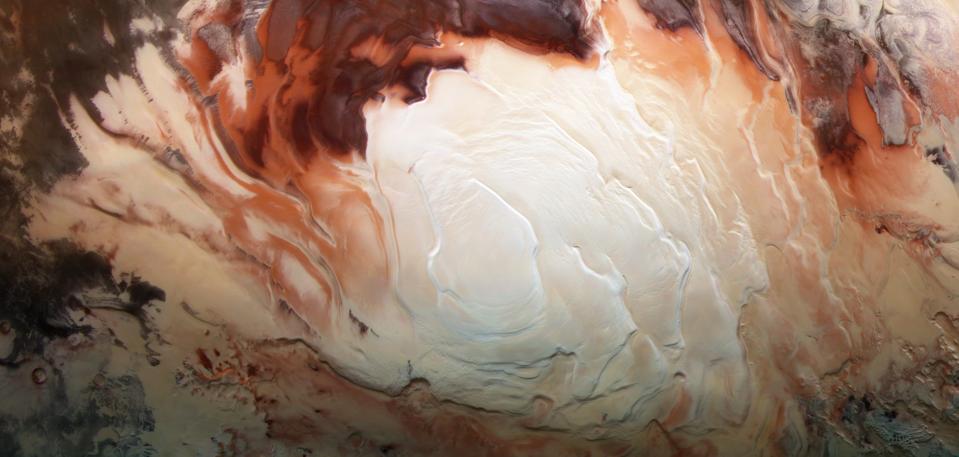
The bright white region of this image shows the icy cap that covers Mars’ south pole, composed of … [+]
ESA/DLR/FU Berlin / Bill Dunford
Mars and Antarctica isn’t the first pairing that comes to mind. But a recent meeting of Mars researchers in Ushuaia, Argentina provided a stark reminder that humankind was once as far removed from Antarctica as it is from Mars today.
The researchers attending the Seventh International Conference on Mars Polar Science and Exploration (ICMPSE) were there to soak up as much of the far Southern Andes’ geomorphology in the form of active glaciers; ancient moraines and lakes and rivers formed by thousands of years of glacial activity as they possibly could. But between soggy field trips to ancient peat bogs, they hotly debated the next steps in Mars polar science.
“Field work that gives you insight into Earth processes can still help you understand processes on other planets, even if the details are different,” Timothy Titus, a geologist at the U.S. Geological Survey’s Astrogeology Science Center in Flagstaff, told me. A lot of my Mars studies involve carbon dioxide (CO2) dry ice deposits which don’t naturally occur on Earth, he says.
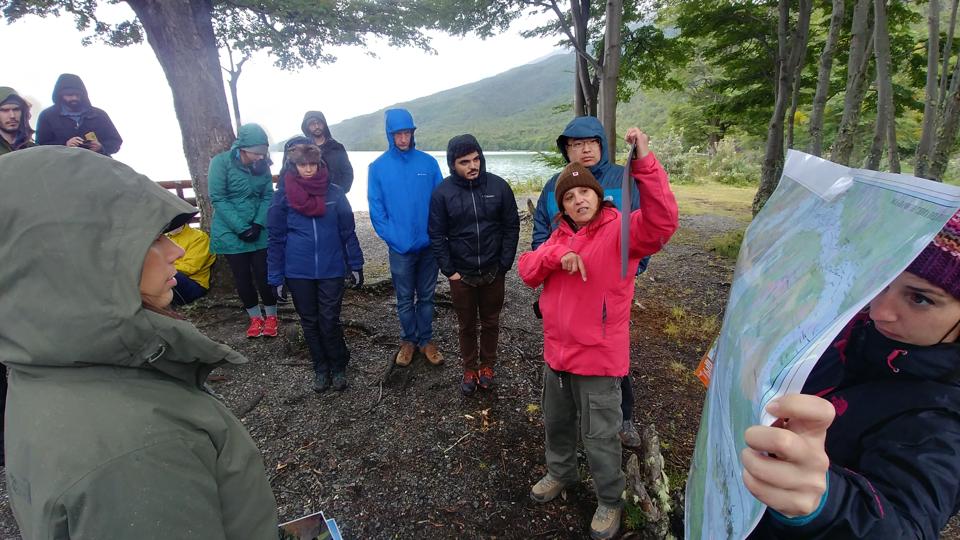
The researchers on a field trip listening to an impromptu lecture on the formation and evolution of … [+]
Bruce Dorminey
Mars’ atmosphere is 95 percent CO2 and in winter gets so cold that 25 percent of that atmosphere freezes out as snow and ice, says Titus. “There is no terrestrial analog for that,” said Titus. “The equivalent is that if the Antarctic became so cold that it started to rain liquid nitrogen.”
But extrapolating hardwon observations of Earth’s processes to the mysterious machinations that are the norm on mars is no trivial feat.
You build that experience in the field by seeing images from above even if they are from a hilltop, Leslie Tamppari, a planetary scientist at NASA’s Jet Propulsion Laboratory (JPL) and NASA’s Mars Reconnaissance Orbiter’s (MRO) deputy project scientist, told me. “It’s started by people doing geology in the field; then photo-geology from airplanes and then satellite photo-geology,” she said. “then we transfer that to our space experience.”
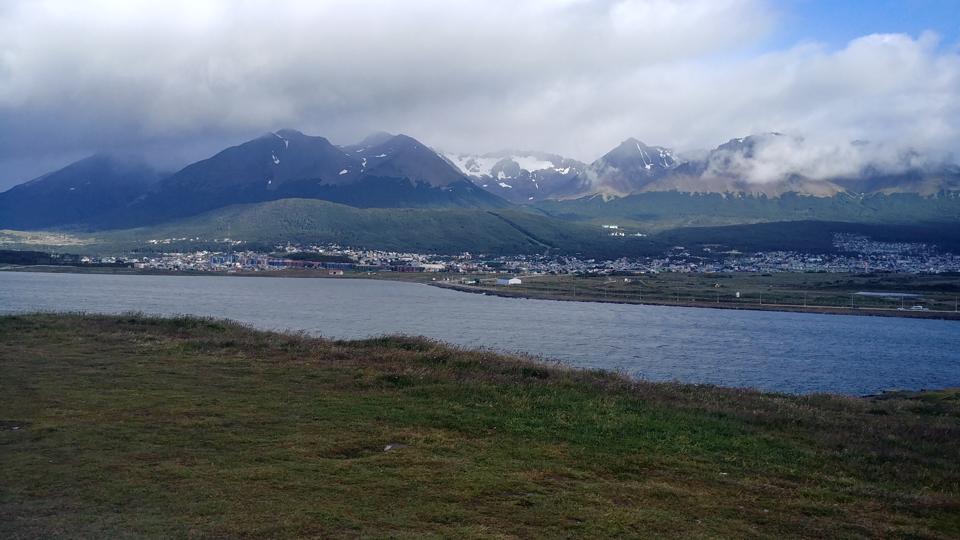
The Beagle Channel and Ushuaia, Argentina in the distance.
Bruce Dorminey
The researchers say that if they knew how old Mars’ ice was at the poles, that would go a long way to helping us understand what’s happened to the climate.
“We think the South pole has been there for a long time and the North pole has arisen in the last 5 million years,” Wendy Calvin, a geophysicist at the University of Nevada in Reno, told me.
A third of Mars’ atmosphere condenses on the pole in winter then it evaporates off that pole and moves to the other pole, says Calvin. The whole atmosphere dynamic on Mars is driven by this condensation, sublimation process, she says.
Even though Mars’ poles are rife with puzzles, we are now living in a heyday of remote observations, particularly with data NASA has provided via its instruments on the MRO orbiter.
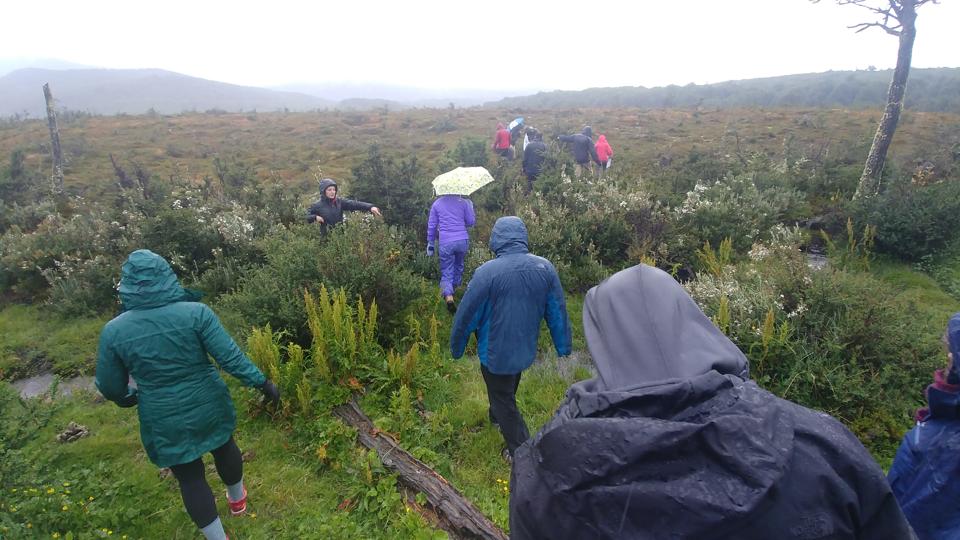
Some of the researchers heading into the middle of a Tierra del Fuego peat bog.
Bruce Dorminey
MRO has changed the paradigm for Mars polar science, says Tamppari. “We have the highest resolution camera outside of Earth and it’s pointed at Mars,” said Tamppari. “We also [detected] visual layering at the margins of the North polar cap.”
And for the first time, MRO was able to make radar observations of Mars’ North pole and its layered sediments and ice deposits. But how would NASA, ESA or any other major space agency efficiently explore these layers from the surface?
“One idea is to get a rover on a scarp outcrop and instead of drilling you just use the rover to roll down the outcrop,” Jeff Plout, a JPL planetary scientist, told me. “Those scarps might be 500 meters in thickness, or roughly the difference of a million years from top to bottom.”
If you could actually determine the dates of some layer, says Plout, then you could calibrate the whole timescale of how old these deposits might be.
The scarp may represent hundreds of millions of years in the recent geologic past, says Plout. And he notes that a polar rover would not be much more expensive than a stationery lander, maybe $1 billion instead of $700 million.
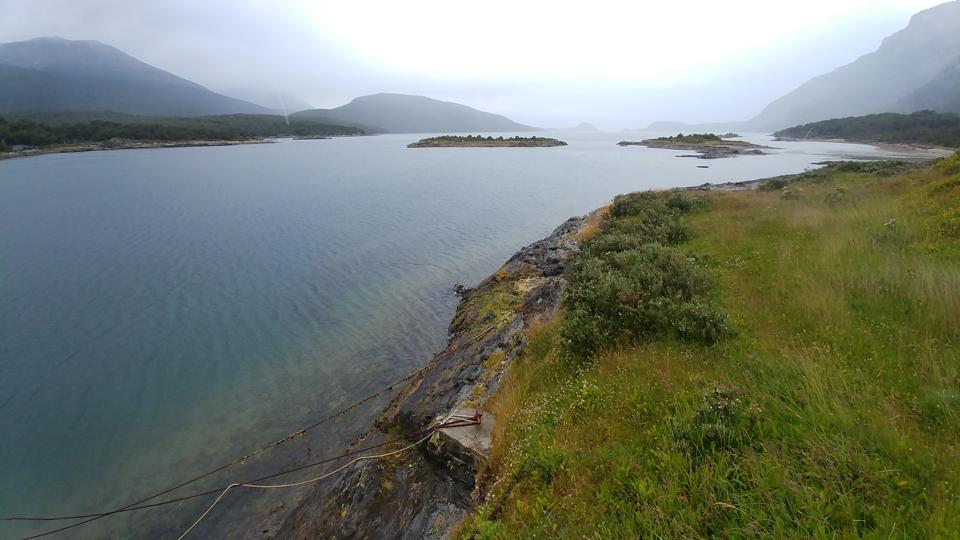
Scene from Tierra del Fuego National Park
Bruce Dorminey
Above all, lessons from Mars polar science is ultimately about exploring the cycles and evolution of the planet’s climate over long timescales. Beyond that, Mars polar science is arguably as much about astrobiology as geology.
“Everything we know about biology would suggest that if there is some sort of bacterial life at Mars’ poles, it will either be dormant or metabolizing incredibly slowly,” Jacqueline Campbell, a doctoral candidate in planetary science at the U.K.’s Mullard Space Science Lab, told me. Given Mars’ changes in its axial tilt (or obliquity) over the eons, such life may spring back to an active state when the poles warm up, she says.
But way down the road, humans will have to learn to operate at the Martian poles both for polar science and in the name of colonization.
Mars’ polar temperatures drop to -195 degrees C. in the winter with no sunlight, says Titus. To mine polar ice, you’d have to go there in summer and do whatever and then get out before the Sun sets on the polar night, he says.
And although the Antarctic is about as dry and desolate as Mars, temperatures at the Martian poles in winter are at least 125 degrees Celsius colder than Antarctica, says Titus.
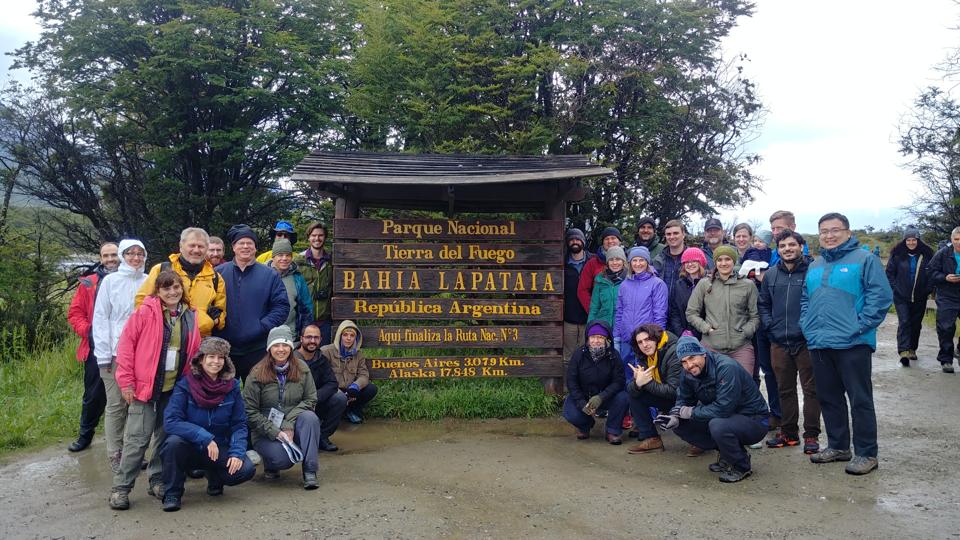
A few of the researchers and the author (left) literally at the end of Argentina’s Route 3.
Bruce Dorminey







