

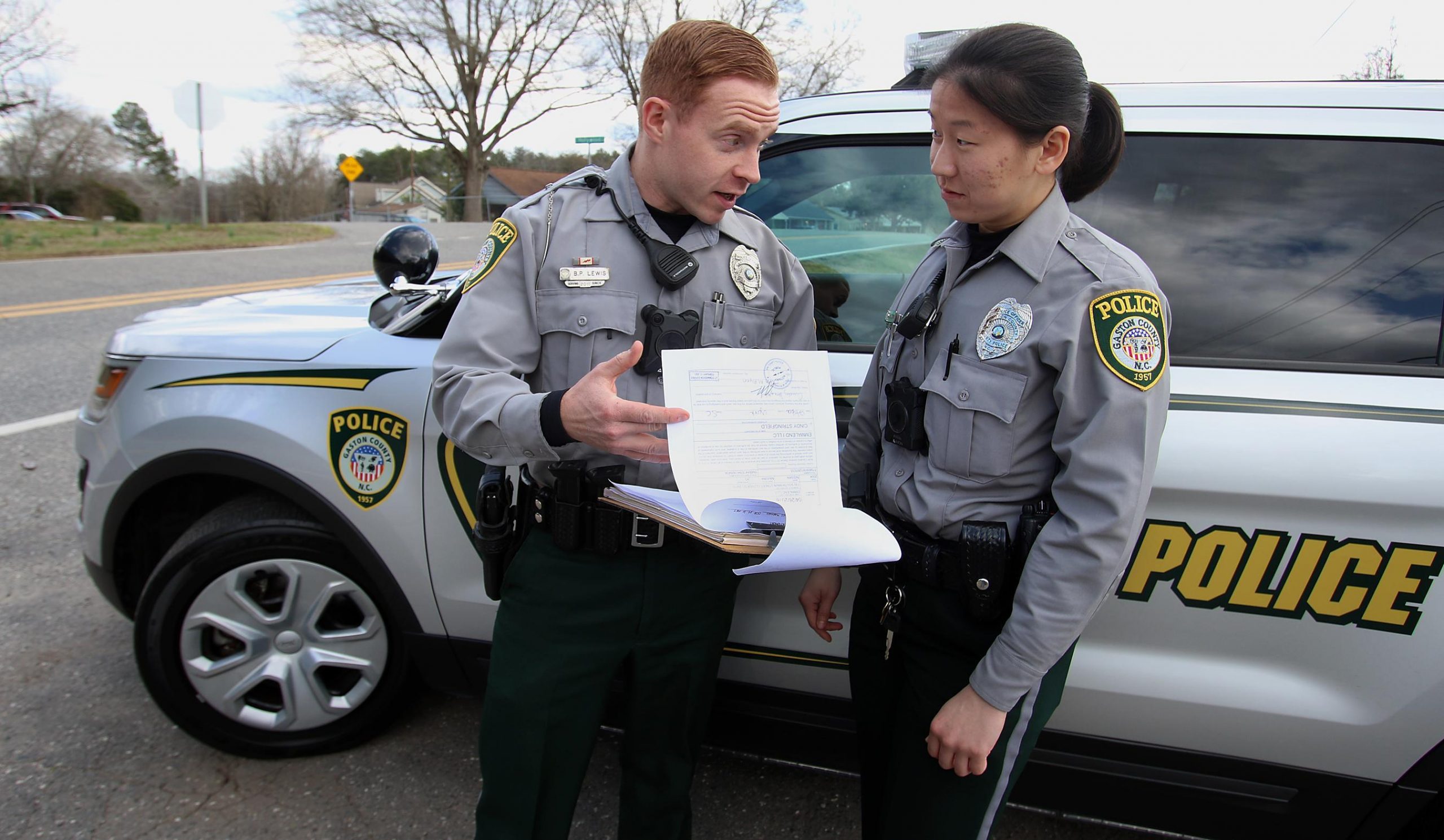
Gastonia Police Chief Robert Helton will be the first person to sing the praises of the rewards that a job in law enforcement can bring.
“I’ve enjoyed the community and fellowship it provides,” he said of his 33-year career. “There’s a lot of reward in who you meet, what you can do, and the opportunities you have to help people out who are maybe having a difficult time.”
But he’ll tell you just as sincerely that such a career isn’t for everyone.
“I think it’s a challenging job, and it takes the right person to be here and handle the types of calls we do, and handle tough and emotionally charged issues,” said Helton. “You need someone who works well with others and has a temperament for it, and someone who has that kind of commitment to do it well. Sometimes people come into this profession and realize they don’t have that.”
Recruiting new officers and retaining them over a long period of time has become increasingly challenging for law enforcement agencies across the country. A variety of factors are playing into that, but the end result is the strain it is placing on police departments and sheriff’s offices to do their jobs in public safety.
Gastonia currently has 178 sworn officer positions, but 10 of those are unfilled. The Gaston County Police Department is funded to support 142 sworn officers, but also currently has 10 vacancies. And the Gaston County Sheriff’s Office, primarily tasked with overseeing the Gaston County Jail, has 212 positions and 15 openings.
“When I go to conferences around the nation, one of the most attended classes that’s typically offered is on hiring and retention,” said Helton. “This has been a nationwide challenge for law enforcement.”
Founded in 1976, the Police Executive Research Forum is a nonprofit that provides technical assistance and tracks trends in support of law enforcement agencies. The organization recently conducted a study and survey of 411 American law enforcement agencies of all shapes and sizes, and released its findings last September.
The study found that fewer people are applying to become police officers, and more people are leaving the profession, often after only a few years on the job. The workforce crisis is also affecting agencies of all sizes and types: small, medium and large; and local, state and federal.
“These trends are occurring even as many police and sheriffs’ offices are already short-staffed and facing challenges in developing a diverse workforce,” the study said.
There are also ominous signs that the crisis may be getting worse. Traditional sources of job applicants — the military and family members of current officers — are diminishing, the study found.
“A robust economy and strong job growth are creating more options for people entering the labor market, so police agencies are facing more competition in hiring,” it stated. “And the often rigid, quasi-military organizational structure of most police agencies does not align with the preferences of many of today’s job applicants.”
Vacancies abound
Nationally, according to an August 2018 report from the U.S. Department of Justice’s Bureau of Justice Statistics, the number of full-time employees in law enforcement is declining. Between 2013 and 2016, the number of full-time sworn officers dropped 3.2 percent, from approximately 725,000 officers to 701,000, ending a period of steady increases from 1997 to 2013.
In Gastonia, the problem isn’t as dire now as it was about three years ago, when the department had roughly 20 vacancies, Helton said. One of the primary triggers then, and something that has continued to present challenges, is officer retirements.
“I think we had 11 officers to retire last year and 11 or 12 the year before,” he said. “That’s a lot of folks going out the door.”
Gaston County Police Chief Joe Ramey said their 10 vacancies are largely also due to recent retirements, though that’s a cyclical problem that is to be expected.
“It can have a major impact, and you’re losing institutional knowledge and skill, but it’s also a major opportunity to bring in youth,” he said. “It’s about succession planning. It brings challenges, but it also has benefits for those wanting to move up in your organization.”
Refilling the ranks has proven more difficult in recent years as the number of candidates interested in becoming officers has dwindled. Part of that is due to like-sized departments competing for the same potential applicants who may be beginning or finishing Basic Law Enforcement Training.
“That’s been a challenge because I think there’s less of a pool these days of people looking to come into law enforcement,” said Helton. “We’re all looking for those quality folks, so it becomes very competitive among all of us.”
Another issue in terms of filling the gaps stems from what goes into preparing a budding police officer for the field. Basic Law Enforcement Training usually takes 16 weeks, and after gaining that certification, new hires typically have to go through a separate orientation and training program at the department where they’ve been hired, which can last 10 to 14 additional weeks.
Many agencies are willing to pay for new hires to go through the BLET program. But after that long investment of funding and training, there’s often no guaranteeing how long a new officer might stay before taking another job, whether in law enforcement or in some other field.
“In the last three months, I have lost five or six deputies to other police departments after I sent them to rookie school,” said Gaston County Sheriff Alan Cloninger. “We pay for them to go there, and then they’re jumping ship for more money and a different environment.”
Two years ago, Cloninger implemented a new program requiring new hires to sign a contract assuring they’ll stay with the Sheriff’s Office for three years after going through BLET classes, or else reimburse the office on a pro-rated basis for whatever time of that tenure they didn’t complete.
“Two (deputies) just left me, and they both owe a little over $6,000,” he said.
Pay, education, and career options
Pay plays a factor in the struggles of some departments to recruit new talent and hold onto it, though to varying degrees.
In Gastonia, the city has taken steps in recent years to increase what it can offer rookie officers, while also modernizing its system for providing pay increases based on tenure and expertise. The pay scale for Gastonia police officers now ranges from $37,926 to $68,993, Helton said.
Previous military or law enforcement experience will boost that starting salary, as will higher education, he said.
“When they come in the door, if they’re a brand new officer with no college education, (their pay) will be closer to that low number,” he said. “We adjust that by a couple thousand if they have a two-year degree, and it can come up to $42,000 if they have a four-year degree.”
A modern-day officer has to be able to do everything from work with complex computer software, to give informative and relatable presentations to the community, Helton said.
“Education is a really important part of what we do,” he said.
The starting salary for a Gaston County police officer who has achieved BLET certification is roughly $43,200, Ramey said. But unlike most police departments, Gaston County requires new officers to have a four-year degree, and has had that policy in place since the mid-1980s.
“I believe we’re very competitive in pay from top to bottom,” said Ramey. “We have opportunities for folks to improve themselves and we invest in our people as far as training.”
Four-year degrees aren’t required for incoming deputies at the Gaston County Sheriff’s Office, though Cloninger said a new hire with that level of education can expect to make $41,000 or more. The problem he’s seen lately is that more applicants are having trouble passing the math and English tests his office requires them to take.
“Smarter people with better abilities are going to bigger-paying jobs in the private sector,” he said. “That leaves us candidates who are not qualified. I had one person come and apply who admitted to smoking marijuana the day before the application.”
With the good economy right now, people have more alternatives to working in law enforcement, Cloninger said.
“You don’t have to risk your life and health, and work third shift and 12-hour shifts,” he said.
Attrition and competition
According to a recent study conducted by the North Carolina Criminal Justice Analysis Center, law enforcement has a higher attrition rate (14 percent) than both teaching and nursing (13 and 12 percent respectively).
Many of Gaston County’s law enforcement agencies fall within that general range on turnover, though the Gaston County Police Department is lower, Ramey said.
“We’re overall at about an 8 percent turnover rate per year, which I think is low for the industry,” he said. “Inside your department, it’s about more than just pay and benefits. It’s about the environment you’re working in.”
In its survey last year, the Police Executive Research Forum asked law enforcement agencies to name the three most common career or life changes identified during exit interviews. “Pursuing a career outside of law enforcement” was the second-most common response. But the most common was “accepting a job at a different law enforcement agency.”
Helton said it’s typical for police departments the size of Gastonia’s to hire officers who are looking to move up after working at smaller agencies. But the poaching goes right up the chain. Gastonia’s officers have been known to leave for larger police departments that can pay more, such as those in Greensboro and Charlotte, Helton said.
“We’re the largest police department within Gaston County,” he said. “We get close to 100,000 calls a year, and folks get a lot of experience very quickly. They become very valuable.”
The opportunities each police department provides in terms of training and special responsibilities become selling points to potential new recruits. Helton pointed out that Gastonia is a big enough agency to provide officers with experience on SWAT teams, K9 and narcotics units, criminal and special investigations, and more.
“There are a lot of opportunities for people to get involved in different ways, but we’re small enough that we all know each other and still have that family feel and a good relationship with the community,” he said.
Ramey said Gaston County also has created different layers within its police department to help in recruiting and retention. Even though they have 10 vacant positions, they have a higher number of applications from people waiting to fill those roles, he said.
“People are our most important asset, so we invest in them and provide them with skills they need to make themselves better candidates for jobs throughout the building,” he said.
Pursuing non-traditional candidates
Among the 411 departments surveyed by the Police Executive Research Forum, the overall makeup of law enforcement officers was 86 percent male and 14 percent female. They were also 76 percent white, 9 percent black, and 11 percent Hispanic.
Agencies across the country have put an increasing emphasis on hiring minority officers, though it hasn’t been easy.
Helton said roughly 15 percent of the officers in Gastonia are minorities, and about 9 percent are female.
“Certainly that’s behind where the community as a whole is,” he said. “Our goal is to try to be as representative of that as we can. There’s been a continuing effort to achieve that diversity. We want our department to reflect the community and the people we serve.”
Ramey said 10 to 11 percent of his officers are minorities. Despite efforts to increase that number, he said part of the problem may be due to things that are out of a typical law enforcement agency’s control.
“I don’t know if it’s trust,” he said. “But I’m not sure there are large numbers of minority candidates interested in getting into law enforcement.”
Cloninger said his office has tried to encourage more interest from minority candidates by reaching out to traditionally black and Hispanic churches throughout the county. He said the percentage of black deputies on his staff is roughly equivalent to the 17.6 percent of Gaston County’s overall population that is black.
“If you can tell me how I can do better, I’d like to know,” he said. “It’s not just a minority issue. It’s who is willing to do the job and who is qualified. You have to be equal to anybody else who comes in the door, and you have the same requirements for employment.”
To help with its overall recruitment efforts, the Gastonia Police Department recently began using a new tool: a minute-and-a-half-long video that aims to highlight the agency’s training opportunities and commitment to the community. It depicts drone footage of the police department and the nearby police memorial, shares department history, and shows officers on the job within the agency’s various divisions and special teams.
The video was produced for free by The Wheelhouse Foundation, a nonprofit whose executive director, Paula Kranz, is a former military officer. Helton said she wanted to show what her company is capable of doing to help law enforcement agencies in recruitment, and Gastonia was fortunate to be selected as a proving ground.
“We’ve got great tactical teams and great technical teams, but we also wanted to show that relationship we have with the community,” said Helton. “We put a lot of time and effort into building that relationship, and we felt like that really showed in the video.”
You can reach Michael Barrett at 704-869-1826 or [email protected].







