


By Jodie Mozdzer Gil 7 hours ago
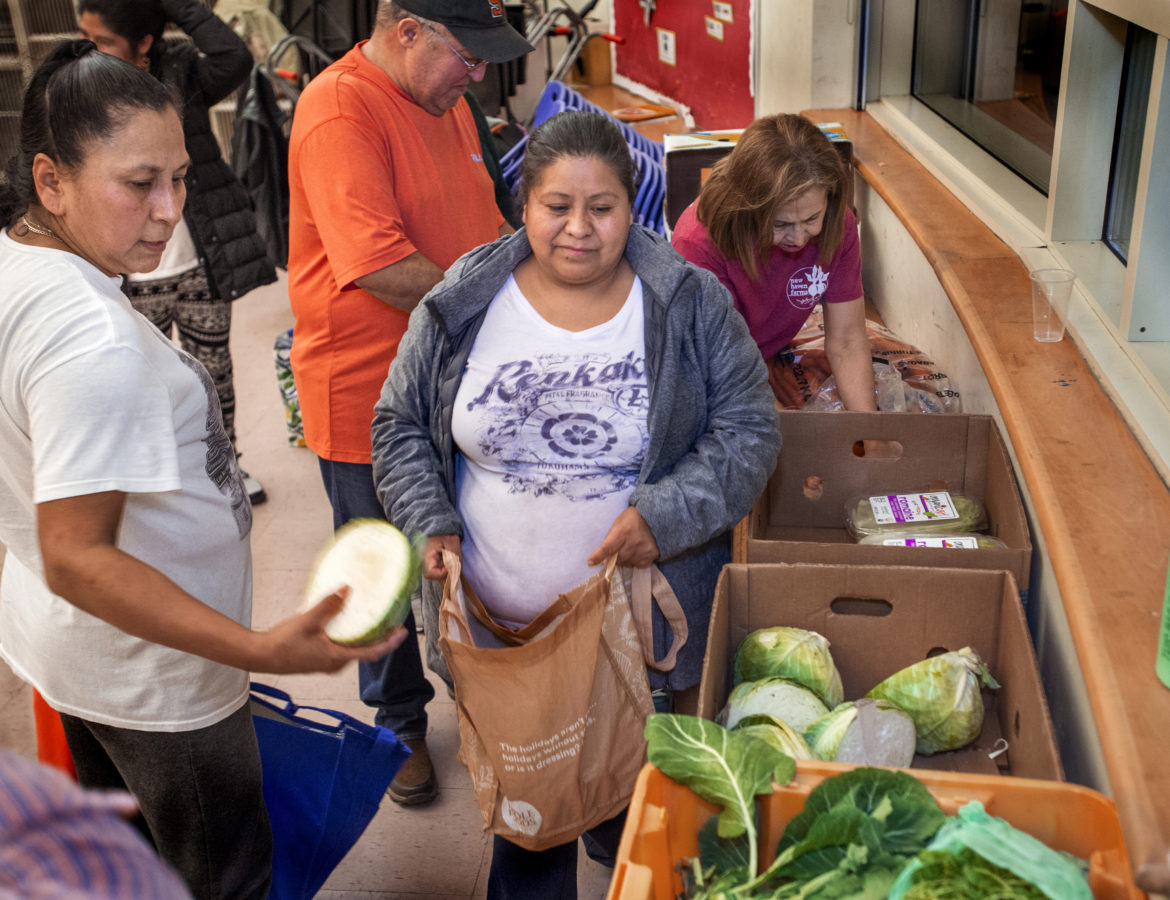
Melanie Stengel Photo.
Georgina Castelon (left) and Juana
Rodriguez pick up produce, including cabbage, carrots and kale after an
exercise class at John S. Martinez School in New Haven. In back are Juan
Ortiz and Ruth Torrez.
In cities throughout Connecticut, urban farms and community gardens
are sprouting up to address a significant health challenge: Many people
don’t have access to enough food or access to healthy food.
About 13% of Connecticut residents
said they did not have enough money to pay for food at least once in the
previous year, according to the most recent Community Wellbeing Survey conducted by DataHaven in 2018.
Black and Hispanic residents were more likely to struggle, with 23%
and 28%, respectively, reporting food insecurity. In several cities,
about a quarter of all residents struggle to pay for food.
Urban residents are also less likely to have access to fresh fruits
and vegetables, according to the survey. Statewide, about 72% said they
had excellent or good access to produce, while the rates were only 56%
in New Haven and 51% in Hartford and Bridgeport.
Studies have linked food insecurity to higher rates of obesity, heart disease and diabetes—as well as higher health care costs.
“There’s endless amounts of data that says exercise and vegetables
make you healthy,” said Jacqueline Maisonpierre, the former co-executive
director for the newly merged New Haven Land Trust and New Haven Farms. Maisonpierre left the organization in mid-February.
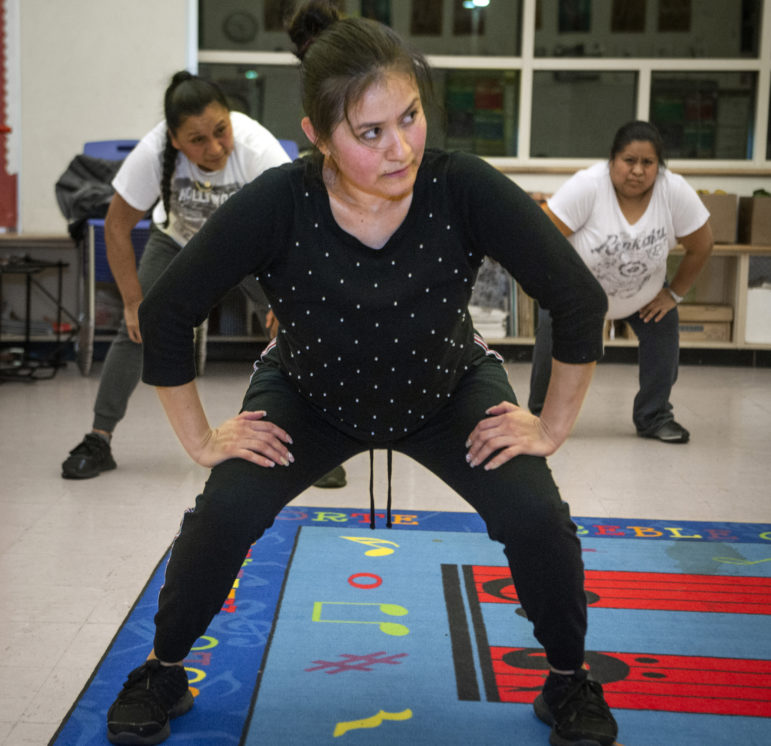
Melanie Stengel Photo.
Eunice
Castelan Castelan keeps her eye on the instructor a during an exercise
and nutrition class at the Martinez school in New Haven. In the back are
Georgina Castelan and Juana Rodriguez.
The group is one of several around the state seeking to connect
lower-income residents with produce from urban farms. The group’s
Farm-Based Wellness Program uses a diabetes prevention curriculum from
the Centers for Disease Control and Prevention (CDC). Participants learn
to prepare healthy meals with fruits and vegetables during an intensive
20-week summer program that continues monthly through the winter.
About 96% of families reported improvements in their eating habits,
with an average weight loss of 4.29 pounds, and an average increase in
exercise of 64 minutes per week, according to the 2019 evaluation
report.
“For those that it works for, it really works,” Maisonpierre said.
“We’ve had a lot of folks who have had a really significant turnaround
in their health.”
Bill Flynn is one. When he joined the Farm-Based Wellness Program in July 2018, he weighed 360 pounds.
“I knew [my weight] was an issue for 10 years,” Flynn said. “It got
to a point where I was a size 50 pants. I couldn’t put on my shoes, and I
had congestive heart failure.”
By January 2020, he was down to 240 pounds. Now Flynn volunteers to
help others in the program, even cooking meals for the winter meetings.
“I can’t say enough about how much this program has done for me,” Flynn said.
Ruth Torres joined the Farm-Based Wellness Program in 2012 when her 18-year-old grandson was diagnosed with pre-diabetes.
“It helped him a lot,” Torres said. “Before a year was up, he had lost 70 pounds.”
Torres stayed involved because she saw her health problems, including
arthritis, improve through the program. She later became a Community
Health Ambassador and is now the program coordinator. She regularly
grows her own fruits and vegetables—something she never imagined doing.
“The program has taught me that food can be used as a medicine,” Torres said.
Cristina Sandolo, the executive director of Green Village Initiative,
said groups operating urban farms and community gardens contribute to
better health in several ways: They increase access to fresh fruits and
vegetables. They educate children and teens about healthy eating. And
they help residents make money through urban farming.
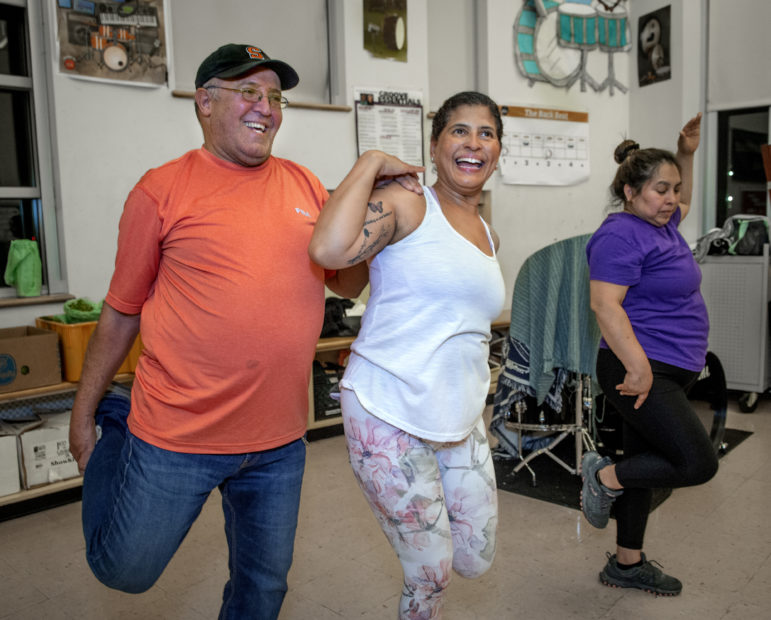
Melanie Stengel Photo.
Juan
Ortiz (L) gets some help from exercise instructor, Amanda Mia (C)
during an exercise and nutrition class at Martinez school. At right is
Soyla Aguilar.
“We are providing access to 150 families in Bridgeport who can now
grow their food for their dinner tables,” Sandolo said. “We hear that
the bulk of their vegetables during the growing season come from their
plots.”
In Hartford, a mobile farmers market brings fresh produce into food
desert neighborhoods. In Stamford, cooking classes help cancer patients
use nutritious food as part of their healing plan. At Naugatuck Valley
food pantries, a nutritionist is available to help provide recipes for
the fruits and vegetables it distributes. In some cities, FoodCorps
members are embedded in public elementary schools.
Still, programs to help those in need often go underused. For
example, the federal Farmers Market Nutrition Program gives books of
checks to mothers, children and senior citizens to buy produce at
participating farmers markets. Each year, WIC participants receive $15
books, and senior citizens receive $18 books.
After federal money is distributed, the state offers a second round
of checks with its own funding. Yet, the state money often sits
untouched, according to Jaime Smith, who manages the program for the Department of Agriculture. Only 36% of state funding for WIC participants and 77% of state funding for senior citizens, was used in a recent year.
“That’s a lot of money on the table that could be used to feed people and generate income to the farmers,” Smith said.
Some are unaware of the program, but others can’t find transportation
to get back for the second distribution, Smith said. It’s just one
example of the layers that contribute to food insecurity.
“We believe that urban agriculture is one part of a much larger
puzzle,” Sandolo said. “The food system is complex, poverty is complex,
and the systems that prohibit folks from living the lives they would
like to live are complex.”
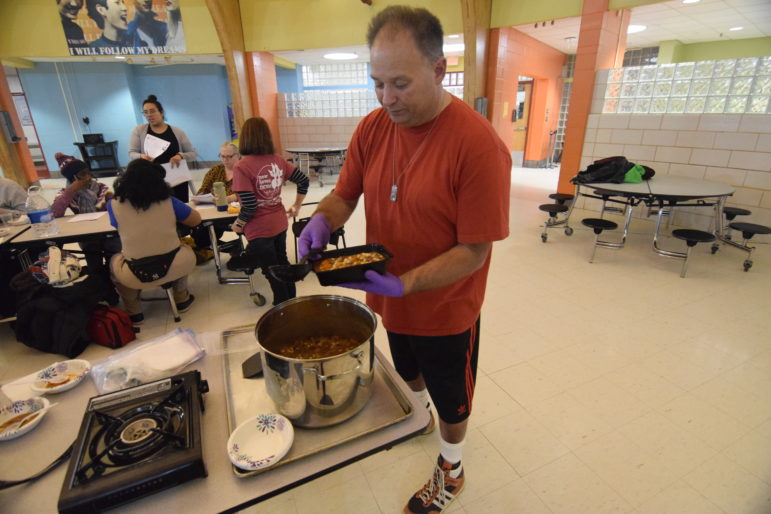
Jodie Mozdzer Gil Photo.
Bill
Flynn joined the Farm-Based Wellness Program in 2018 and now volunteers
to help others and even cooking meals to serve during wellness events.
Martha Page, the executive director of Hartford Food System,
says helping people become self-sufficient is a first step. She noted
that a decrease in food insecurity in Hartford, from 33% in 2015 to 23%
in 2018 according to the Community Wellbeing Survey, followed decreased
unemployment in the city over the same period.
“At the end of the day, the best thing that can be done for most
people from a health perspective as it relates to food, is they have to
be able to afford the food that will make them healthy,” Page said.
She has hope despite data showing continued lack of access in cities.
“You have a right to access healthy food in your neighborhood or
within easy reach,” Page said. “More people are thinking about it, and
more people are arriving at the notion of food justice and food
democracy. That was not a concept that we even talked about when I
started this job. More people know what it means when your community is a
food desert. I think that’s progress.”
Support Our Work
The Conn. Health I-Team is dedicated to producing
original, responsible, in-depth journalism on key issues of health and
safety that affect our readers, and helping them make informed health
care choices. As a nonprofit, we rely on donations to help fund our
work.Donate Now
Related Stories
More From C-HIT
Similar Posts:








