



evgeni-tcherkasski-SHA85I0G8K4-unsplash
In Part One of this article, we looked at the myriad of ways that purpose drove success with consumers, on metrics such as trial, advocacy, loyalty and willingness to pay price premiums.
Let’s now turn our attention from consumers to employees and investors. Again, the data is clear and compelling on the effect that purpose has.
EMPLOYEES
Recruiting New Talent
According to Inc, Millennials will make up 75 percent of the workforce by 2025 and they are looking for socially responsible employers.
The Cone Communications Millennial Employee Study found that 64% of Millennials won’t take a job if their employee doesn’t have a strong CSR policy, and 83% would be more loyal to a company that helps them contribute to social and environmental issues (vs. 70% U.S. average).
And when it comes to Gen-Z, again the data is even more compelling. The newest entrant to the workforce, Gen-Z, is expected to make up 30 percent of the U.S. workforce in just four years.
A study by WeSpire found that Gen-Z is ‘The first generation to prioritize purpose over salary. They read Mission Statements and Values documents to select where they work and want their employer’s values to match their values. They expect consistency and authenticity and will call you out, often publicly, if they don’t see it. They will leave companies they believe are hiding or putting too much spin on bad news, ignoring their negative environmental or social impacts, or that have toxic workplace cultures.’
A study by Peakon reviewing employee comments found that Generation Z is “the only generation to reference social concerns within employee comments. Raised in a time when the effects of climate change are making weekly headlines, it shows that they care deeply about the world around them.”
So if you want to future proof your talent for the next two generations, and attract the best and the brightest, it is crucial that you show them how their work ladders up to something more than just a quarterly profit goal.
Employee Performance
A sense of purpose, along with autonomy and mastery, is a key driver of employee engagement.
However, Gallup’s Employee Engagement Poll found that only 34% of American workers were ‘actively engaged’ (defined as ‘those who are involved in, enthusiastic about and committed to their work and workplace’) with the remainder either ‘not engaged’ or ‘actively disengaged’.
Organizations and teams with higher employee engagement and lower active disengagement perform at higher levels. For example, organizations that are the best in engaging their employees achieve earnings-per-share growth that is more than four times that of their competitors.
Compared with business units in the bottom quartile, those in the top quartile of engagement realize substantially better customer engagement, higher productivity, better retention, fewer accidents, and 21% higher profitability. Engaged workers also report better health outcomes.
Pay Parity
Fast Company found that ‘most millennials would take a pay cut to work at an environmentally responsible company.’
Reducing Turnover
Deloitte Insights 2020 Global Marketing Trends Report found that purpose-driven companies had 40 percent higher levels of workforce retention than their competitors.
Benevity’s Engagement Study, which examined the activity of more than 2 million users on the Benevity platform, found that turnover dropped by an average of 57 percent in the employee group most deeply connected to their companies’ giving and volunteering efforts.
Studies show that the total cost of losing an employee can range from tens of thousands of dollars to 1.5–2 times an employee’s annual salary, which for U.S. companies totals more than $160 billion a year. This shows that giving employees a sense of meaning in their work has tangible and hugely impactful benefits.
INVESTORS
And finally, let’s look at investors and the exponential increase in ‘impact investing’ — looking to invest in ways that generate social impact alongside financial returns.
(For the uninitiated, this is sometimes also called ‘ESG investing’: ‘E’ is for ‘environment’ and includes issues such as climate change policies, carbon footprint, and use of renewable energies. ‘S’ is for ‘social’ and includes workers’ rights and protections. ‘G’ is for ‘governance’ and includes executive compensations, diversity of the board and corporate transparency.)
The Business Roundtable ‘Statement on the Purpose of a Corporation’ created shockwaves when it announced that 181 of America’s leading CEO’s had signed a letter signaling a shift away from the era of shareholder primacy (as most famously propagated by Milton Friedman) towards ‘stakeholder capitalism’, focused on creating long-term value, better serving all stakeholders — investors, employees, communities, suppliers, and customers.
But the data backs up why this move is essential for long-term success for publicly held companies.
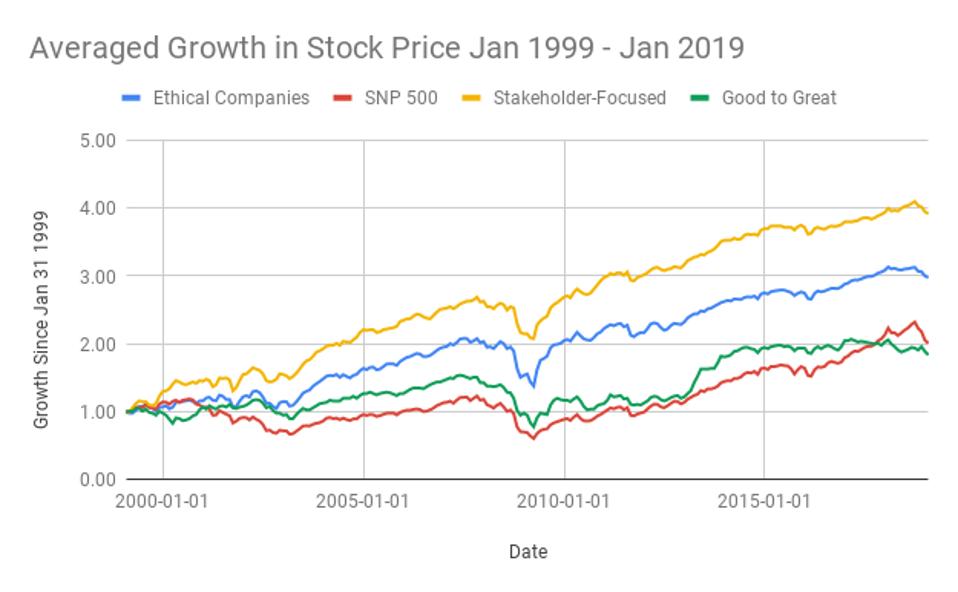
A 20-year study by the Torrey Project explodes the myth that an ethical, stakeholder-driven approach to business cannot lead to shareholder returns by examining the long-term historical performance of different sets of companies including the S&P 500, Jim Collins’ “Good to Great” companies, Raj Sisodia’s stakeholder-focused “Firms of Endearment” and Ethisphere’s 2019 “Most Ethical Companies.”
After comparing these 4 sets of companies’ financial performance on the NASDAQ and NYSE over the past 20 years, they found that while Ethical Companies do enjoy a higher level of stock price growth (50% higher than that of the S&P 500 over the same period), stakeholder-focused companies (Sisodia’s Firms of Endearment) had the highest growth of all in stock price (100% higher than that of the S&P 500 over the same period).
This data has two clear conclusions. (1) Ethical business behavior correlates with high financial returns. (2) Companies who take things one step further and adopt a stakeholder-focused model (that explicitly serves employees, customers, suppliers, business partners, investors, local communities, the environment, and society) have historically shown even higher returns than standard ethical companies.
Torrey Project Shareholder Returns
The Torrey Project
Current Investors
According to Morningstar, ‘net flows into sustainable funds this year are on track to triple their 2018 total, driven by ESG (environmental, social and governance) factors as well as the desire to make a social impact.’
A recent Bank of America Merrill Lynch report predicted a “tsunami” of capital flowing to “good” stocks, fueled by high levels of interest among women, millennials, and wealthy individuals. BofA Merrill Lynch predicts that over the next two decades, $20 trillion in assets will flow into sustainable funds and strategies, nearly equaling the market value of the S&P 500 today (some $24.7 trillion).
Future investors
This does not even take into account the seismic shift that is happening as more values-driven investors from the Millenial and Gen-Z generations enter the market.
According to Coldwell Banker, The “Great Wealth Transfer” will see an estimated $68 trillion passed down from boomers over the next 30 years, and by 2030, Millennials will hold five times as much wealth as they have today.
According to DeVere Group, a survey of Millennial investors around the world found that some 77% of them say that environmental, social and governance concerns are their top priority when considering investment opportunities.
A global poll of 1,125 millennials, conducted by deVere Group, a British advisory firm, found that ESG concerns topped traditional factors such as anticipated returns (cited as most important by 10% of those polled), past performance (7%), risk tolerance (4%) and tactical allocation (2%) when making investment decisions.
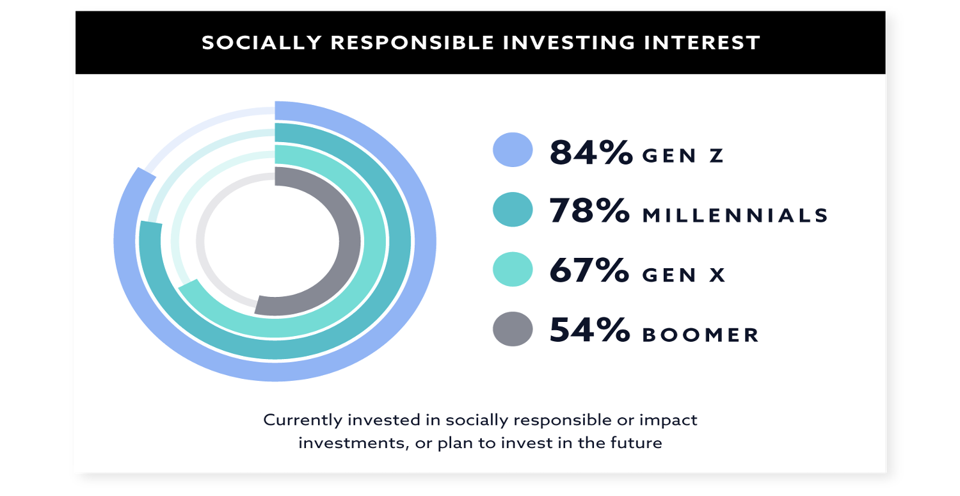
Swell Investing’s ‘Money Meets Morals’ survey found that 84 percent of Gen Z investors are either already invested in socially responsible or impact investments or plan to invest this way in the future. Nearly one in three Gen Z investors (31 percent) said they would be willing to allocate 50 percent or more of their investment portfolio to socially responsible or impact investments. One in four millennial investors would do the same.
Swell Socially Responsible Investing
Swell Investing
The world has been irrevocably changed by seismic events such as the 2008 financial crisis, and the rising rage over massive income inequality; the fracturing of political consensus with events like Brexit, and the election of President Trump ; and the looming specter of the climate apocalypse.
As we said in our 2016 book ‘Good is the New Cool: Market Like You Give a Damn’: ‘Unless business deals with income inequality, no one will be able to afford our products. Unless business deals with climate change, there won’t be a planet left to sell them on.’
I hope this article helps CEO’s see the unavoidable reality: that purpose is going to be as transformative to their business as the arrival of digital was. And just like digital, it is a competitive edge that they can either embrace — or watch helplessly as their competitors do.
Capitalism needs to evolve dramatically to keep up with these changes, and purpose is the key to doing so authentically and sustainably, in a way that creates a durable prosperity for the many, not the few.







