

Luxury travel has long been synonymous with privacy and peace; notions of comfort and exclusivity inextricably bound up with ideas of Zen retreat and seclusion. But, says Roland Fasel, Chief Operating Officer for Aman: “the world is really lonely, and people have lost the art of connection and interaction.”
“You might want to switch off and recharge and have some peace on holiday, but you might want to interact a little more,” he notes. “Why wouldn’t we, at Aman, give people the opportunity to make that decision for themselves?”
On Wednesday night in New York, the beloved ultra-luxury brand, renowned for its high-end properties in remote and exotic locations, such as Bhutan and the Utah desert, its luxury yachts and its 12-seat private plane, announced a brand new sister brand, Janu. Where Aman means ‘peace’ in Sanskrit, Janu means ‘soul’, and, in this case, not the soul you’re searching for in your meditation class, but the sort of soul that makes for an earthy, visceral prefix to ‘food’ or ‘music’.

“While I see other hotel brands placing greater emphasis on wellness, relaxation and privacy, many lack excitement, buzz and a scene,” says Chairman and CEO Vladislav Doronin, who has owned Aman since 2014. “We want to kick-start human interaction again and believe Janu offers a place to find new energy and enrich the soul.”
Guests at Wednesday’s predictably glamorous cocktail party were expecting simply an update on the forthcoming Aman New York, with the ambitious gut renovation of the iconic Crown Building on 5th Avenue anticipated to open towards the end of this year. In addition, however, we were treated to the surprise announcement and a short but evocative and visually arresting introduction to Janu, whose three initial properties, in Montenegro, Saudi Arabia and Tokyo, are scheduled to launch in 2022, with five more in the pipeline; Janu plans to have eight properties open within its first 10 years.
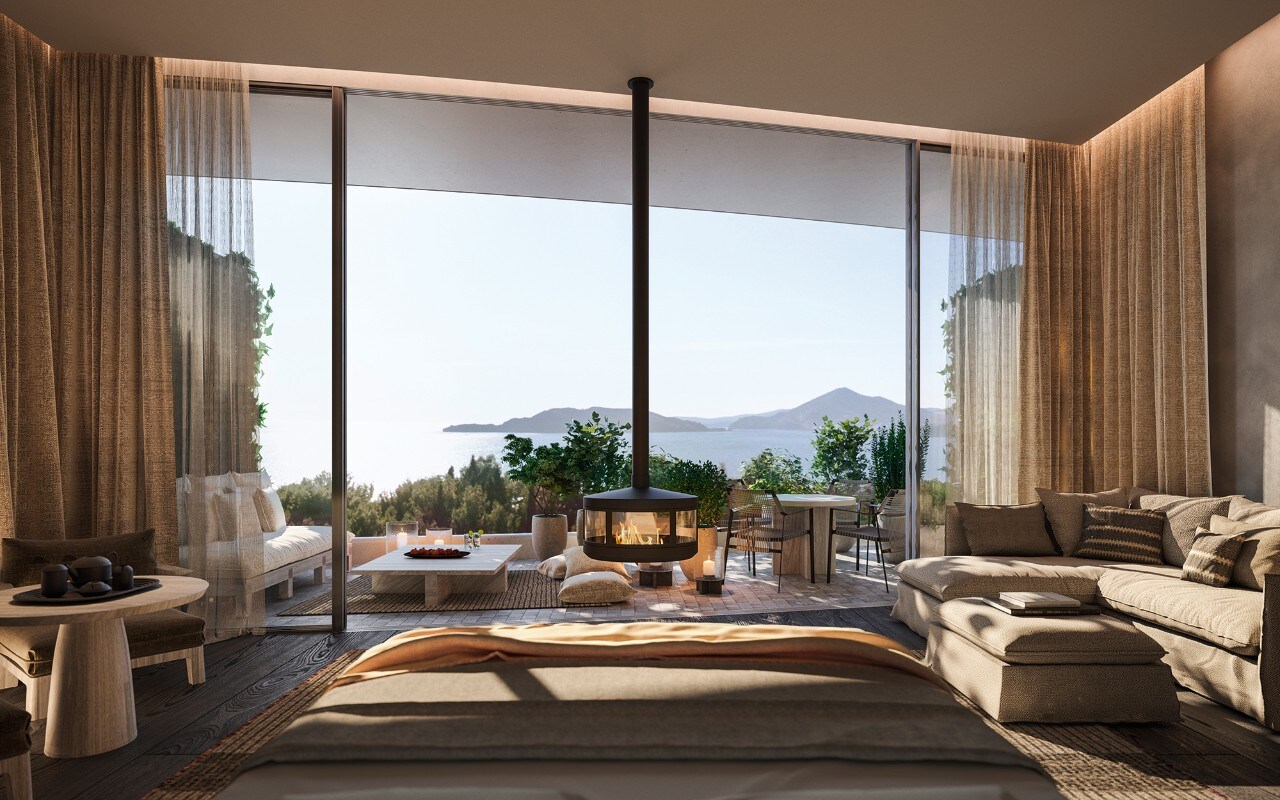
Though design will still be a “pillar”, says Fasel, “playing with light and courtyards, bringing the outside in” with “the same design intensity that we would have in a different environments with Aman,” it will not be the famously minimal design of its sister brand, but softer and warmer. The interiors of the Montenegro property, for example, will be designed by colourful New York interiors duo Yabu Pushelburg. And, while some properties will, as with Aman, be resorts, they will be “vertical” – bedrooms within buildings, not stand-alone villas.

Janu hotels will also be larger, with up to 150 rooms (by comparison, the largest Aman hotel is Tokyo, with 84 rooms), and with smaller bedrooms – an average of 450 square feet, compared with the smallest room in the forthcoming Aman New York, which is 680 square feet. But prices (officially to be confirmed) will reflect that – Janu rates will be “more affordable” than the notoriously hefty Aman price tag, where entry level rooms rarely fall below $1,000 USD (£774) per night, and are often much more.
“There’s a finite number of Amans that you can put into this world,” says Fasel (and only a finite number of travellers who can afford to fill them, of course). The brand currently counts 32 properties in 20 locations, with nine more in the pipeline. Even with its new city locations, such as Tokyo and New York, “there is only a handful of urban cities where I can put an Aman,” he says. “Janu gives us much more flexibility, to build something more contemporary, and there’s no finite number of how many we could build.
This is not, however, to borrow a term from fashion, a designer diffusion range – this is not Erdem for H&M. “This is not a sub-brand to Aman,” insists Fasel. “It is a sister brand, but will be resourced independently. It is being driven by the Aman team, but, as a brand in itself, it will operate independently in the luxury space.” Hence why he doesn’t believe that launching the first three properties in locations already home to Amans is overkill. “You have the opportunity to do all the spiritual, soul-searching and the mindfulness on one hand, but you have the opportunity, if you want it, to dial into a more lively, community-focussed context too,” he says.

The concept, say its creators, came from a glaring gap in the market. At one end there’s Aman, with its private villas and tented camps with pools; at the other, the booming lifestyle brands, such as the ever-proliferating Soho House group, the likes of Andaz and Edition hotels, and the recent trend for accessibly priced hotels offering more communal social spaces, such as the Ace, Hoxton and Moxy. “In the middle, there is a white space which nobody has explored,” says Fasel – luxury plus social connectedness.
The brand conducted intensive research, interviewing hundreds of regular travellers, Aman guests, journalists and travel agents, who represented growing trends, such as the rise in solo and multigenerational travel, and many of which demand a greater focus on togetherness rather than seclusion.
Wellness at Janu, therefore, will not only mean spas and yoga, but “edgier” group classes, such as contemporary martial arts, says Fasel, along with “time-conscious and high-octane” classes (perhaps Spin and Megaformer Pilates). Treatments will involve newer, cutting-edge trends, less traditional and conservative than those on offer at Aman. And other group activities will be offered outside the boundaries of fitness and health, such as masterclasses in sustainable cooking – all strictly optional, of course; it isn’t Guide Camp.

But where Aman offers sanctuary, Janu will encourage engagement. “You might not necessarily want a digital detox, being forced into putting your laptop or your phone in a sealed bag,” says Fasel. “But hopefully you might be too busy having a good time and meeting people, enjoying human interaction, that you’re not on your phone.” The restaurants and bars of Janu will be designed to foster that interaction too, physically, with communal tables, and atmospherically, with lively entertainment programmes that showcase local arts scenes and feature local bands and DJs.
“Guilt-free ultra-luxury travel is a challenge for brands,” recognises Fasel, so “local” is very much a watch-word, as is, of course, sustainability. “We need to get away from having all this fancy stuff flown in, and move to using locally sourced produce from close by.” The fledgling brand is considering running its own organic farms, as well as microbreweries. Using a local workforce is already part of the Aman ethos, and will be more so in Janu, he says. “And as all of our properties will be new-builds, we will be able to install the most modern, efficient solar energy, recycling, and waste management systems.” Will every property also be plastic-free? “In three years time, that cannot even be a discussion any more,” says Fasel.
For more information, see: janu.com







