
GLOBAL RESEARCH SYNDICATE
No Result
View All Result
  • Login
  • Latest News
  • Consumer Research
  • Survey Research
  • Marketing Research
  • Industry Research
  • Data Collection
  • More
    • Data Analysis
    • Market Insights
  • Latest News
  • Consumer Research
  • Survey Research
  • Marketing Research
  • Industry Research
  • Data Collection
  • More
    • Data Analysis
    • Market Insights
No Result
View All Result
globalresearchsyndicate
No Result
View All Result
Home Data Analysis

Violence-related knife injuries in a UK city; epidemiology and impact on secondary care resources

globalresearchsyndicate by globalresearchsyndicate
March 3, 2020
in Data Analysis
0
Violence-related knife injuries in a UK city; epidemiology and impact on secondary care resources
0
SHARES
2
VIEWS
Share on FacebookShare on Twitter

1. Introduction

Knife-related incidents are a significant public and political concern in the UK. Across England and Wales, in the year ending March 2019, there were 47,136 recorded offences involving a knife; the highest figure since recording began in 1946 [

1

Statistics OoN
Police force area tables, crime in England & Wales, year ending March 2019.

]. The West Midlands has the fourth highest national rate of crime involving a knife or sharp instrument (111 per 100,000 population) [

1

Statistics OoN
Police force area tables, crime in England & Wales, year ending March 2019.

]. Although knives and sharp objects account for the greatest proportion (39–45%) of homicides in the UK, the true burden of injury is more obscure []. The rise in knife crime is multifactorial. Contributory factors are thought to include income inequality and deprivation, school exclusion, adverse childhood environments and changes in the illicit drug trade [,

4

Crime A-ppgoK. Back to school? Breaking the link between school exclusions and knife crime; 2019. [Accessed 30 October 2019].

]. Police data demonstrate a national upward trend with all forms of violent crime; knife injuries account for only 4% of violence with injury but are associated with significantly higher mortality [

1

Statistics OoN
Police force area tables, crime in England & Wales, year ending March 2019.

,

5

Digital HESN
Hospital admitted patient care activity; 2017-18.

]. UK in-hospital mortality from knife injuries ranges between 0·5–8%, with deaths most commonly attributable to penetrating cardiac injuries [

6

  • Christensen M.C.
  • Nielsen T.G.
  • Ridley S.
  • Lecky F.E.
  • Morris S
Outcomes and costs of penetrating trauma injury in England and Wales.

,

7

  • Webb E W.J.
  • Henry J.
  • Busuttil A
A comparison of fatal with non-fatal knife injuries in Edinburgh.

,

8

  • Clarke D.L.
  • Quazi M.A.
  • Reddy K.
  • Thomson S.R
Emergency operation for penetrating thoracic trauma in a metropolitan surgical service in South Africa.

,

9

  • Vulliamy P.
  • Faulkner M.
  • Kirkwood G.
  • et al.
Temporal and geographic patterns of stab injuries in young people: a retrospective cohort study from a UK major trauma centre.

]. Crucially, the incidence of knife crime appears to be rising despite considerable efforts at injury prevention.

The only national infrastructure that records knife-related injuries is the national Trauma Audit and Research Network (TARN) registry, with a focus on severe or multisystem injuries []. No UK organisation makes publicly available a breakdown of the type of knives implicated in injuries, limiting evidence-based approaches to reducing knife-related violence. Several media reports cite machetes as the causative weapon in knife assaults, but the true incidence of their use in unknown [,

12

Man charged after machete attack in east London where police officer was saved by his Taser.

]. In the UK, studies pertaining to knife injuries have largely been based in inner city London and the extent to which these findings are generalisable in other large urban areas, such as the Midlands and North of England, is unclear [

9

  • Vulliamy P.
  • Faulkner M.
  • Kirkwood G.
  • et al.
Temporal and geographic patterns of stab injuries in young people: a retrospective cohort study from a UK major trauma centre.

,

13

Lam C, Aylwin C, Khan M. Are paediatric stabbings in London related to socioeconomic status? Trauma 2019;21(4):310-6.

,

14

  • Pallett J.R.
  • Sutherland E.
  • Glucksman E.
  • Tunnicliff M.
  • Keep J.W
A cross-sectional study of knife injuries at a London major trauma centre.

]. Studies indicate that assaults involving knives typically affect young men living in deprived, urban areas [

6

  • Christensen M.C.
  • Nielsen T.G.
  • Ridley S.
  • Lecky F.E.
  • Morris S
Outcomes and costs of penetrating trauma injury in England and Wales.

,

13

Lam C, Aylwin C, Khan M. Are paediatric stabbings in London related to socioeconomic status? Trauma 2019;21(4):310-6.

,

15

  • Ariel B.
  • Weinborn C.
  • Boyle A
Can routinely collected ambulance data about assaults contribute to reduction in community violence?.

]. A public health approach to knife crime has been advocated on the basis that there are identifiable demographic and social risk factors, which may be amenable to intervention [

16

Protecting people, promoting health: a public health approach to violence prevention for England.

]. Government has proposed the imposition of Knife Crime Prevention Orders, involving a supervised programme of preventive rather than punitive measures [

17

Acts UPG
Offensive weapons act 2019.

]. This will include some prohibitions, such as a curfew, geographical and restriction of association, as well as positive elements such as educational courses, life skills programmes and targeted interventions [

7

  • Webb E W.J.
  • Henry J.
  • Busuttil A
A comparison of fatal with non-fatal knife injuries in Edinburgh.

,

18

Knife crime prevention orders guidance.

]. There remains an urgent need to identify opportunities for targeted injury prevention and law enforcement strategies as part of a multi-agency effort to reduce knife injuries.

It is estimated that violence costs the NHS £2·9 billion a year [

13

Lam C, Aylwin C, Khan M. Are paediatric stabbings in London related to socioeconomic status? Trauma 2019;21(4):310-6.

,

16

Protecting people, promoting health: a public health approach to violence prevention for England.

]. Indirect costs are much greater, including loss of psychological and social function to the individual, diminished community cohesion and, loss of economic productivity. A better understanding of knife-related injuries and the patients affected could facilitate targeted injury prevention strategies and aid resource planning within trauma systems of care. This study aimed to collate the epidemiological characteristics of knife-related injuries in order to further our understanding of knife crime victims. A secondary aim was to quantify the burden of knife injuries on Major Trauma Centre (MTC) resources.

2. Methods

This single-centre, observational study was designed and reported according to STROBE guidance for observational studies. Inclusion criteria were consecutive patients who required hospital admission, or died within the Emergency Department (ED), following injury with a knife as a result of interpersonal violence within a three year period (May 2015 to April 2018). A knife is defined as a cutting instrument typically in the form of a blade fitted into a handle or into machinery [

19

Chambers. Chambers 21st century dictionary. chambers 21st century dictionary; 2019 [Accessed 30 October 2019].

]. Patients admitted following accidental or self-inflicted knife wounds were excluded. The setting is an urban MTC in Birmingham, UK, representing the highest tier of trauma care for all patients aged 16 years and above, within a regional trauma network. The centre receives patients living within its locality, as well as those who trigger the pre-hospital Major Trauma Triage Tool across a region encompassing a population of 2·44 million []. Those aged under 16 years are served by a separate paediatric regional MTC.

Patients were identified using three sources. The TARN database includes consecutive patients who attend hospital after sustaining injury who meet any of the following criteria: hospital length of stay greater than 72 h, admission to intensive care or in-hospital mortality. After meeting inclusion criteria, a hospital-based TARN audit co-ordinator will record prospectively collected variables into a standardised, web-based case record form including demographic, injury-related and outcome parameters. For these TARN-eligible patients, injury descriptions are coded centrally by TARN using the Abbreviated Injury Score (determined using manual AIS2005, Updated 2008), allowing calculation of Injury Severity Score (ISS). Additionally, the hospital’s blood bank maintains a prospective log of all massive transfusion protocol (MTP) activations; this log was perused to identify any trauma patients presenting within the three-year period, followed by screening of their medical records for eligibility. Furthermore, patients who attended the ED or the hospital with the discharge code “knife/sharp instrument” were identified retrospectively via the Hospital Informatics system and medical records were screened for eligibility.

Demographic and clinical data were collected from ambulance and hospital electronic medical records by four investigators and abstracted directly into a single, standardized Excel spreadsheet, monitored by one investigator. Definitions for each variable were agreed upon prior to data abstraction. Where conflicting data were found or doubt existed, these were checked by a second investigator. The following variables were recorded: age, gender, mode of arrival, incident location, circumstances of assault, time of presentation to ED, psychiatric and medical history including pregnancy, alcohol intoxication, declared use of recreational drugs and/or drug-dependence at the time of attendance. Weapon description was categorised to reflect legality as per English law and relative availability: a folding blade of three inches long or less, which is legal to possess; household knife; knife (other/unspecified) and machete. A note was made when precise weapon description was not recorded in the medical records. Folding blades of three inches or less were recognised by their common names “pen knife,” “flick knife” and “switch blade.” A machete is defined as a long heavy broad-bladed knife used as a weapon or cutting tool [

19

Chambers. Chambers 21st century dictionary. chambers 21st century dictionary; 2019 [Accessed 30 October 2019].

].

Previous or subsequent attendance at our ED with violence-related injuries during the period 1 April 2012 and 1 January 2019 was noted. Clinical data and resource utilisation were recorded including: trauma pre-alert; hypotension on arrival in ED (SBP

21

Youth and health risks: report from the 64th world health assembly, 2011.

]. As a registered hospital audit, no further ethical approval was required.

 2.1. Data analyses

Data were collected using Microsoft Excel V·15·3 (Microsoft, California, USA) and analysed using R v3·6·1 software (R Core Team, Auckland, New Zealand, 2000). Continuous data are presented as medians and interquartile ranges (IQR) and categorical data are presented as frequencies (n) and percentages. Risk ratios and associated 95% confidence intervals and p-values were obtained using unadjusted log-binomial regression models, assessing the likelihood of sustaining injury in a domestic setting for female compared with male patients. The relationship between body region and weapon type and associated 95% confidence intervals was assessed using unadjusted log-linear multinomial regression models. The p-value for the relationship between body region and weapon type was obtained through a Monte Carlo simulation of Fisher’s exact test due to small cell frequencies. The relationships between weapon type and ISS and associated 95% confidence intervals and p-values were assessed using unadjusted linear regression models.

2.2 Role of funding

The funders had no role in study design, data collection and analysis, decision to publish, or preparation of the manuscript.

2.3 Data sharing statement

De-identified participant data may be requested via email from the corresponding author following publication ([email protected]).

2.4 Patient consent

Not required.

2.5 Ethics approval

Not required, project registered with the Hospital Audit Department.

4. Discussion

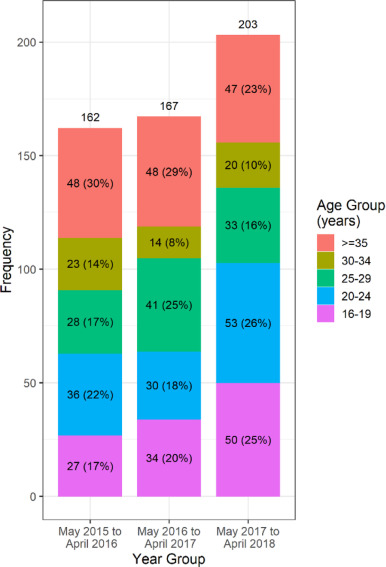
In keeping with the national upward trend, there has been an increase in incidence of knife-related admissions in our Birmingham MTC over the last three years, particularly in male patients aged less than 25 years [

1

Statistics OoN
Police force area tables, crime in England & Wales, year ending March 2019.

]. TARN captured less than 50% of all patients admitted with knife injuries resulting from interpersonal violence. Knife injuries amongst women most commonly occurred within a domestic setting (65%), highlighting the problem of intimate partner violence. Injuries were attributable to machete use in 13·9% of patients. Our study also demonstrates a significant degree of violence recidivism, with nearly one in 5 patients presenting to our centre previously or subsequently with violence-related injuries during the observed period.

The significant degree of violence recidivism (18·5%) has not been reported in previous UK-based studies. A US-based study undertaken in an urban trauma centre demonstrated that 15·7% of those presenting with penetrating trauma were recidivists [

22

Knife-related injuries treated in united states emergency departments, 1990-2008.

]. The true degree of recidivism may be higher than that demonstrated in our single-centre study. This finding of significant violence recidivism highlights an opportunity for secondary prevention and identifies the secondary care setting for delivery. The government-endorsed youth violence charity, RedThread has partnered with six NHS Hospital Trusts, most recently our own [

23

Redthread Youth Limited rc
RedThread: What we do.

]. Following referral by a doctor or nurse, a RedThread youth worker builds rapport with the young victim of violence during their vulnerable period in the ED, at which point they may be receptive to engagement [

23

Redthread Youth Limited rc
RedThread: What we do.

]. This is followed by efforts to enhance social factors that are deemed protective against violence, such as identifying avenues into education and employment, as well as signposting services such as housing and substance abuse programmes. Multi-agency collaboration between healthcare, local government and law enforcement has proved effective in Cardiff, Wales, where evidence has shown that the routine sharing of anonymised ED patient data with law enforcement to inform policing strategies has been associated with reductions in violent crime [

24

  • Boyle A.
  • Snelling K.
  • White L.
  • Ariel B.
  • Ashelford L.
External validation of the Cardiff model of information sharing to reduce community violence: natural experiment.

,

25

  • Florence C.
  • Shepherd J.
  • Brennan I.
  • Simon T
Effectiveness of anonymised information sharing and use in health service, police, and local government partnership for preventing violence related injury: experimental study and time series analysis.

]. The community-focussed Cure Violence initiative has demonstrated similar results across several US cities [

26

Cure violence: who we are.

]. As a minimum requirement, the General Medical Council specifies that clinicians have a statutory duty to report all knife injuries to the police [

27

Confidentiality: reporting gunshot and knife wounds.

]. Further research is required to determine whether the newly proposed Knife Crime Prevention Orders, issued by law enforcement alongside criminal conviction, are effective in reducing knife injuries [

18

Knife crime prevention orders guidance.

].

Our study demonstrates that 13·9% of patients were injured using a machete; conferring a heavy burden on limb reconstructive services. The association between machete use and limb injuries, particularly the upper limbs, has been demonstrated internationally [

28

  • Omoke N.I.
  • Madubueze C.C.
Machete injuries as seen in a Nigerian teaching hospital.

]. Weapon description was unrecorded in 36·3% of patients and these patients were found to have a higher Injury Severity Score than those in whom precise causative weapon was recorded. Possible explanations for this finding are that patients with more severe injuries were less able to provide a detailed history of events, or that clinicians did not pursue or record weapon details when dealing with more severely injured patients. Whilst folding blades of three inches or less are currently legal to possess, they accounted for 40% of head and neck injuries in the study population, imposing major additional demands on healthcare resources; further studies to measure their involvement in violent crime in other regions are required and a review of their legal status is recommended. In August 2019, the Offensive Weapons Act 2019 specifically recognises the doubled-edged “zombie” and “cyclone” knives as offensive weapons, however no mention is made of machetes, which may be easily distinguished by their size [

17

Acts UPG
Offensive weapons act 2019.

,

18

Knife crime prevention orders guidance.

]. The authors recommend that law enforcement agencies develop strategies to limit the availability of machetes and to view the possession of machetes in the UK as a serious crime, as it is likely that these have been purposefully acquired for use as weapons.

Female patients were injured in a domestic setting in 65% of cases [

1

Statistics OoN
Police force area tables, crime in England & Wales, year ending March 2019.

,

29

  • Jacovides C.L.
  • Bruns B.
  • Holena D.N.
  • et al.
Penetrating trauma in urban women: patterns of injury and violence.

]. Of particular concern was the relatively high proportion of pregnant women sustaining stab wounds. Clinicians caring for female patients with knife injuries should routinely enquire about the identity of the perpetrator, particularly in those who present during pregnancy, and ensure that the necessary referral to law enforcement agencies and domestic abuse services is offered.

The UK national registry (TARN) captured only 42% of patients in our cohort, underestimating the true burden of knife injuries. TARN does not routinely include patients admitted for less than 72 h, hence it will systematically exclude those patients with isolated limb injuries (median LOS 2 days, IQR 1·3–3·8 days), as well as some patients with thoracic trauma (median LOS 3 days, IQR 2·6–5·0 days), two-thirds of whom are managed non-operatively. Notably, TARN also does not record deaths occurring pre-hospital or those patients who attend ED without requiring admission [

14

  • Pallett J.R.
  • Sutherland E.
  • Glucksman E.
  • Tunnicliff M.
  • Keep J.W
A cross-sectional study of knife injuries at a London major trauma centre.

]. In order to objectively report prevalence and trends in violent injuries and, crucially, to measure the impact of any preventative strategies, the development of a regional or national registry including all knife injuries is urgently warranted.

In-hospital mortality in our cohort was relatively low at 1·9%; this is comparable to mortality of 1.08% to 2% recently reported at London MTCs [

9

  • Vulliamy P.
  • Faulkner M.
  • Kirkwood G.
  • et al.
Temporal and geographic patterns of stab injuries in young people: a retrospective cohort study from a UK major trauma centre.

,

14

  • Pallett J.R.
  • Sutherland E.
  • Glucksman E.
  • Tunnicliff M.
  • Keep J.W
A cross-sectional study of knife injuries at a London major trauma centre.

]. Multiple specialists are often involved in the care of knife-injured patients, with favourable in-hospital mortality figures suggesting that care is well co-ordinated in the context of our regional major trauma network. The majority of deaths in our cohort were attributable to penetrating chest injuries, consistent with previous studies [

6

  • Christensen M.C.
  • Nielsen T.G.
  • Ridley S.
  • Lecky F.E.
  • Morris S
Outcomes and costs of penetrating trauma injury in England and Wales.

,

9

  • Vulliamy P.
  • Faulkner M.
  • Kirkwood G.
  • et al.
Temporal and geographic patterns of stab injuries in young people: a retrospective cohort study from a UK major trauma centre.

]. Thoracic trauma is common, occurring in 18% of patients, and often severe. For policy makers, this finding should provide impetus for co-locating cardiothoracic surgical services within MTCs. Whilst our in-hospital mortality is low, homicide data suggest that there have been almost four times the number of knife-related deaths within our region during our study period [

1

Statistics OoN
Police force area tables, crime in England & Wales, year ending March 2019.

]. Further research is needed to determine the current injury pattern in those who die before reaching hospital, in order to elucidate the means by which these deaths may be prevented.

Temporal patterns in admission after trauma of all aetiologies have been well established internationally. As observed by others, in addition to noting a diurnal variation with most admissions occurring ‘after hours,’ we have seen a peak in incidence between May and July in Birmingham, associated with relatively warm weather and holiday periods [

14

  • Pallett J.R.
  • Sutherland E.
  • Glucksman E.
  • Tunnicliff M.
  • Keep J.W
A cross-sectional study of knife injuries at a London major trauma centre.

,

30

What is the effect of the weather on trauma workload? A systematic review of the literature.

]. These findings reinforce the need for senior ED clinicians and surgeons to be readily available out of hours and during the summer months to tend to these patients, who have a high likelihood of requiring operative intervention (65%), as demonstrated in this study.

The prevalence of a formal mental health diagnosis in our cohort did not exceed that seen in the general population but may represent under reporting bias; however, alcohol and drug intoxication was common[

31

Getting drunk safely? Night-life policy in the UK and its public health consequences.

]. Intoxication with heroin was recorded in 4·7% of patients and cocaine in 1·7%. Whilst overall drug use appeared relatively unchanged during the period in which knife-related crime has increased, it is thought that changes in the drugs market, such as extension of heroin and cocaine distribution outside of urban areas into ‘county lines’ by drug-dealing gangs, have contributed to the increase in serious violence [,

32

The Home Office HG
Serious violence strategy.

]. Knowledge of drug and alcohol intoxication is clinically relevant as this may impact upon patients’ neurological status and physiology, as well as their ability to give consent, with implications for anaesthesia/analgesia and the need for detoxification.

The median estimated cost of the index admission in our cohort was £4375 (IQR 2574–8490). This is lower than that reported by Christensen et al. (£7983), whose TARN-based study was focussed on more severely injured patients and also included cost of prehospital care [

6

  • Christensen M.C.
  • Nielsen T.G.
  • Ridley S.
  • Lecky F.E.
  • Morris S
Outcomes and costs of penetrating trauma injury in England and Wales.

]. Challenges in the way that data are collected, both within healthcare and externally, make identification of the true direct and indirect costs associated with knife injuries difficult.

The main strength and novelty of this study is that it provides a comprehensive characterisation of the knife-injured patient and their injuries from a multi-agency perspective, extending beyond the usual remit of secondary care. The detailed consideration of risk factors for violence exceeds that afforded through other UK secondary-care based studies, several of which were based on trauma registry data [

6

  • Christensen M.C.
  • Nielsen T.G.
  • Ridley S.
  • Lecky F.E.
  • Morris S
Outcomes and costs of penetrating trauma injury in England and Wales.

,

9

  • Vulliamy P.
  • Faulkner M.
  • Kirkwood G.
  • et al.
Temporal and geographic patterns of stab injuries in young people: a retrospective cohort study from a UK major trauma centre.

,

14

  • Pallett J.R.
  • Sutherland E.
  • Glucksman E.
  • Tunnicliff M.
  • Keep J.W
A cross-sectional study of knife injuries at a London major trauma centre.

]. This study represents the more severe end of the knife injury spectrum by virtue of its major trauma centre setting. The findings may be more generalizable to urban centres in the Midlands and North of England as compared with previous London-based studies, as these cities share demographic similarities and have all experienced a sudden increase in knife crime in the last 5 years [

1

Statistics OoN
Police force area tables, crime in England & Wales, year ending March 2019.

]. An inherent weakness of this study include its retrospective nature and that the study was based in an adult MTC. With growing public concern regarding the involvement of minors in knife-related incidences, as highlighted in the media and national hospital admission reports, future studies should include specialist children’s hospitals [,

5

Digital HESN
Hospital admitted patient care activity; 2017-18.

,].

Knife-related injuries consume a large amount of secondary care resources, constituting 12·9% of the trauma team workload at our MTC. A thorough understanding of patient and injury characteristics will be beneficial in future resource planning. Our study has illustrated that knife injuries predominantly affect young men under the age of 25 years and that the overall increase in incidence is accounted for by this demographic. Reliance on the national major trauma database significantly under-represents the true burden of knife injuries. Our novel findings of a significant degree of violence recidivism and machete use have several potential implications for targeted violence-reduction and law enforcement strategies. An important minority of knife-injured patients are women injured by intimate partners. There is an urgent requirement to generate a national collaborative database to inform multi-agency strategies in the prevention and treatment of violent penetrating injury. Healthcare must continue to play an important role as part of a multi-agency approach to better understand and address the important public health issue of knife crime.

 4.1. Transparency statement

NM guarantees that the manuscript is an honest, accurate, and transparent account of the study being reported. No important aspects of the study have been omitted.


Related Posts

How Machine Learning has impacted Consumer Behaviour and Analysis
Consumer Research

How Machine Learning has impacted Consumer Behaviour and Analysis

January 4, 2024
Market Research The Ultimate Weapon for Business Success
Consumer Research

Market Research: The Ultimate Weapon for Business Success

June 22, 2023
Unveiling the Hidden Power of Market Research A Game Changer
Consumer Research

Unveiling the Hidden Power of Market Research: A Game Changer

June 2, 2023
7 Secrets of Market Research Gurus That Will Blow Your Mind
Consumer Research

7 Secrets of Market Research Gurus That Will Blow Your Mind

May 8, 2023
The Shocking Truth About Market Research Revealed!
Consumer Research

The Shocking Truth About Market Research: Revealed!

April 25, 2023
market research, primary research, secondary research, market research trends, market research news,
Consumer Research

Quantitative vs. Qualitative Research. How to choose the Right Research Method for Your Business Needs

March 14, 2023
Next Post
Manufacturing Bits: March 3 – SemiEngineering

Manufacturing Bits: March 3 - SemiEngineering

Categories

  • Consumer Research
  • Data Analysis
  • Data Collection
  • Industry Research
  • Latest News
  • Market Insights
  • Marketing Research
  • Survey Research
  • Uncategorized

Recent Posts

  • Ipsos Revolutionizes the Global Market Research Landscape
  • How Machine Learning has impacted Consumer Behaviour and Analysis
  • Market Research: The Ultimate Weapon for Business Success
  • Privacy Policy
  • Terms of Use
  • Antispam
  • DMCA

Copyright © 2024 Globalresearchsyndicate.com

Welcome Back!

Login to your account below

Forgotten Password?

Retrieve your password

Please enter your username or email address to reset your password.

Log In
This website uses cookies to improve your experience. We'll assume you're ok with this, but you can opt-out if you wish. Cookie settingsACCEPT
Privacy & Cookies Policy

Privacy Overview

This website uses cookies to improve your experience while you navigate through the website. Out of these cookies, the cookies that are categorized as necessary are stored on your browser as they are essential for the working of basic functionalities of the website. We also use third-party cookies that help us analyze and understand how you use this website. These cookies will be stored in your browser only with your consent. You also have the option to opt-out of these cookies. But opting out of some of these cookies may have an effect on your browsing experience.
Necessary
Always Enabled
Necessary cookies are absolutely essential for the website to function properly. This category only includes cookies that ensures basic functionalities and security features of the website. These cookies do not store any personal information.
Non-necessary
Any cookies that may not be particularly necessary for the website to function and is used specifically to collect user personal data via analytics, ads, other embedded contents are termed as non-necessary cookies. It is mandatory to procure user consent prior to running these cookies on your website.
SAVE & ACCEPT
No Result
View All Result
  • Latest News
  • Consumer Research
  • Survey Research
  • Marketing Research
  • Industry Research
  • Data Collection
  • More
    • Data Analysis
    • Market Insights

Copyright © 2024 Globalresearchsyndicate.com



