
GLOBAL RESEARCH SYNDICATE
No Result
View All Result
  • Login
  • Latest News
  • Consumer Research
  • Survey Research
  • Marketing Research
  • Industry Research
  • Data Collection
  • More
    • Data Analysis
    • Market Insights
  • Latest News
  • Consumer Research
  • Survey Research
  • Marketing Research
  • Industry Research
  • Data Collection
  • More
    • Data Analysis
    • Market Insights
No Result
View All Result
globalresearchsyndicate
No Result
View All Result
Home Data Collection

Astronomers spot hundreds of baby stars and planet-forming disks

globalresearchsyndicate by globalresearchsyndicate
March 1, 2020
in Data Collection
0
Astronomers spot hundreds of baby stars and planet-forming disks
0
SHARES
8
VIEWS
Share on FacebookShare on Twitter

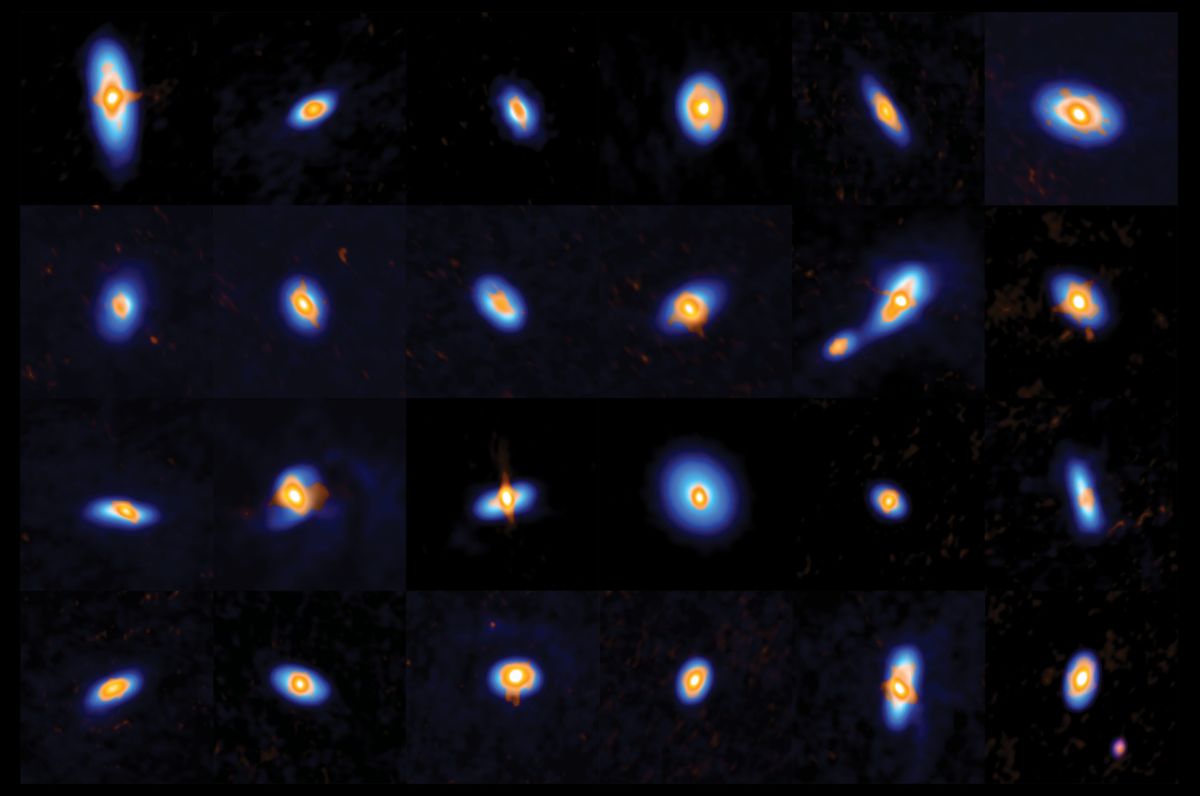
Astronomers have imaged more than 300 newborn stars, revealing new clues about the early stages of star formation and the birth of planets. 

In the new research, astronomers using the Karl G. Jansky Very Large Array (VLA) and the Atacama Large Millimeter/submillimeter Array (ALMA) studied hundreds of young stars surrounded by rings of dust and gas. These stellar infants lie in a dense star-forming region known as the Orion Molecular Cloud Complex. 

The ring of dust and gas surrounding a young star, also known as a protoplanetary disk, supports the birth of new planets. Using the VLA and ALMA telescopes, the astronomers could peer through the dense clouds of dust and gas in the Orion Complex to see the protoplanetary disks forming around the infant stars, according to a statement from the National Radio Astronomy Observatory (NRAO). 

Related: Gallery: The strangest alien planets

“This survey revealed the average mass and size of these very young protoplanetary disks,” John Tobin, who led the survey team from the NRAO, said in the statement. “We can now compare them to older disks that have been studied intensively with ALMA as well.” 

The survey, called the VLA/ALMA Nascent Disk and Multiplicity (VANDAM), is the largest study of planet-forming disks around infant stars to date. Using this data, researchers identified young stars and their disks in various stages of formation. 

Young stars, also known as protostars, form in dense clouds of gas and dust like the Orion Complex. When such a cloud collapses due to gravity, it forms a disk of material that continues to fuel the growth of a new star. 

In turn, planets form from the leftover material in the disk surrounding the newborn star. The new images show that young protoplanetary disks tend to be more massive than older disks, because stars consume more material from their disk as they grow. 

“This means that younger disks have a lot more raw material from which planets could form,” Tobin said in the statement. “Possibly, bigger planets already start to form around very young stars.” 

Newly imaged protostars matched to their location in the Orion Molecular Clouds.

Newly imaged protostars matched to their location in the Orion Molecular Clouds.  (Image credit: ALMA (ESO/NAOJ/NRAO), J. Tobin; NRAO/AUI/NSF, S. Dagnello; Herschel/ESA)

Four of the young stars captured in the survey stood out from the rest, as they appeared to be “irregular or blobby,” the researchers said. The strange shapes suggest that the stars are still in the very early stages of forming, because they do not yet have the flattened, rotating disk surrounding them or the strong outflow of material that are both characteristic of a protostar, the statement said. 

“We rarely find more than one such irregular object in one observation,” Nicole Karnath, one of the survey team members from the Stratospheric Observatory for Infrared Astronomy (SOFIA) Science Center, said in the statement. “We are not entirely sure how old they are, but they are probably younger than 10,000 years.” 

For an infant star, developing an outflow not only clears the surrounding dense cloud of material that would otherwise obscure it from view, but also prevents the star from spinning out of control as it grows. 

However, little is known about how these outflows form. One of the four “irregular” stars surveyed, called HOPS 404, has one of the smallest outflows ever seen, shedding light on the earliest stages of star formation. 

“It is a big, puffy sun that is still gathering a lot of mass but just started its outflow to lose angular momentum to be able to keep growing,” Karnath said in the statement.

The findings contributed to two studies published Feb. 20 in The Astrophysical Journal.

Follow Samantha Mathewson @Sam_Ashley13. Follow us on Twitter @Spacedotcom and on Facebook.  

Related Posts

How Machine Learning has impacted Consumer Behaviour and Analysis
Consumer Research

How Machine Learning has impacted Consumer Behaviour and Analysis

January 4, 2024
Market Research The Ultimate Weapon for Business Success
Consumer Research

Market Research: The Ultimate Weapon for Business Success

June 22, 2023
Unveiling the Hidden Power of Market Research A Game Changer
Consumer Research

Unveiling the Hidden Power of Market Research: A Game Changer

June 2, 2023
7 Secrets of Market Research Gurus That Will Blow Your Mind
Consumer Research

7 Secrets of Market Research Gurus That Will Blow Your Mind

May 8, 2023
The Shocking Truth About Market Research Revealed!
Consumer Research

The Shocking Truth About Market Research: Revealed!

April 25, 2023
market research, primary research, secondary research, market research trends, market research news,
Consumer Research

Quantitative vs. Qualitative Research. How to choose the Right Research Method for Your Business Needs

March 14, 2023
Next Post
Humin Market – Key Players, Applications, Outlook, SWOT Analysis and Forecast to 2038 – Instant Tech Market News

Anti-Riot Equipment Market – Survey on Consumption Benefits 2025 – Nyse News Times

Categories

  • Consumer Research
  • Data Analysis
  • Data Collection
  • Industry Research
  • Latest News
  • Market Insights
  • Marketing Research
  • Survey Research
  • Uncategorized

Recent Posts

  • Ipsos Revolutionizes the Global Market Research Landscape
  • How Machine Learning has impacted Consumer Behaviour and Analysis
  • Market Research: The Ultimate Weapon for Business Success
  • Privacy Policy
  • Terms of Use
  • Antispam
  • DMCA

Copyright © 2024 Globalresearchsyndicate.com

Welcome Back!

Login to your account below

Forgotten Password?

Retrieve your password

Please enter your username or email address to reset your password.

Log In
This website uses cookies to improve your experience. We'll assume you're ok with this, but you can opt-out if you wish. Cookie settingsACCEPT
Privacy & Cookies Policy

Privacy Overview

This website uses cookies to improve your experience while you navigate through the website. Out of these cookies, the cookies that are categorized as necessary are stored on your browser as they are essential for the working of basic functionalities of the website. We also use third-party cookies that help us analyze and understand how you use this website. These cookies will be stored in your browser only with your consent. You also have the option to opt-out of these cookies. But opting out of some of these cookies may have an effect on your browsing experience.
Necessary
Always Enabled
Necessary cookies are absolutely essential for the website to function properly. This category only includes cookies that ensures basic functionalities and security features of the website. These cookies do not store any personal information.
Non-necessary
Any cookies that may not be particularly necessary for the website to function and is used specifically to collect user personal data via analytics, ads, other embedded contents are termed as non-necessary cookies. It is mandatory to procure user consent prior to running these cookies on your website.
SAVE & ACCEPT
No Result
View All Result
  • Latest News
  • Consumer Research
  • Survey Research
  • Marketing Research
  • Industry Research
  • Data Collection
  • More
    • Data Analysis
    • Market Insights

Copyright © 2024 Globalresearchsyndicate.com




