

READ THE FULL ATE.V RESEARCH REPORT
Business Update
Phase 2b Study Fully Enrolled
Antibe Therapeutics Inc. (TSX:ATE.V) is currently conducting a Phase 2b dose-ranging, efficacy study of ATB-346 that was initiated in March 2019. It is a randomized, double blind, placebo controlled trial in approximately 360 patients suffering from osteoarthritis (OA) of the knee. Study subjects will receive once daily doses of placebo or ATB-346 (150 mg, 200 mg, or 250 mg) over a 14-day treatment period. The company increased the number of subjects to 360 (from the original target of 200 patients) in order to power both the 200 mg and 250 mg cohorts for statistical significance. This will also provide a more thorough dataset on the efficacy of ATB-346, which should help facilitate partnering discussions. On February 28, 2020, the company announced that the trial was fully enrolled. We anticipate topline results within the next six weeks.
The company is scheduled to conduct a Pre-IND meeting with the FDA within the next month. This meeting is designed to inform the IND filing that will allow for commencement of Phase 3 testing in the U.S. and will also strengthen Antibe’s position in partnering negotiations.
ATB-346
ATB-346 uses the non-steroidal anti-inflammatory drug (NSAID) naproxen as a base molecule with a hydrogen sulfide releasing moiety covalently attached. Hydrogen sulfide (H2S) has been identified as an important gasotransmitter, a gas that serves as an important signaling molecule in the body. Other examples of gasotransmitters are nitric oxide (NO) and carbon monoxide (CO).
Antibe is developing ATB-346 as a solution to the dose-related gastrointestinal (GI) side effects associated with NSAIDs. These effects are a result of the inhibition of the COX-1 enzyme, which is responsible for the normal gastro-protective processes (Roth, 1988). In addition, many NSAIDs are acidic molecules, resulting in irritation to the gastric mucosa. Dyspepsia, abdominal pain, and nausea are all common side effects of oral NSAIDs (Makris et al., 2010). While these adverse events are manageable, more serious events are known to occur with oral NSAID use including upper GI bleeding, ulcers, and death (Hernández-Díaz et al., 2000). According to The Arthritis, Rheumatism, and Aging Medical Information System, more than 100,000 Americans are hospitalized each year and more than 16,000 die from ulcers and GI bleeding linked to NSAID use.
With the discovery of COX-2, research and development efforts were directed at discovering compounds that inhibited COX-2 selectively in order to overcome the GI side effects. While COX-1 is constitutively expressed throughout the body, COX-2 is typically only expressed in inflammation, with the inhibition of COX-2 resulting in the desired clinical response of NSAIDs.
Selective COX-2 inhibitors, such as rofecoxib (Vioxx®), celecoxib (Celebrex®), and valdecoxib (Bextra®), were initially very popular with both physicians and patients for their ability to relieve pain with a significantly decreased risk of adverse GI events. For example, Vioxx achieved over $1 billion in sales in its first year on the market. However, some clinical trials of the COX-2 inhibitors showed that treatment led to an increased risk of adverse cardiovascular (CV) events (Antman et al., 2007; Kearney et al., 2006). These results led Merck to voluntarily recall Vioxx® in 2004, with Bextra® withdrawn from the market in 2005. In addition, the FDA required a black box warning on the label for Celebrex®. Follow-up studies have shown celecoxib has similar CV risk as non-selective NSAIDs (Nissen et al., 2016), however an analysis of several Phase 4 studies has shown that it’s a relatively low-dose of celecoxib administered to low-risk patients that may carry the same CV risk of conventional NSAIDs, but with less effective control of arthritic pain (Antman et al., 2017).
While on the one hand non-selective NSAIDs are great at offering pain relief, they are accompanied by the threat of serious GI problems, including the development of intestinal damage and bleeding ulcers. Selective NSAIDs can be effective at mitigating pain and they cause significantly fewer GI effects, but they come with an increased risk of CV events at therapeutic doses. Thus, what is needed is an effective NSAID that does not increase a patient’s risk of serious GI or CV events.
Phase 2b GI Safety Results
In April 2019, Antibe announced the publication of results from the Phase 2b GI safety study in the British Journal of Pharmacology (Wallace et al., 2019). The company had previously announced positive topline results from the study showing that 42.1% of naproxen-dosed subjects had GI ulceration compared to only 2.5% of subjects administered ATB-346 following two weeks of dosing in a total of 244 subjects.
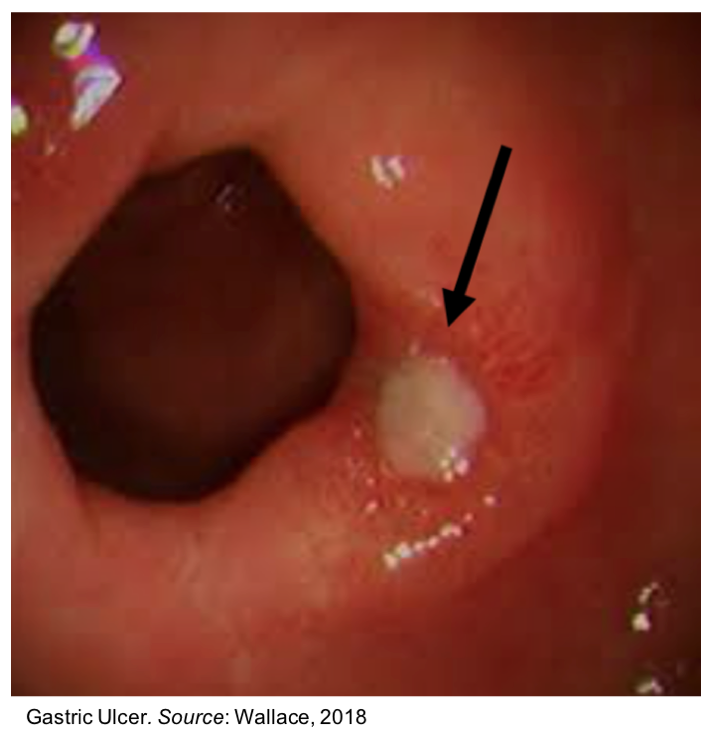
The Phase 2b study was designed to show superiority of ATB-346 in GI safety compared to naproxen through the quantitation of endoscopically observed gastric and duodenal ulcers that were ≥ 3 mm. The following figure shows what a gastric ulcer looks like.

The primary endpoint of the study was achieved, as 53/126 (42.1%) naproxen-treated subjects had at least one ulcer ≥ 3 mm compared to only 3/118 (2.5%) ATB-346-treated subjects (P<0.0001). In addition, the following figures show that the total number of participants with ulcers, the total number of ulcers, and the number of large ulcers were all much higher in the naproxen-treated subjects compared to those administered ATB-346.

In addition to significantly decreasing the number of GI ulcers, subjects administered ATB-346 also showed lower rates of GI symptoms such as abdominal pain, gastro-esophageal reflux, and nausea.

While the incidence of GI ulcers is a very important outcome, it would not mean much if ATB-346 was not as effective as naproxen. While a full efficacy study is currently ongoing, data collected in this study showed that the level of COX activity (as measured by thromboxane, a substance produced mainly via the COX enzyme) was reduced similarly by both ATB-346 and naproxen (>94%), as shown in the following figure on the left. Interestingly, the similar level of COX inhibition was achieved with a much lower level of naproxen in the plasma, as shown in the following figure on the right.

From a safety standpoint, there were very few non-GI differences between ATB-346 and naproxen. There was no effect of ATB-346 on blood pressure, a similar low incidence between the two groups in regards to headache and dizziness, and some mild transient elevations of liver transaminases (ALT/AST) that were not clinically important. Specifically, in regards to ALT/AST, non-clinically significant transient elevations were seen in up to 7% of subjects in both treatment groups. Data from all clinical trials conducted with 250 mg ATB-346 once daily show a 4.7% overall incidence of clinically significant, transient elevation in ATL/AST, which is quite similar to the 4% rate seen in those prescribed the NSAID naproxen (NIH).
Publication on ATB-352 Shows Enhanced Pain Relief with Increased Safety Over Ketoprofen
On February 24, 2020, Antibe announced a publication entitled “Enhanced Analgesic Effects and GI Safety of a Novel Hydrogen Sulfide-Releasing Anti-Inflammatory Drug (ATB-352): A Role for Endogenous Cannabinoids” that was published in the peer-reviewed journal Antioxidant and Redox Signaling. ATB-352 is a hydrogen-sulfide releasing derivative of ketoprofen, which is a very potent NSAID typically prescribed for severe pain and which prior studies show is more effective at pain management than ibuprofen or diclofenac (Sarzi-Puttini et al., 2013).
Pain management is becoming an increasingly important area of research due to the country’s ongoing opioid crisis. Opioids, such as oxycontin, are typically prescribed for pain, however they have a very high propensity for abuse due to being highly addictive. Thus, an effective, non-addictive therapy for pain management is clearly needed.
The recently published article on ATB-352 showed that the drug provided much greater pain relief (>3-fold) than ketoprofen in an animal model of surgical pain. However, even though it was more potent, ATB-352 was much better tolerated in the GI tract than ketoprofen. ATB-352 did not induce GI damage, even at high doses, while mice treated with ketoprofen experienced dose-dependent increases in the severity of bleeding ulcers in the stomach and intestines.
In addition to showing that ATB-352 had superior pain management qualities, the research team also showed that ATB-352 significantly elevated naturally occurring endocannabinoids in addition to blocking the production of prostaglandins. The increase in endocannabinoid production could explain why ATB-352 showed superior pain relief compared to ketoprofen.
Antibe will be developing an aqueous formulation of ATB-352 to be utilized for post-operative pain through intravenous administration in the hospital along with a tablet formulation that can then be utilized by patients once they have been discharged from the hospital. The company has initiated IND-enabling preclinical studies and will commence animal toxicology studies in the second quarter of 2020.
Financial Update
On February 25, 2020, Antibe announced financial results for the third quarter of fiscal year 2020 that ended Dec. 31, 2019. The company reported revenues of CAD$2.6 million compared to CAD$2.5 million for the third quarter of fiscal year 2019. The increase was driven by increased Citagenix sales in the U.S.
General and administrative, selling and marketing, research and development, stock-based compensation, and amortization and depreciation expenses totaled CAD$5.1 million for the third quarter of fiscal year 2020 compared to CAD$4.2 million for the third quarter of fiscal year 2019. The increase was primarily due to the following:
• G&A expenses increased by CAD$0.5 million to CAD$1.6 million primarily due to higher professional expenses partially offset by lower salaries and office costs.
• Selling and marketing expenses increased slightly to CAD$1.0 million primarily due to increased salaries, commissions, travel, and entertainment costs.
• R&D expenses increased CAD$0.6 million to CAD$1.6 million primarily due to higher development costs and consulting fees for ATB-346.
• Stock-based compensation decreased CAD$0.3 million primarily due to expensing of previously granted restricted stock units.
• Amortization and depreciation increased slightly to CAD$0.14 million.
As of December 31, 2019, Antibe had approximately CAD$6.6 million in cash and cash equivalents and subsequent to the end of the quarter the company raised approximately CAD$2.6 million from the exercising of approximately 9.3 million warrants. In addition, the company has approximately 31 million warrants outstanding that could raise an additional approximately CAD$9.0 million.
We estimate that the company currently has approximately 290.5 million shares outstanding and when factoring in options, RSUs, and warrants a fully diluted share count of approximately 361.4 million.
Valuation
We are anxiously awaiting the results of the Phase 2b efficacy study for ATB-346, which we anticipate will be announced within the next six weeks. We model for approval of ATB-346 in OA followed by approval for multiple indications similar to celecoxib. ATB-346 has blockbuster potential and we believe sales in excess of $1 billion are possible in both the U.S. and E.U. with the data from the Phase 2 study lending support to that thesis. In addition, the potential for sales in excess of $1 billion is supported by the fact that Celebrex® (celecoxib) had peak sales of $2.9 billion even with a ‘black box’ warning regarding an increased risk of cardiovascular events with long-term use. We are confident that Antibe will be able to enter into a partnership with a global pharmaceutical company (most likely following completion of the efficacy trial) and we currently model for a 12% royalty with associated milestone payments.
Our valuation has increased slightly to CAD$1.75 due to advancing our DCF model forward a year, and while the stock has had a nice run over the past couple of months we believe there remains the potential for considerable upside, particularly with data from the dose-ranging efficacy study due soon.
SUBSCRIBE TO ZACKS SMALL CAP RESEARCH to receive our articles and reports emailed directly to you each morning. Please visit our website for additional information on Zacks SCR.
DISCLOSURE: Zacks SCR has received compensation from the issuer directly, from an investment manager, or from an investor relations consulting firm, engaged by the issuer, for providing research coverage for a period of no less than one year. Research articles, as seen here, are part of the service Zacks provides and Zacks receives quarterly payments totaling a maximum fee of $30,000 annually for these services. Full Disclaimer HERE.







