

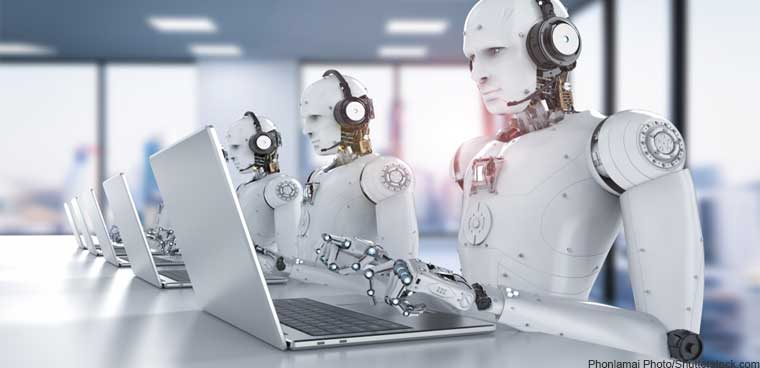

Don’t fear a ‘robot apocalypse’ — tomorrow’s digital jobs will be more satisfying and higher-paid
 If you’re concerned that automation and artificial intelligence are going to disrupt the economy over the next decade, join the club. But while policymakers and academics agree there’ll be significant disruption, they differ about its impact.
On one hand, techno-pessimists like Martin Ford in “Rise of the Robots” argue that new forms of automation will displace most jobs without creating new ones. In other words, most of us will lose our jobs.
On the flip side of the debate are techno-optimists such as Erik Brynjolfsson and Andy McAfee. In “The Second Machine Age,” they contend that continued investments in education and research and development will offset the job losses and generate many new human tasks that complement AI.
While I can’t predict who will turn out to be right, I do have some good news based on my own research and the work of others: Tomorrow’s digital jobs will likely pay better and be more satisfying than today’s. And, as Brynjolfsson and McAfee noted, education holds the key to ensuring there are enough to go around.
Bigger paychecks
Researchers have been studying jobs that involve digital skills for years to try to understand their value. But what does it really mean for a job or skill to be “digital”?
In earlier research, all it meant was that a worker used a computer. Since nearly all workers use a PC today, we need a more refined definition of digital skills that takes into account how much a job depends on doing things like programming, crunching data in Excel spreadsheets and even using a smartphone.
In research conducted with economist Giovanni Gallipoli at the University of British Columbia, we created a new way to measure digital or information technology skills in the labor market based on how frequently they’re used in an occupation. For example, how much time does a financial adviser spend analyzing data or an event planner use a computer?
We found that workers in occupations that rank higher in IT intensity earn more than demographically similar peers in other occupations – and that this earnings gap has been growing.
Not only that, but we also found something interesting on the impact of a college degree on the lifetime earnings of different occupations. Historically, workers with a college degree have earned a lot more than peers without one. Recent research has shown that this so-called college premium has been flattening.
The main cause, according to our analysis, is that the college premium for occupations requiring fewer digital skills has been declining, while it has been rising for those we identified as digital jobs such as software developers, programmers and aerospace engineering. At least some of the flattening in the college premium is due to the increasing number of bachelor’s degrees that convey few skills that are valued in the marketplace.
Higher quality
Higher pay is one thing. What about job quality?
Fortunately, a recently released survey from Gallup provides some answers.
The survey, which came out in October, compares measures of job quality — such as a sense of purpose, enjoyability and career advancement — with income, occupations and a range of demographic characteristics. I then connected the survey results with my IT intensity data.
I found that jobs that require greater interaction with technology tended to score higher in quality, particularly in terms of measures like career advancement.
The role of education
The fact that these jobs not only pay more but also provide greater levels of employee satisfaction and engagement paints a more optimistic picture about the future of work. And that gives me hope, particularly since the digital economy is growing at a pace nearly four times faster than the broader economy.
The key is making tomorrow’s jobs “robot-proof” by designing them in a way that takes advantage of the digital skills described above. And universities must play a big role in this by identifying what a good job looks like and ensuring future generations learn the necessary skills.
But I believe higher education needs a different approach to teaching skills than the one that supported the jobs of the 20th century. Some are already innovating, such as Arizona State University, Purdue and Georgia State, by leveraging technology in new ways to accelerate the learning process for their students.
I believe this is how we not only survive the “robot apocalypse” but thrive as well.
This article was first posted on The Conversation.







