

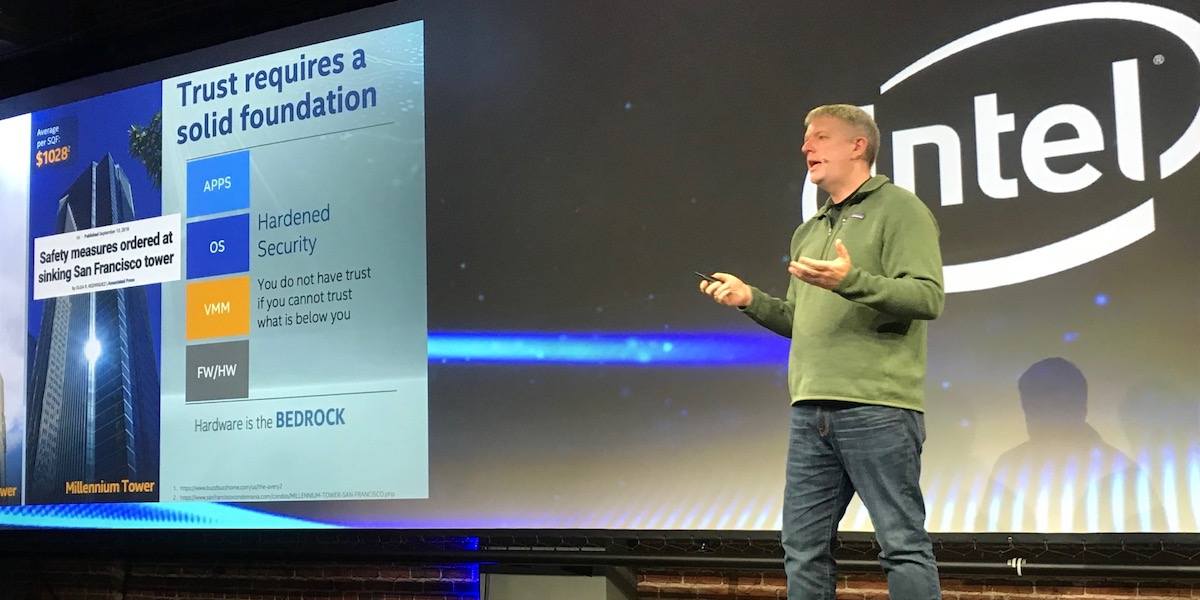

SAN FRANCISCO — Intel provided new details about its security stack at an event on the outskirts of this week’s RSA Conference. And, not surprisingly, the chipmaker’s security strategy is rooted in its silicon.
“When it comes to building an overall security stack, hardware and the firmware that runs on that hardware is bedrock,” said Tom Garrison, VP and GM of client security strategy and initiatives at Intel. “There’s nothing below hardware, and hardware is key. If you have trusted hardware below you, you can then build a trusted security stack.”
One of the ways Intel is working to build this trust in its hardware is through its Compute Lifecycle Assurance Initiative. The company first launched this initiative in December, and it aims to improve transparency and provide higher levels of security assurance across all Intel platforms and during the entire platform lifecycle.
Transparent Supply Chain
“Within Compute Lifecycle Assurance we have a set of tools we call Intel Transparent Supply Chain (TSC) tools,” Garrison said. These policies and procedures provide better visibility and traceability across Intel hardware and firmware components in PCs and data center servers including Intel Xeon platforms. They use the Trusted Computing Group’s (TCG) Trusted Platform Module 2.0 (TPM) standard to validate where and when these components were manufactured.
This process also helps manufacturers and customers detect tampering because they can review the platform’s inventory for suspect parts and attest to the platform’s authenticity, Garrison added. “You’ve got to start with trusted hardware and making sure you know if the hardware has been altered in any way,” he explained. “If it hasn’t, then you can trust it and start building your security stack.”
Today, Intel announced several ecosystem partners that are manufacturing Intel-based servers using Transparent Supply Chain tools. These include Hyve Solutions, Inspur, Lenovo, Mitac, Quanta, Supermicro, and ZT Systems. Intel is also working with enterprise IT and cloud services providers including Google Cloud to deploy Intel TSC.
In fact, Google VP of Security Engineering Vitaly Gudanets was supposed to join Garrison on stage to talk about Google’s experience with transparent supply chain. But he fell ill with a fever, and “given the environment and abundance of caution,” ahem, coronavirus, Gudanets stayed home.
“Google appreciates Intel’s leadership in establishing increased platform trust across the entire lifecycle of the device,” he said in a prepared quote on a screen. “Google has been collaborating with Intel to improve traceability and transparency solutions for Intel commercial notebook and desktop PCs. We appreciate the innovation of Transparent Supply Chain, and we want to guide future innovation to provide even greater levels of assurance.”
More TSC partners are in the works, Garrison said. “Our vision is much grander. Our vision is really across all phases of the compute lifecycle.”
Moving Up the Intel Security Stack
Moving up the stack, Intel is also developing new security capabilities for future data center platforms, said John Sell, Intel fellow and director of Intel security architecture and technology. These capabilities stretch from the field-programmable gate array (FPGA) layer all the way up to the application layer.
Starting at the top, Intel is going to expand its Software Guard Extensions to a broader range of mainstream data-centric platforms and provide larger protected enclaves to better isolate applications.
The company is also developing similar protections for containers and virtual machines (VMs), which will isolate them from each other, from the hypervisors, and from cloud providers without requiring application code modifications.
Full memory encryption is another soon-to-come capability that will help to better protect against physical memory attacks by providing hardware-based encryption transparent to the operating system and software layers.
And finally, Intel is developing an FPGA-based technology that helps protect the various platform firmware components by monitoring and filtering malicious traffic on the system buses. It also verifies the integrity of platform firmware images before any firmware code is executed and can recover corrupted firmware back to a known good state.







