

A California hemp-based cannabidiol (CBD) startup is selling products with what it calls intelligent labels that leverage Near Field Communication (NFC) technology to deliver information to its customers. PearlCBD, owned and operated by Origin Labs, began manufacturing and selling its goods this year, each with a unique ID number encoded on a passive NFC tag built into a label. PearlCBD sells all of its products with NFC-enabled labels so that users can verify a product’s authenticity before buying it, as well as view lab test results regarding ingredients and other content.
CBD products are sold legally in stores throughout most of the United States, though they must meet restrictions dictated in the 2018 U.S. Farm Bill. They must contain less than 0.3 percent tetrahydrocannabinol (THC), the compound that provides the narcotic effect of cannabis. Anything with a higher THC level is classified as marijuana, which is federally illegal, though legal in many states. Because CBD-based goods are still relatively new, the general public often lacks an understanding of what they are and what they consist of, says Danny Davis, PearlCBD’s CEO. They may also not understand what kind of certification is available for them to view before making a purchase, or what that certification means.

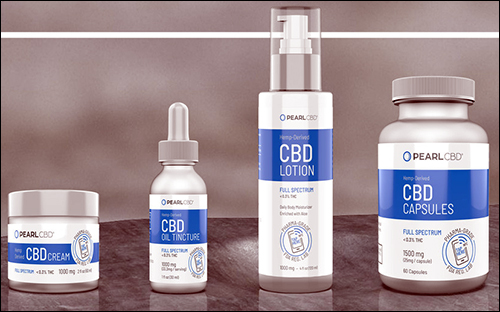
PearlCBD’s line of lotions, tinctures, creams and capsules.
Origin Labs aims to provide clarity as it sells its new merchandise. PearlCBD’s products are manufactured at the company’s FDA-registered lab in Florida. The firm recently released a series of lotions, tinctures, creams and capsules, and it provides technology to help consumers get acquainted with CBD and understand what is in each product. From the onset, the company wanted to use technology to help its customers make sense of what they were buying. There are regulations related to the sale of cannabis-based goods, Davis explains, but there is no way for consumers to easily know if a manufacturer has met those requirements when making a purchase.
Davis says he chose NFC as a means of providing consumers with proof that his company’s products are authentic, and to offer transparency “so they know what they’re putting in or on their body, with lab test results.” To that end, the NFC system is designed to educate customers. The PearlCBD line is now being sold by several major retailers, Davis says, and he expects that number to expand this year. “We believe that if we took a pharmaceutical product and gave consumers technology to understand it better,” he states, “they would then trust that product, and we can build brand loyalty.”
Many cannabis-based goods provide QR codes on their labels. Scanning a QR code with a mobile phone provides some information, Davis says, though most shoppers tend not to scan QR codes. What’s more, a QR code can be copied, meaning it cannot prove an item’s authenticity even if a code is scanned.
PearlCBD sought to provide more information that could change as necessary, including the Certificate of Analysis (COA) that includes details about the raw oil used in its product. That information can be difficult to understand, Davis says. “Most consumers don’t really know what they are looking for,” he states. For instance, some lab results are more meaningful than others. Davis estimates that 95 percent of cannabis products do not display post-formulation ingredients and testing results after they are manufactured, instead providing only the pre-formulation rating for the raw CBD oil. Thus, PearlCBD wanted to provide both pre- and post-formulation data to its customers.







