

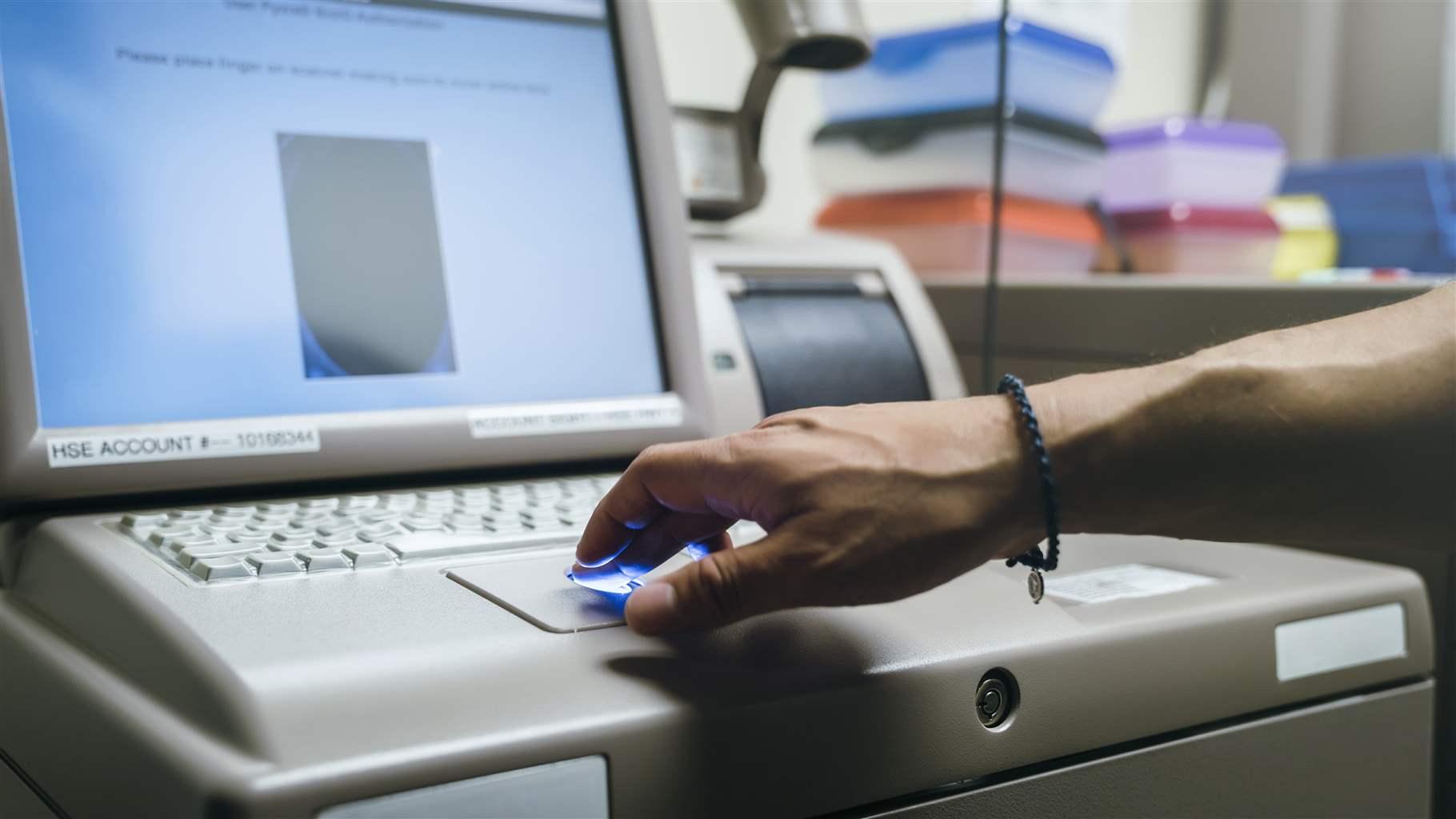
Over the past decade, the use of biometrics—analysis of individually distinguishable characteristics such as fingerprints or eye scans—as a form of identification has become more commonplace. From the ability to use facial recognition to unlock smartphones to passing through airport security with only a fingerprint scan, biometrics are already transforming the way Americans go about their daily lives.
These technologies also have the potential to greatly enhance the matching of patient records from a range of health care settings. Still, as with many new approaches, serious privacy and technical issues need to be resolved. That’s why The Pew Charitable Trusts and RTI International, a nonprofit research institute, are working to develop a roadmap for the widespread use of biometrics-enhanced patient matching.
On the privacy front, recent reporting, including an article in The New York Times about a company using facial scans to help law enforcement agencies track suspects, highlights the risks of using this technology without individuals’ awareness or consent. At the same time, the use of biometrics in health care presents considerable technical challenges—such as how to safely move and accurately compare data across health systems that rely on different companies’ scanners. Complicating these calculations is the reality that the answers to the technical and privacy questions may be at odds with one another.
These issues, however, are central to improving the interoperability of electronic health record systems, particularly when it comes to making sure that different systems can link medical records for the same patient no matter where those records are needed.
Currently, patients’ records are matched based on demographic data—such as names, addresses, or date of birth—to determine if a record from one facility refers to the same person as a record from another. If that information has been entered incorrectly—for example, if numbers in an address have been transposed—or has changed—such as with a patient taking a spouse’s name or moving—mismatches or failures to match can result. That, in turn, can lead to duplication of medical testing, as well as patients facing delays in getting the care they need or even receiving care that might not be right for them.
Research indicates that as many as half of all attempted transfers between facilities can fail, making it harder to get patients the care they need and increasing costs. Biometrics could provide an additional data point to help improve the accuracy of matches. Because this information should be close to unique when combined with demographic data, such an approach could significantly reduce the potential for mismatches.
In focus groups conducted by Pew, patients overwhelmingly cited a preference for using biometrics to improve patient matching rates. Unlike unique numbers or ID cards, a patient can’t forget or lose track of his or her fingerprints, and a facial scan doesn’t rely on a patient being responsive when wheeled into the emergency department.
Pew and RTI International are exploring how best to implement these technologies in health care settings to ensure that they work as intended—and with appropriate safeguards. This work will include conducting in-depth interviews with key stakeholders from throughout the United States and convening experts committed to building a consensus-based approach to guide responsible implementation.
The research, which will be conducted this year and in 2021, will assess questions such as:
- How can patients be assured that their biometric data will be protected and used according to their wishes?
- If two health care facilities use different scanners to capture patients’ facial scans, how can they use that information to match records?
- What support will be needed to implement the framework in facilities with limited resources—including how to best use smartphones or tablets?
The goal of this project is to establish actionable guidance on issues such as privacy, technical standards, implementation, and costs, topics that are relevant to a wide range of stakeholders—from government officials to technology developers and health care providers. By answering these and other questions, Pew and RTI will help enable the use of biometrics to protect privacy while improving patient matching—and help ensure that patients get the care they need when they need it.
Ben Moscovitch directs The Pew Charitable Trusts’ health information technology initiative. Robert Furberg is a senior clinical informaticist at RTI International.







