


Lori Valigra | BDN
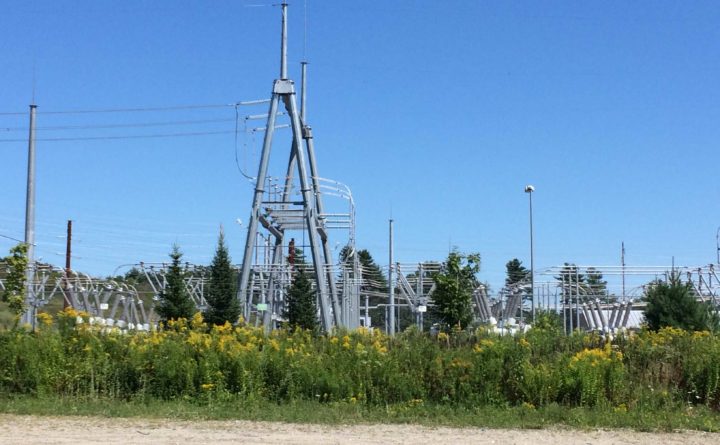
Central Maine Power’s substation on Larrabee Road in Lewiston is seen in this Aug. 19, 2019, file photo.
An independent study on how proposed legislation to replace Central Maine Power and Emera Maine with a consumer-owned utility would affect consumers found they may pay higher rates in the short-term, but those fees should go down once the new utility is up and running.
The 100-page report conducted by London Economics International highlighted other tradeoffs of the proposal. The report was sent to legislators over the weekend.
The Maine Public Utilities Commission asked London Economics to conduct the study after the Legislature’s energy committee last June asked for more information on the potential effects of the proposed creation of the Maine Power Delivery Authority, which would be owned and controlled by Maine consumers. London Economics is a global economic, financial and strategic advisory firm specializing in utilities.
The controversial proposal, LD 1646, came in response to frustration over high rates by CMP and Emera Maine, renewable energy policies and ongoing customer service issues.
Only one other U.S. state, Nebraska, has broad-based consumer-owned utilities to deliver electricity.
London Economics looked at the expected effects on electricity rates, utility employees and ratepayers and any possible alternatives or amendments to the LD 1646 proposal to address obstacles to its implementation.
London Economics said in its summary that its report would not recommend or dissuade the Legislature from passing LD 1646.
Responses so far to the report are mixed.
“The independent report’s findings demonstrate that public power is not in the best interest of Maine electric customers or taxpayers. We look forward to providing detailed comments to support policymakers during the review process,” said Ed Crowder, a spokesperson for Avangrid, CMP’s parent. “Meanwhile, CMP remains focused on our ongoing efforts to improve customer service and build a smarter, cleaner, more reliable electric grid for Maine people and businesses.”
But it is CMP’s customer service and management issues that Gordon Weil, a former Maine Public Advocate, criticized. The public utilities commission on Jan. 30 ruled that CMP must compensate customers for high bills and that the company would be penalized $10 million in revenue for 18 months for poor performance.
Weil, a long-time promoter of consumer-owned power, said the London Economics report sidesteps key issues such as electric-system reliability and CMP’s management problems.
“In my eyes [the report] is not really biased, but it is grossly incompetent,” he said, claiming the report had “flawed or unsupported assumptions.”
The consumer-owned utility would be nonprofit and tax-exempt. It would buy and then own the transmission and distribution assets of CMP and Emera Maine.
One of the tradeoffs the report found between the proposed and current utilities is that Maine electric ratepayers may face higher transmission and distribution rates in the near-term with the consumer-owned utility as it buys assets and starts operations. But those rates should be lower in the future because of its tax-exempt status.
And the tax-exempt status will give a consumer-owned utility access to lower financing costs than the public utilities have.
Another major tradeoff is that Maine electric ratepayers could forego paying local, state and federal taxes as much as is allowable. But Maine taxpayers, which include businesses from out of state operating in Maine, “would like to see electric utility service continue to contribute to the tax base in the state,” London Economics wrote.
There also are union considerations. A consumer-owned utility could save money using nonunion labor. But changes in labor costs linked to LD 1646 account for less than 3 percent of the total labor costs of CMP and Emera Maine combined, London Economics found.
The report also listed things that LD 1646 does not help with. If enacted, LD 1646 would not eliminate the costs of administration and management of the transmission and distribution portions of the electric utility business. It also would not guarantee free improvements in reliability or customer service. And it would not ensure financial benefits to local residents, according to London Economics, a global economic, financial and strategic advisory firm specializing in utilities.
“Maine taxpayers may experience reduced public services or higher taxes if (state or local) tax revenues decline due to the [Maine Power Delivery Authority’s] tax-exempt status and depending on the compensation of the contractor,” the report said.
Emera Maine said those are reasons for caution.
“The London Economics study uses conservative assumptions and may actually underestimate the risks of a government power takeover. It’s also recommending much more spending just to study the idea,” Emera Maine spokesperson Judy Long said.
“The study shows that the proposed transition would put Mainers on the hook for billions of dollars without concrete evidence that customers will benefit,” she said. “It also states that a transition to government-operated power could put Maine jobs at risk, lead to higher rates for customers for an extended period of time and offers no guarantees of increased reliability or customer service improvements.”
She said the report also shows that the proposed transition doesn’t improve the prospects for the transition to more clean energy.
London Economics said the two biggest effects on benefits to ratepayers of the consumer-owned utility will be the cost of buying CMP’s and Emera Maine’s assets and the structure of future capital investments.
The report recommended that the Legislature consider applying the same regulatory oversight by the utilities commission that currently exists for certain operations.
London Economics also recommended changes to LD 1646, including possibly having ratepayers elect the utility’s board instead of having the governor appoint them.
Additionally, it recommended that the Legislature conduct four more studies. They are a study of tax issues, a study of future capital expenditures for the transmission and distribution network, a study of how to optimize the new utility’s capital structure and a study of the competitive procurement process and optimal contractual agreements for contractors.







