
GLOBAL RESEARCH SYNDICATE
No Result
View All Result
  • Login
  • Latest News
  • Consumer Research
  • Survey Research
  • Marketing Research
  • Industry Research
  • Data Collection
  • More
    • Data Analysis
    • Market Insights
  • Latest News
  • Consumer Research
  • Survey Research
  • Marketing Research
  • Industry Research
  • Data Collection
  • More
    • Data Analysis
    • Market Insights
No Result
View All Result
globalresearchsyndicate
No Result
View All Result
Home Data Collection

Phishing scammers pose as World Health Organization to exploit coronavirus fears

globalresearchsyndicate by globalresearchsyndicate
February 18, 2020
in Data Collection
0
Phishing scammers pose as World Health Organization to exploit coronavirus fears
0
SHARES
15
VIEWS
Share on FacebookShare on Twitter

Fraudulent emails ask for sensitive personal data and include malicious links and attachments
The World Health Organization (WHO) has warned that it is being impersonated by cybercriminals in a phishing campaign that exploits anxieties surrounding the latest coronavirus outbreak.

In a recently posted security alert, the WHO said the offending emails ask recipients to hand over sensitive information like usernames or passwords, and include malicious links and attachments that trigger the installation of malware.

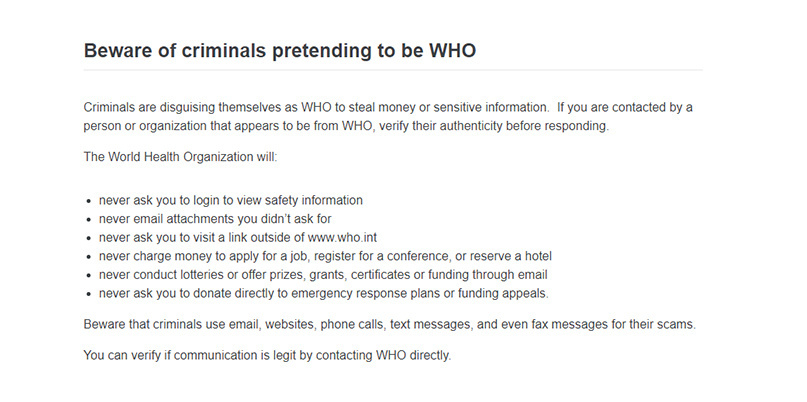
“Criminals are disguising themselves as WHO to steal money or sensitive information,” the alert reads. “If you are contacted by a person or organization that appears to be from WHO, verify their authenticity before responding.”

Email recipients can verify the sender’s authenticity, as well as report scams, by contacting the WHO directly, the organization said.

The WHO, which declared the outbreak of the unique coronavirus pathogen COVID-19 a global public health emergency on January 30, also advises recipients to check the sender’s email address.

Legitimate emails from WHO employees always follow the ‘[email protected]’ format, while web links will always start with ‘https://www.who.int’, the Geneva-based health agency confirmed.

Disaster fraud

On February 5, security researchers from Sophos flagged fraudulent emails purporting to come from the WHO that asked users to download measures for avoiding the now notorious coronavirus strain.

Kaspersky has discovered a similar campaign that hijacked the US Centers for Disease Control and Prevention’s identity in an attempt to trick people into clicking a malicious link.

Unscrupulous cybercrooks have also used COVID-19, which has now claimed more than 1,800 lives, to spread Emotet malware in Japan.
Although the WHO’s latest warning may go some way to helping internet users be on their guard, this latest campaign is by no means an isolated incident.

Major global crises, such as health scares, natural disasters or terror attacks, have long been a favored target for so-called ‘disaster fraud’ phishing campaigns, which exploit fear, confusion, and, in the case of phony donation requests, compassion.

Kelvin Murray, senior threat researcher at Webroot, said such global crises helped to fuel a 640% rise in phishing URLs reported in the 2020 Webroot Threat Report, which was released today.

“It’s unsurprising that the World Health Organization is currently being impersonated at scale, as scams based off current news are always going to be more effective, especially when tied to emotive topics in the public interest,” he told The Daily Swig.

“Whereas in the past we have seen fake stories about Conor McGregor or Elon Musk driving click-through to malicious twitter links, today we see coronavirus emails driving click-through to threats such as Emotet.”

Javvad Malik, security awareness advocate at security training provider KnowBe4, added: “We’ve seen several variations of phishing emails under the guise of warnings, to charitable donations, to flight and travel updates.

“Many of these phishing emails don’t contain any malicious attachments which can be scanned, so they have a high success rate in reaching the user’s desktop.”

Mitigation measures

Murray recommends that risk mitigation measures should include email filtering, antivirus protection, strong password policies, security awareness training, and backing up data to a secure location.

Both Facebook and Twitter have issued statements explaining their own measures for combating the spread of misinformation and scams that exploit the coronavirus crisis.

The WHO is also urging the public to not be rushed into handing out personal information, and to be suspicious of requests for usernames and passwords in order to access what should be freely available information.

Scammers can request such information not just through emails but websites, phone calls, text messages, and even fax messages too, the alert warns.

Anyone who believes they may have given sensitive data to cybercriminals are advised to immediately update their relevant login credentials.

The Daily Swig has contacted the WHO for further details.

RELATED Black Hat Asia 2020 postponed due to coronavirus epidemic

Related Posts

How Machine Learning has impacted Consumer Behaviour and Analysis
Consumer Research

How Machine Learning has impacted Consumer Behaviour and Analysis

January 4, 2024
Market Research The Ultimate Weapon for Business Success
Consumer Research

Market Research: The Ultimate Weapon for Business Success

June 22, 2023
Unveiling the Hidden Power of Market Research A Game Changer
Consumer Research

Unveiling the Hidden Power of Market Research: A Game Changer

June 2, 2023
7 Secrets of Market Research Gurus That Will Blow Your Mind
Consumer Research

7 Secrets of Market Research Gurus That Will Blow Your Mind

May 8, 2023
The Shocking Truth About Market Research Revealed!
Consumer Research

The Shocking Truth About Market Research: Revealed!

April 25, 2023
market research, primary research, secondary research, market research trends, market research news,
Consumer Research

Quantitative vs. Qualitative Research. How to choose the Right Research Method for Your Business Needs

March 14, 2023
Next Post
Veterinary Orthopedic Implants Market Primary Research, Secondary Research, Product Research, Size and Forecast by 2025| DePuy Synthes Vet, Scil animal care, B.Braun Vet Care

Veterinary Orthopedic Implants Market Primary Research, Secondary Research, Product Research, Size and Forecast by 2025| DePuy Synthes Vet, Scil animal care, B.Braun Vet Care

Categories

  • Consumer Research
  • Data Analysis
  • Data Collection
  • Industry Research
  • Latest News
  • Market Insights
  • Marketing Research
  • Survey Research
  • Uncategorized

Recent Posts

  • Ipsos Revolutionizes the Global Market Research Landscape
  • How Machine Learning has impacted Consumer Behaviour and Analysis
  • Market Research: The Ultimate Weapon for Business Success
  • Privacy Policy
  • Terms of Use
  • Antispam
  • DMCA

Copyright © 2024 Globalresearchsyndicate.com

Welcome Back!

Login to your account below

Forgotten Password?

Retrieve your password

Please enter your username or email address to reset your password.

Log In
This website uses cookies to improve your experience. We'll assume you're ok with this, but you can opt-out if you wish. Cookie settingsACCEPT
Privacy & Cookies Policy

Privacy Overview

This website uses cookies to improve your experience while you navigate through the website. Out of these cookies, the cookies that are categorized as necessary are stored on your browser as they are essential for the working of basic functionalities of the website. We also use third-party cookies that help us analyze and understand how you use this website. These cookies will be stored in your browser only with your consent. You also have the option to opt-out of these cookies. But opting out of some of these cookies may have an effect on your browsing experience.
Necessary
Always Enabled
Necessary cookies are absolutely essential for the website to function properly. This category only includes cookies that ensures basic functionalities and security features of the website. These cookies do not store any personal information.
Non-necessary
Any cookies that may not be particularly necessary for the website to function and is used specifically to collect user personal data via analytics, ads, other embedded contents are termed as non-necessary cookies. It is mandatory to procure user consent prior to running these cookies on your website.
SAVE & ACCEPT
No Result
View All Result
  • Latest News
  • Consumer Research
  • Survey Research
  • Marketing Research
  • Industry Research
  • Data Collection
  • More
    • Data Analysis
    • Market Insights

Copyright © 2024 Globalresearchsyndicate.com




