

The ground rules have been laid for a new survey to measure residents’ satisfaction with Halifax Regional Municipality police services.
“We want to make sure that we are getting community involvement and understanding of what we should be measuring prior to going out and crafting the (survey) questions,” Margaret Chapman, co-owner and partner of Narrative Research, told the Halifax police commission Monday about the parameters for the survey.
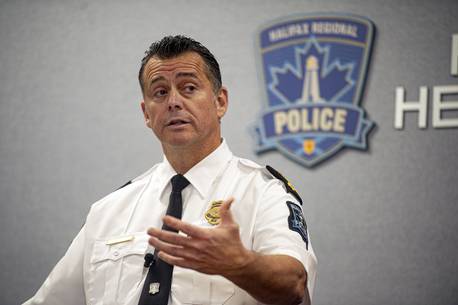
Chief Dan Kinsella of the Halifax Regional Police said the important thing for both himself and Chief Supt. Janis Gray of the Halifax District RCMP will be to get survey feedback and then to seek out where improvements can be made.
“When the time comes for a follow-up survey, which will be a replica of the initial survey, we would hope that there will be improvement in some of those areas,” Kinsella said. “That’s why we’re looking at creating this type of survey that can be replicated.
“Historically, what’s happened is a survey has been done, we have the feedback, we try to make some change and we get a different kind of survey the next time. We ask different questions and the next time we get a different kind of survey again.”
Kinsella was talking about police satisfaction surveys done in 2014 and 2018 and a third as part of an omnibus municipal survey.
Chapman said this survey will be more in depth, providing a deeper, more comprehensive level of questioning.
“We want to make sure that we are asking the questions that the community wants us to ask,” Kinsella said.
Long before the Wortley report on street checks last March confirmed that African Nova Scotians were six times more likely than whites to be checked by police in HRM, the black community had complained that they had been historically targeted and profiled by local police.
Carlos Beals, a member of the police commission, said the black community could snub the new survey.
“There might be a strong sense of cynicism,” Beals said. “It’s one of those things that you kind of have to wait and see how the community is going to react or respond. It might be the case that they just might not be interested in it, that they might feel that the Wortley report sufficed or that was an accurate depiction of their perception of the police force. This process, from what I’ve heard, is a means to allow us to continue to get information back on the perception of the community.
“I’m hopeful that will be the case.”
Tony Mancini, a member of the police commission who represents Dartmouth East-Burnside on council, said the survey has to reach out to every community within the municipality.
“We need to definitely go back to the African Nova Scotia community again but there are other communities — our Indigenous community, and I think our newcomers,” Mancini said. “We have grown our city in the last three years, we’ve broken population records. The last stat that I heard from Halifax Partnership is 65 per cent of the new citizens that we have are new Canadians. We have a large population of new Canadians in certain communities and we definitely want to hear from them. With new Canadians, they come from countries where their interaction with the police is a whole lot different than it is here in Canada.”
Mancini said part of the goal is to hear citizens’ perceptions of police and their evaluation of police work.
“The idea here is to get better at policing,” he said. “What is it we’re doing well, but more importantly, where are the areas that we need to focus on to get better.”
Chapman said Narrative, formerly known as Corporate Research Associates, will adopt a two-phase approach for the survey.
It will start with consultation and engagement to ensure the survey is designed to measure what citizens want measured. That phase will consist of focus groups of 15 to 20 people in public spaces like libraries.
The feedback from those groups will provide the input for the survey questions, which will be asked through telephone questionnaires and an online survey. The survey, online or by telephone, should take about eight to 10 minutes.
She said separate questions could be asked depending on where the respondents live.
“We would want to determine public perception with policing service providers and how they might differ across various areas within HRM,” Chapman said. “It is important to note that at this stage we haven’t landed on a firm methodology. We are still talking things through.”
Chapman said the entire process from its first phase of inviting focus groups through to analyzing the initial feedback, creating survey questions and looking at the responses and making a report ought to take about three months.
The start date for the project should come within weeks but the cost of the survey is not yet known.
Mancini said whatever the cost, it’s a “worthwhile investment.”







