

Manchester, N.H.
There is something exhilarating about attending a
Bernie Sanders
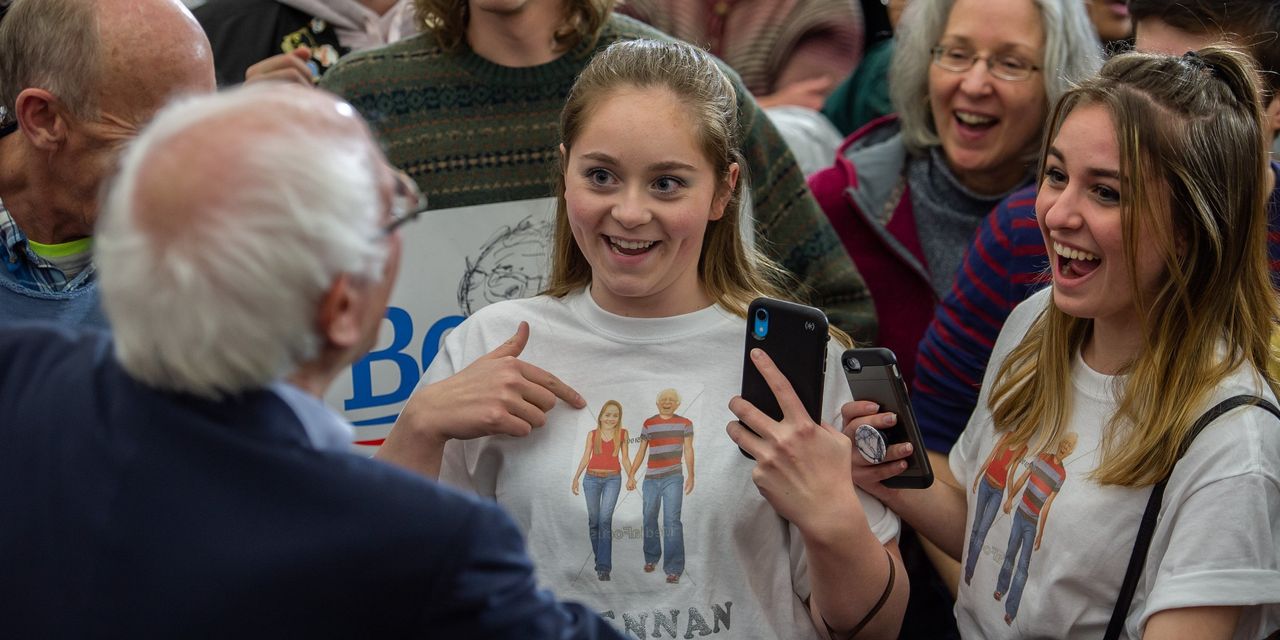
campaign event for the first time, even for an incorrigible conservative like me. The crowd is larger, louder and weirder than the typical primary election gathering. There are sweatshirt-wearing college students, cantankerous geriatrics, bedraggled parents of toddlers, hipsters with multiple facial piercings and purple-haired 20-somethings of indeterminate gender. When I arrived at the Bernie rally in Milford, N.H., an all-female rock band called the Bad Larrys was warming up the crowd with angular chords and indecipherable lyrics. I happened to see a guy holding a book, so I sidled up next to him and asked him what it was. The book was titled “Why Buddhism Is True.”
At campaign events like this one, I like to ask people if they’re certain of their support for the candidate or still considering alternatives. At an ordinary event—a rally for
Pete Buttigieg,
say, or
Elizabeth Warren
—some substantial minority of people have come simply to observe. “I haven’t decided yet” is a common response. Not at a Bernie rally. I tried and failed to find an attendee at one of his New Hampshire events who wasn’t already committed to Mr. Sanders. Many said they would vote for whoever the party nominates, but all said they planned to vote for Mr. Sanders in the New Hampshire primary on Feb. 11.
When you ask Mr. Sanders’s supporters what it is about him they find attractive, you often get something about authenticity. “I don’t know if I’d say ‘authentic’ or ‘honest,’ ” the Buddhism guy told me, “but it’s something like that.” “With some of them,” one woman said, speaking of the other Democratic candidates, “you’re just not sure what they really believe. With Bernie, you know.” The social-justice campaigner
Shaun King,
who spoke before Mr. Sanders at the Milford rally, put this question to the crowd: “Who’s more authentic, more real than Bernie Sanders?” Somebody behind me muttered, “Nobody, man.”
Four years ago, when pundits compared the Vermont senator to
Donald Trump,
saying that both were “populists” running “insurgent” campaigns, Mr. Sanders bristled, and maybe rightly so. But the two men’s supporters have this much in common: They believe their man is who he says he is.
Even I get the appeal. There is a kind of endearing grouchiness about Mr. Sanders. At the Milford event, his wife, Jane, introduced him, and kissed him on the cheek as he walked onto the stage, eliciting a quick shy grin from the senator, but otherwise he never smiled. When a woman interrupted one of his lines by shouting “We love you, Bernie!” he looked slightly annoyed. His persona suggests a man who doesn’t cultivate his image—messy hair, ill-fitting jacket, untempered Brooklyn accent (“health keeah is a yooman right”). You might guess that young people would prefer the fresher and more polished Mr. Buttigieg to a crotchety 78-year-old, but you would be wrong.
What Mr. Sanders’s fans love about him—his forthrightness—is also, of course, what makes him a hard sell in a general election. Unlike Sen. Warren, whose economic views are broadly the same as his, Mr. Sanders proudly wears the label “democratic socialist.” Also unlike Ms. Warren, he concedes that he will have to raise taxes.
Admittedly his claim that he can pay for student debt “cancellation” by a “modest tax on Wall Street speculation” sounds hopelessly vague, but he deserves some credit for honesty. Sometimes you have the feeling that Mr. Sanders is so forthcoming that he genuinely doesn’t know how preposterous his words sound. He plays down the radicalism of Medicare for All, his single-payer health-insurance proposal, by arguing that we are only “talking about expanding the most popular health-insurance program in America.”
At his talk in Derry, Mr. Sanders’s response to a question on climate change was both refreshingly honest and utterly risible. The ordinary Democratic line on climate change emphasizes intellectual assent and emotional engagement over plans and precise commitments, and it sidesteps the inability or unwillingness of China and India to develop plans to curb their rising emissions, together more than double the U.S. total. Merely proclaiming belief in the reality of climate change, perhaps also calling for a carbon tax and heightened investments in green energy, seems to satisfy most Democratic audiences.
Mr. Sanders doesn’t take that approach. “I could come to you and say, ‘We’re gonna put more money into solar panels, and we’re gonna do a little bit of this, and do more for public transportation,’ ” he says in answer to a question about climate policy. “But that’s not gonna solve the problem.”
He’s right. So what’s his alternative? “What we need to do is set up a long-term structure, and not just for this country—for the entire world.” The room falls silent. “You follow me?” he goes on. “We could do all the right things tomorrow, but if China and Russia and India and Pakistan and Brazil and other countries are not doing the right thing, this planet will be in very deep trouble.”
A “long-term structure” for “the entire world?” I confess I did not follow.
The chief challenge for Mr. Sanders is the present shape of the economy. In any election, the challenger, Democrat or Republican, can be counted on to deny or dismiss any positive economic news. Mr. Sanders has a double challenge: First, the U.S. economy appears pretty robust. Second, Mr. Sanders doesn’t only argue that the Trump administration isn’t “handling” the economy well; he insists capitalism itself needs a radical overhaul.
On the night of President Trump’s State of the Union address, Mr. Sanders delivered his own response in the auditorium of a museum in Manchester. “President Trump has told the American people that the economy today is booming as it has never boomed before,” Mr. Sanders said in a scripted speech before a teleprompter, signaling air quotes around the words “booming” and “boomed.” A typical data point from the speech: Whereas “billioneahs” have seen their wealth increase by 37% over the last three years, “wages for the average American worker have gone up by all of 17 cents an hour over the last year, after adjusting for inflation, an increase of less than 1%.”
Leaving aside the accuracy or otherwise of that data point, the likelihood that it resonates in the present economy—modest wage and GDP growth, unemployment at historic lows—would appear minimal. The rhetoric of revolution works better at some times than at others; it’s harder to man the barricades when you’ve got a job.
Mr. Sanders has a fine gift for simplifying complicated issues. Partly it’s a skill he has developed over the decades in political office, but partly it’s an outgrowth of his worldview. His foreign-policy views, for instance, which he didn’t spend much time on in New Hampshire, often seem reducible to this: He voted against every war he could vote against as an elected official, especially the Iraq war. On health-care policy, he has a nice riff on the bewildering complexity of premiums, deductibles, copays and out-of-pocket expenses.
“It’s all very simple,” a man with a long gray beard remarked to me at one Sanders event. “It’s supposed to be simple.” The man went on to explain that he is a pacifist and believes the human animal is making a mess of his habitat.
But for all of Mr. Sanders’s talents as a simplifier, he holds limited appeal for people who don’t know much or anything about politics. There is plenty of energy at a Bernie event, but for the uncommitted it goes on too long.
Other candidates in the race typically speak for about 30 minutes and engage the crowd with jokes and anecdotes.
Andrew Yang
events can fairly be called a hoot—the crowd laughs from beginning to end. Mr. Buttigieg is an able storyteller. The typical Sanders event is a humorless affair. The candidate speaks for 45 minutes to an hour, and there is a tragic air about all of it: grave recitations of injustice, greed and corruption, accompanied by bold policy ideas certain to right these wrongs, all of it brought together by the dreary language of working-class solidarity.
This is the point at which Mr. Sanders’s campaign contrasts with Mr. Trump’s. Donald Trump won in 2016 in part by appealing to people who had rarely or never voted. Many of his fans had never followed politics. There must be very few such people at a Sanders event. It takes a special kind of person, after all, to enjoy a nearly hourlong discourse on the depredations of the pharmaceutical industry, the urgent need for increased Title I funding for schools and the tragedy that 97 million Americans are “uninsured or underinsured.”
Lots of people come to Sanders events to hear left-wing wonkery and to deplore capitalism and oligarchy. The problem is, they are already Bernie fans. The more important question is this: Who comes to Sanders events to listen and observe and, perhaps, be persuaded to vote?
Nobody, man.
Mr. Swaim is an editorial page writer at the Journal.
Copyright ©2019 Dow Jones & Company, Inc. All Rights Reserved. 87990cbe856818d5eddac44c7b1cdeb8







