


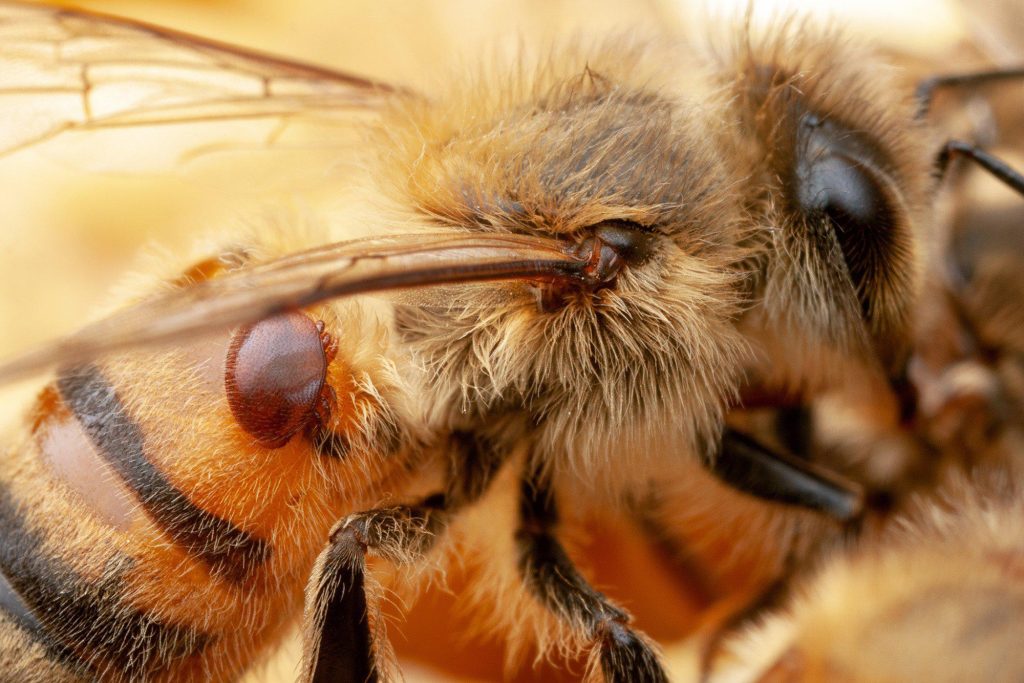
Honey bee populations have sharply declined around the world in recent years, confounding scientists and posing a grave threat to agriculture.
Now, University of Texas researchers may have discovered a way to reverse the trend.
Writing in the new issue of the journal Science, the team wrote that it had genetically engineered strains of bacteria that live in honey bee guts; there, they pump out medicines that protect the bees from Varroa mites and deformed wing virus — two chief culprits of colony collapse, a phenomenon that occurs when the majority of worker bees in a colony disappear.
The findings have “direct implications for bee health,” said Nancy Moran, a professor of integrative biology and the primary investigator on the study.
The stakes are high. Bees are a key player in the food chain. During a single day, a female bee may visit several hundred flowers, depositing pollen along the way; roughly a third of our food chain is the result of pollination. Austin alone has about 180 species of bees.
According to the American Beekeeping Federation, honey bees contribute nearly $20 billion each year to the value of U.S. crop production, and they play an enormous role in global food production. The California almond industry, for example, requires approximately 1.8 million colonies of honey bees to pollinate nearly one million acres of orchards.
But bee colonies have been beset by disease and die-offs. According to a national survey, beekeepers lost nearly 40% of their honey bee colonies during the 2018-2019 winter, the highest rate reported since the survey began 13 years ago.
One of the suspects is the Varroa mite, a parasite spread in recent decades from East Asia to the U.S.
The mite is “considered the biggest problem in beekeeping today,” said Mary Reed, chief apiary inspector of the Texas Apiary Inspection Service, an arm of Texas A&M University, “The reason is that they can vector viruses. If we didn’t have honey bee viruses, the Varroa mite would just be considered a nuisance. If mite levels get too high, they can weaken the immune system of a single bee and of a whole colony.”
She said virtually every bee colony in Texas has the mites.
After feeding on a honey bee host, the adult female mite reproduces by crawling off her host into a cell with a bee larva. Offspring then alternate between feeding on the larva and defecating on the side of the cell. While the mites do not kill adult honey bees, they can weaken and shorten individuals’ lifespans and ultimately will kill the colony by outcompeting their host. And the mites are vectors of numerous viruses including deformed wing virus.
While the background causes of particular instances of colony collapse disorder remain “a contentious issue under investigation,” said Sean Leonard, a graduate student and lead author of the study, “mites are an increasingly severe problem” over the past couple of decades that are contributing to high bee mortality rates.
The UT team — which involved at least eight other professors and students — engineered one strain of bacteria to target the virus and another for the mites.
Engineering the bacteria to “knock down” genetic targets in bee bodies, Moran said, the researchers found that compared with control bees, the bees treated with the strain of bacteria targeting the virus were 36.5% more likely to survive to day 10. Meanwhile, Varroa mites feeding on another set of bees treated with the mite-targeting strain of bacteria were about 70% more likely to die by day 10 than mites feeding on control bees.
“This is the first time anyone has improved the health of bees by genetically engineering their microbiome,” Leonard said.
The team introduced modified bacteria to hundreds of bees in a laboratory setting. Sprayed with a sugar water solution containing the bacteria, the bees groomed one another and ingested the solution. The team found inoculating young worker bees with the engineered bacteria led the bees’ immune systems to be primed to protect them against deformed wing virus — essentially acting as a vaccine — and caused the mites’ own immune systems to fight against and ultimately kill them.
Writing an accompanying commentary in Science, Robert J. Paxton, a zoologist with the Institute for Biology at Martin Luther University Halle-Wittenberg in Germany, writes that the approach is “effective, long-term, potentially cheap, and easy to apply.”
The approach could “provide a solution to many of the honey bee’s woes” and provide a way “to dissect the molecular intricacies of honey bees and their societies,” Paxton said.
But there remain major hurdles to any widespread rollout of the bacteria as a vaccinelike solution.
Leonard said it remains an open question how the genetically engineered bacteria will perform in an actual hive, where social behavior among the bees could differ from inside the lab. “How they’ll perform in an actual hive we don’t know: it might be better or worse,” he said.
And because the bacteria are genetically modified, any manufacturer or distributor of the bacteria will first have to pass through regulatory hoops, Moran said.
“These species of bacteria occur only in honey bees,” said Moran. “They are not going to jump into butterflies or other insects or anything else. They’re very restricted. They aren’t going to invade the environment in some way that concerns people.”
The type of bacteria used are highly specialized to live in the bee gut, can’t survive for long outside of it and are protective for a virus that strikes only bees. Still, further research will be needed to determine the effectiveness and safety of the treatments in agricultural settings.
News about research like this is “always good to hear,” said Charles Reburn, co-owner of Bee Friendly Austin, which operates in Southwest Austin and sells bee hives, wax and honey.
Having worked with Texas A&M University researchers, “I know what it takes from initial study to getting something marketed,” he said. “It takes a lot to get out of the lab and into the field. If it comes to testing, sign me up.”







