


Citation
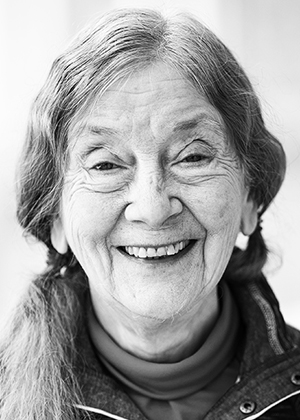
Professor Eugenia Kalnay is recognized for her exceptional contributions to numerical weather prediction; ensemble forecasting; data assimilation, including the production of global data sets for weather and climate research; and modeling the interactions between human society and the global environment.
While serving as director of the Environmental Modeling Center of the National Centers for Environmental Prediction (NCEP), she led development of their pioneering operational ensemble weather forecasting system, producing better forecasts with quantified uncertainties that are now part of everyday life. She also was lead author on the NCEP/National Center for Atmospheric Research 40-year reanalysis, the hugely influential effort to provide a consistent, accurate atmospheric history by using an up-to-date system to assimilate historical data, enabling important scientific advances in weather, climate, and environmental science.
With students and colleagues, she has worked vigorously to cross-fertilize nonlinear dynamics and meteorology, with a special focus on Kalman filters for data assimilation. Her textbook is a classic, and she has applied her techniques to such disparate problems as weather on Mars and carbon sources and sinks on Earth. She has especially sought to solve problems of societal relevance, helping develop the Human and Nature Dynamics (HANDY) model exploring interactions among economics, population dynamics, and environmental quality and showing how massive renewable energy installations could increase Saharan rainfall and vegetation.
Professor Kalnay is highly generous to students and colleagues. In 2015 she won the American Meteorological Society’s Joanne Simpson Mentorship Award “for effectively mentoring many early career scientists, with her unstinting generosity of time and attention in providing advice, encouragement, leadership, and inspiration.”
She was the first female Ph.D. recipient and first female faculty member in the Massachusetts Institute of Technology’s (MIT) Department of Meteorology; her thesis explored the circulation of the atmosphere of Venus. She joined the University of Maryland as department chair in 1999 and is now a Distinguished University Professor, their highest faculty honor, after service with NASA, the National Oceanic and Atmospheric Administration, and the University of Oklahoma. Professor Kalnay’s contributions have been recognized by numerous prestigious awards, including election to the U.S. National Academy of Engineering, American Academy of Arts and Sciences, Academia Europaea, and Argentine National Academy of Sciences.
For her broad and deep contributions to improved weather forecasting, Professor Eugenia Kalnay surely follows the tradition of Roger Revelle and thus is highly deserving of the medal in his honor.
—Richard B. Alley, Pennsylvania State University, University Park; John M. Wallace, University of Washington, Seattle; and Steven C. Wofsy, Harvard University, Cambridge, Mass.
Response
I am very humbled to receive this medal and want to express my deep gratitude to Mike Wallace, Steve Wofsy, and Richard Alley for their kind and generous citation, and to my friend and mentor Fuqing Zhang, whose recent unexpected passing has been devastating to our field and our scientific community.
I am grateful to Argentina, and to Rolando García, the meteorologist dean of the College of Sciences of the University of Buenos Aires (UBA), where I received an extremely good, and completely free education that later made me feel MIT was rather easy.
I left UBA, like many hundreds of outstanding students and professors, after the military dictatorship attacked them and the dean in “the night of the long police batons.” García recommended me to Jule Charney, my amazing adviser at MIT.
Since about 40% of science students at UBA were women, I expected the more “advanced” MIT would have 50%, so I was shocked to be the first woman in meteorology. At MIT, I met lifelong friends, like Inez Fung, J. Shukla, George Philander, and Mark Cane, whom I want to thank again for being my mentors.
I was blessed to work at NASA Goddard and to learn and practice global modeling and data assimilation. Shukla was head of “climate” and I was head of “weather,” and we both worked for Milt Halem, so I learned a lot about both climate and life. Then I became director of NCEP’s Environmental Modeling Center, under Bill Bonner and Ron McPherson, who were very supportive when I wanted to change our methods. We introduced many improvements, like the first Variational Data Assimilation, and Ensemble Forecasting, and developed the first long Reanalysis, described in Kalnay et al., (BAMS, 1996) the most cited paper in all Geophysics.
After a decade at NCEP, my husband reminded me that power corrupts, so I asked McPherson if I could step down. I became a professor and the chair of the Department of Atmospheric and Oceanic Science at the University of Maryland, where I found what I really like to do: work with students and discover with them ways to improve models and data assimilation. In Motesharrei et al. (Ecological Economics, 2014) we developed HANDY, a groundbreaking model that bidirectionally coupled the Earth and human systems showing that overconsumption of nature and large economic inequality both lead to societal collapse. More optimistically, in Li et al. (Science, 2018), we showed that large-scale solar and wind energy in the Sahara could provide ~4 times the energy used by humanity while substantially increasing precipitation and vegetation in both the Sahara and Sahel.
—Eugenia Kalnay, University of Maryland, College Park







