


TOKYO — In the wake of natural disasters in Japan, “cardboard beds” have provided a relatively warmer and comfortable sleeping environment for victims at some evacuation centers, freeing them from the ordeal of having to sleep huddled on the chilly floors of gyms and other public spaces. However, some local governments are lukewarm about introducing the alternative solution.
On Oct. 15, 2019, Kazuhiko Hanzawa, a specially appointed professor at Niigata University, rushed to the city of Nagano in central Japan in an attempt to have cardboard beds set up at evacuation centers for victims of Typhoon Hagibis.
Cardboard beds are said to be effective in sustaining evacuees’ health as they can protect them from the chilliness, dust, shaking of the floor and other discomfort at temporary shelters.
Hanzawa first headed to the Nagano Prefectural Government to ask officials to install cardboard beds at evacuation facilities. Officials approved the plan, with one saying, “It’s a matter of course to provide beds to everyone.” The professor then enquired with the Nagano Municipal Government, which was running evacuation centers in affected areas.
However, a municipal official showed reluctance toward the proposal, saying, “Is there any evidence showing the efficacy of cardboard beds?” Although Hanzawa showed them materials including a booklet introducing the positive effects of such beds, city officials “didn’t even give them a look,” he recalls.
In the wake of the Great Hanshin Earthquake in 1995, which left more than 6,400 people dead, survivors were forced to sleep on the floor at evacuation centers, among other harsh conditions, resulting in 919 people being recognized as having died from causes related to the disaster alone in Hyogo Prefecture, western Japan. The immediate cause of their deaths ranged from pneumonia to stress-induced heart attacks.
Although the momentum to improve living conditions at evacuation shelters picked up, evacuees were again seen sleeping on the floor at shelters in the aftermath of other subsequent disasters. In response, the central government called for municipalities to make efforts to improve the living environment at evacuation shelters under the 2013 revision to the Basic Act on Disaster Management. In 2016, the Cabinet Office recommended the use of cardboard beds in its guidelines for operating disaster evacuation centers. However, understanding toward the new idea has not yet been widely shared.
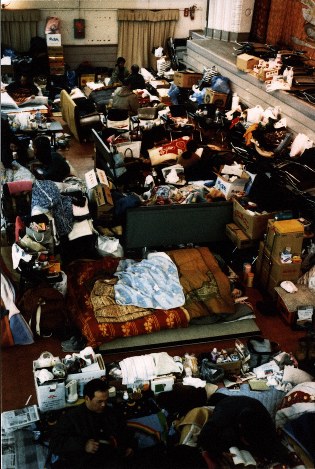
After Typhoon Hagibis ripped through Japan in the fall of 2019, the national government supplied some 3,900 cardboard beds to affected areas. The move came as part of support efforts to send supplies without waiting for requests from those areas. However, some evacuation shelters never used those beds, according to a field survey by the Society for Disaster Shelter and Refuge Life, and documents of the Ministry of Economy, Trade and Industry. Meanwhile, only one cardboard bed was introduced at an evacuation center in the city of Mito, northeast of Tokyo, where 69 people were taking shelter as of Oct. 24, 2019.
So why are cardboard beds so unpopular? Hanzawa, who chairs the Society for Disaster Shelter and Refuge Life, and Yoshihiro Mizutani, director of the society, attribute it to a lack of awareness among operators of evacuation centers and local governments. According to their survey, some operators of evacuation facilities were reluctant to install cardboard beds, with one saying, “Saving people’s lives takes priority,” and another saying, “We are OK, as this shelter is not going to be run for long.” One local official declined to use cardboard beds, saying, “We have bigger issues to worry about.”
“There are government officials who even say things like, ‘Evacuees won’t leave if we allowed them luxuries,'” Mizutani revealed. To such officials, Mizutani replied, “There’s no way sleeping on (cardboard) beds can be a luxury.”
In late 2019, the central government decided to stockpile 1,000-plus cardboard beds in preparation for disasters. Given the lack of awareness among local officials about the efficacy of such beddings, however, it is feared that such equipment may end up not being put to full use.
After the Great Hanshin Earthquake, Japan saw a series of major quakes and rain disasters affecting wide areas, increasingly prolonging the time evacuees spend at evacuation centers. Yet many local governments are unenthusiastic about improving the environment at such facilities.
Professor Yoshiteru Murosaki, dean at the Graduate School of Disaster Resilience and Governance at the University of Hyogo, points out that a stipulation in the Disaster Relief Act that limits the operation of evacuation centers to no more than seven days is “outdated.” The clause is said to have been left unchanged for 73 years since the law was instituted in 1947.
The operational policy, period of evacuation facilities and other guidelines provided for by the law are called “general standards.” In major disasters, “special standards” are applied, allowing for an extension of the operational period and requiring the improvement of the environment at such facilities.
However, a lot of municipalities establish evacuation centers with “general standards” in mind. Because of a lack of preparations for prolonged evacuation, the living conditions at those facilities can hardly be improved.
“The scale and frequency of disasters have changed a great deal over the past 70 years, as have the standards of our daily living,” Murosaki noted. “Considering the nature of recent disasters, municipalities should plan on evacuation centers serving as places where evacuees can spend at least one month.”
In the meanwhile, it is also necessary to introduce measures to prevent prolonged evacuation at makeshift shelters. In the wake of disasters, it takes time before people who lost their homes can move into temporary housing from evacuation centers, as it costs time to acquire land and build such facilities. In the aftermath of the Great Hanshin Earthquake, it took about six months before all evacuation facilities were shut down, while the figure shot up to nine months in the wake of the Great East Japan Earthquake in 2011, which affected extensive areas in eastern Japan.
Prolonged stays at evacuation centers can increase the number of disaster-related deaths. In the 2016 Kumamoto earthquakes, evacuation centers were operated for as long as seven months, leading 220 people to die from disaster-related causes — accounting for 80% of the 275 deaths reported after the disaster.
According to the Reconstruction Agency, of the 1,263 people who were recognized to have died due to causes related to the Great East Japan Earthquake and whose cause of deaths has been identified, more than half, or 638 people, are believed to have died from their living conditions at evacuation centers.
(Japanese original by Koki Matsumoto, Osaka Science & Environment News Department)







