


Vahid Davoudi, MD.
Science@Work
Why did you become interested in academic bullying?
While studying and working at top research universities, I often saw people suffering from being targets of a wide range of academic bullying. In my research, I’m often focusing on overlooked factors in nanomedicine, and it struck me that bullying is an important but ignored factor in science’s backyard.
How do you define academic bullying?
I think people can confuse academic bullying with academic freedom. Academic freedom means that you can pursue any kind of research you want and that you have the right to criticize any hypothesis in a polite and scientific manner. Often, however, people use this concept as a back door to justify inappropriate behaviors.

Brigham and Women’s Hospital
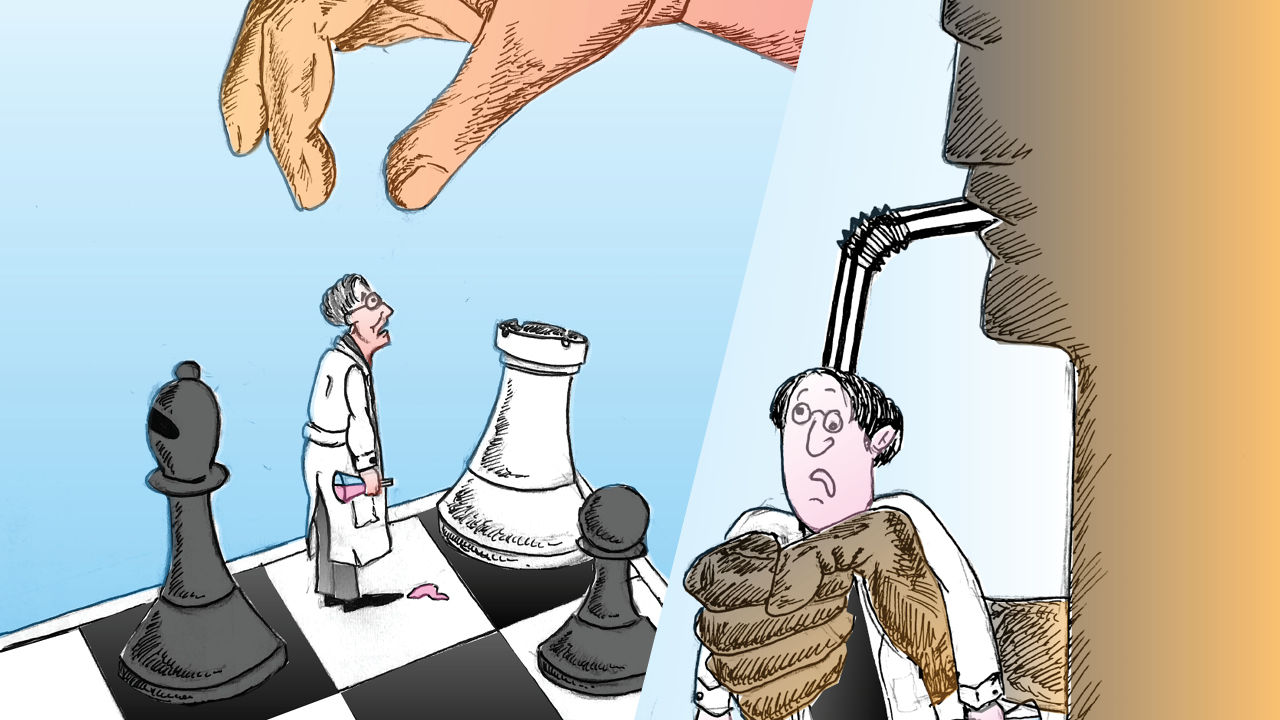
Academic bullying happens because the academic hierarchy creates a large difference in power between principal investigators who fund and drive the research and the lab members who carry out the research. Bullying can consist of inappropriately changing authorship positions, taking credit for ideas or intellectual property for one’s own benefit, verbally abusing others in a regular and progressive way, ridiculing or publicly shaming people, and threatening a bad recommendation or the loss of a job position.
Most but not all cases follow the direction of the power, with principal investigators and others who hold more power bullying those with little to no power (1).
What is the scope of the problem?
We don’t have robust and comprehensive data in this field, because the targets of bullying don’t feel safe talking about it. There is a fear of retaliation, job loss, visa cancellation, or mobbing and ganging-up behaviors, which results in a code of silence. One survey found that the rate of people who are bullied in academia and report it is less than 2% (2).
One leading researcher on academic bullying pulled together a meta-analysis of studies and found that the prevalence of academic bullying is roughly more than 30% across the globe (1). The Max Planck Institutes in Europe conducted a survey of more than 9,000 of their employees and reported in 2019 that 10% had experienced bullying in the past year (3). To me, the fact that Max Planck proudly published that figure means that 10% is a very low number for bullying across academia.
Personally, I think the rate is much higher and is probably highly dependent on the type of institution. At highly ranked institutions, where competition for joining labs is high and where lab workers can easily be replaced by another candidate, I would guess the incidence is even higher.
Why do you think bullying thrives in the academic environment?
There are several reasons for it (4), but in my opinion, we have no regulations or laws aimed at preventing academic bullying, and this is why institutions feel they cannot do anything about it. At every institution where I have worked, I have had to take mandatory sexual harassment training, but there has never been a single institution where there was training on how to handle bullying, how to report it, or what to do if you witness it.
Typical university general harassment policies cover only people in protected classes from being discriminated against due to aspects such as their ethnicity, gender, age, and religion. There are no structures in place to address harassment that are based on an abuse of power by those ranked more highly in the university system—and especially by those who have already achieved tenure as professors. There’s no Title IX–like office for bullying.
Who is most vulnerable to bullying?
International students or postdoctoral researchers may suffer from it the most. In the United States, more than 50% of postdocs are international.
An international researcher who has come on a visa usually has no (or [only] a few) friends or family support nearby, and might have cultural and language barriers to overcome. In addition, researchers who are highly dependent on their monthly paychecks, especially those supporting family members, cannot afford to lose their position. These factors make international researchers more vulnerable to abusive behavior.
I’ve heard or seen cases where visa cancellations and firing were threatened, or researchers have been asked to sign away their rights to intellectual property or to give up authorship. Targets of such bullying, especially when they are international, feel they cannot do anything but acquiesce to these pressures. In the few cases where researchers spoke up, many ended up having to leave their positions while the bullies stayed. This sends a strong signal to other targets and bullies.
What damage does bullying do?
When bullying happens in hospital settings, it has been shown to increase both the symptoms of burnout and suicidal thoughts in surgical residents, which can lead to increased medical errors (5). When researchers are targets, it may have a wide spectrum of physical and psychological damage and even affect their scientific integrity. Bullying may also lead to a cycle of bad behavior, with targets later becoming bullies.
Bullying also pushes many talented researchers to leave academia to find positions in industry or outside of research altogether. This is a loss for science.
Institutions should also care about the damage to their reputations when a major retraction must be issued or when a bullying scandal breaks into public view.
What are some possible solutions to this problem?
I have also proposed establishing a global committee on academic behavior, which would function similar to the Committee on Publication Ethics, to independently track bullying reports related to particular researchers (6).
By themselves, institutions aren’t motivated to address bullying effectively. There’s no incentive to get rid of a star researcher who brings money into the university and publishes prolifically but who is a well-known bully. But institutions could be forced to include their anti-bullying records in their rankings (7).
Some agencies, like the U.S. National Science Foundation, have instituted clear policies about not giving grants to researchers found guilty of sexual harassment. They could [implement] similar policies on academic bullying. The Wellcome Trust in the United Kingdom established a policy in 2018 to not award grants to researchers with complaints of bullying or harassment against them and to sanction institutions that do not deal with bullying promptly or fail to report an incident of bullying. That could be a good role model for other funding agencies to follow.
What can be done currently to alleviate academic bullying?
Ideally, stakeholders should create a safe environment for targets to report incidents, and such reports could be confidentially available. In the absence of this ideal, though, many researchers turn to surveys to get more information.
My colleague, Sherry Moss at Wake Forest University, and I have [started] a collaborative project to do an anonymous global survey about academic bullying in higher education. We hope to capture the details of academic bullying—the portion of people who witness and who experience it, the targets’ positions, their ethnicity, gender, citizenship status, the outcome of any investigations, or the reasons why they might have stayed silent about it.
Whether you have experienced or witnessed academic bullying or not, please participate in this global online anonymous survey (https://wakeforest.qualtrics.com/jfe/form/SV_0uZSsSRmzJDVnb7), which takes about 10 minutes to complete. If you are a faculty member or administrator, please consider sharing this link with your institution, division, or department.
References
1. L. Keashly, in Special Topics and Particular Occupations, Professions and Sectors, P. D’Cruz, E. Noronha, L. Keashly, S. Tye-Williams (eds.), Handbooks of Workplace Bullying, Emotional Abuse and Harassment, vol. 4 (Springer, Singapore, 2019), pp. 1–77, https://doi.org/10.1007/978-981-10-5154-8_13-1.
2. K. Zabrodska, P. Kveton, Empl. Responsib. Rights J. 25, 89–108 (2013).
3. A. Abbott, Nature 571, 14–15 (2019).
4. S. Moss, Nature 560, 529 (2018).
5. Y.-Y. Hu et al., N. Engl. J. Med. 381, 1741–1752 (2019).
6. M. Mahmoudi, Lancet 394, 1410 (2019).
7. M. Mahmoudi, S. E. Moss, Nature 572, 439 (2019).







