

GLOBAL RESEARCH SYNDICATE
No Result
View All Result
  • Login
  • Latest News
  • Consumer Research
  • Survey Research
  • Marketing Research
  • Industry Research
  • Data Collection
  • More
    • Data Analysis
    • Market Insights
  • Latest News
  • Consumer Research
  • Survey Research
  • Marketing Research
  • Industry Research
  • Data Collection
  • More
    • Data Analysis
    • Market Insights
No Result
View All Result
globalresearchsyndicate
No Result
View All Result
Home Data Collection

Hot gas feeds spiral arms of the Milky Way

globalresearchsyndicate by globalresearchsyndicate
January 14, 2020
in Data Collection
0
Hot gas feeds spiral arms of the Milky Way
0
SHARES
18
VIEWS
Share on FacebookShare on Twitter

Hot gas feeds spiral arms of the Milky Way
False-colour representation of the radio emission in the Milky Way from the THOR survey at a wavelength of about 21 cm. The upper band (1.4 GHz continuum) shows the emission from different sources, while the lower bands show the distribution of atomic hydrogen. Credit: Y. Wang/MPIA

An international research team, with significant participation of astronomers from the Max Planck Institute for Astronomy (MPIA), has gained important insights into the origin of the material in the spiral arms of the Milky Way, from which new stars are ultimately formed. By analysing properties of the galactic magnetic field, they were able to show that the dilute so-called warm ionized medium (WIM), in which the Milky Way is embedded, condenses near a spiral arm. While gradually cooling, it serves as a supply of the colder material of gas and dust that feeds star formation.

The Milky Way is a spiral galaxy, a disc-shaped island of stars in the cosmos, in which most bright and young stars cluster in spiral arms. There they form from the dense interstellar medium (ISM), which consists of gas (especially hydrogen) and dust (microscopic grains with high abundances of carbon and silicon). In order for new stars to form continuously, material must be constantly flushed into the spiral arms to replenish the supply of gas and dust.

A group of astronomers from the University of Calgary in Canada, the Max Planck Institute for Astronomy (MPIA) in Heidelberg and other research institutions have now been able to show that the supply comes from a much hotter component of the ISM, which usually envelops the entire Milky Way. The WIM has an average temperature of 10,000 degrees. High-energy radiation from hot stars causes the hydrogen gas of the WIM to be largely ionised. The results suggest that the WIM condenses in a narrow area near a spiral arm and gradually flows into it while cooling.

Hot gas feeds spiral arms of the Milky Way
Segment of the THOR survey near the Sagittarius arm of the Milky Way. The crosses indicate the position of sources of polarised radio emission. Their sizes correspond to the magnitude of the Faraday rotation effect. The strongest signals were measured in a rather inconspicuous strip to the right of the bright objects in the middle of the image. The strong radio sources indicate the position of the spiral arm. Credit: J. Stil/University of Calgary/MPIA

The scientists discovered the dense WIM by measuring the so-called Faraday rotation, an effect named after the English physicist Michael Faraday. This involves changing the orientation of linearly polarised radio emissions when they pass through a plasma (ionised gas) traversed by a magnetic field. One speaks of polarised radiation when the electric field oscillates in only one plane. Ordinary light is not polarised. The magnitude of the change in polarisation also depends on the observed wavelength.

In the present study, recently published in The Astrophysical Journal Letters, astronomers were able to detect an unusually strong signal in a rather inconspicuous area of the Milky Way, which is located directly on the side of the Sagittarius arm of the Milky Way facing the Galactic Centre. The spiral arm itself stands out in the imaging data due to strong radio emissions generated by embedded hot stars and supernova remnants. However, the astronomers found the strongest shift in polarisation outside this prominent zone. They conclude from this that the increased Faraday rotation does not originate within this active part of the spiral arm. Instead, it originates from condensed WIM, which, like the magnetic field, belongs to a less obvious component of the spiral arm.
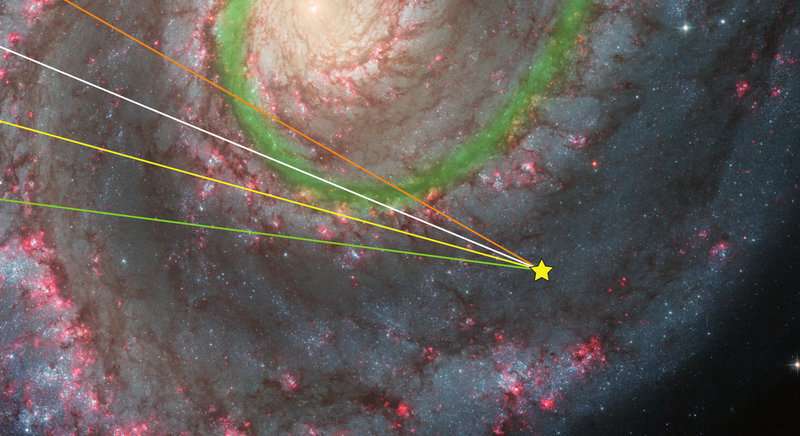
Hot gas feeds spiral arms of the Milky Way
Illustration of selected lines of sight within the Milky Way, which roughly covers the area under investigation. The star indicates the location of the Earth. The green arc indicates the presumed location of the condensed Warm Interstellar Medium (WIM). The white line of sight that runs through this area along the longest distance corresponds to the position with the strongest effect of the Faraday rotation. The orange line of sight passes through the WIM on shorter distances and thus observes a weaker effect. The smallest contributions stem from the lines of sight outside (green) and inside the spiral arm (yellow). Credit: MPIA

The analysis is based on the THOR survey (The HI/OH Recombination Line Survey of the Milky Way), which has been conducted at MPIA for several years now and in which a large area of the Milky Way is observed at several radio wavelengths. Polarised radio sources such as distant quasars or neutron stars serve as “probes” for determining the Faraday rotation. This allows astronomers not only to detect the otherwise difficult to measure magnetic fields in the Milky Way, but also to study the structure and properties of the hot gas. “We were very surprised by the strong signal in a rather quiet area of the Milky Way,” says Henrik Beuther from MPIA, who is leading the THOR project. “These results show us that there is still a lot to be discovered in studying the structure and dynamics of the Milky Way.”


Giant magnetic ropes seen in Whale Galaxy’s halo


More information:
R. Shanahan et al. Strong Excess Faraday Rotation on the Inside of the Sagittarius Spiral Arm, The Astrophysical Journal (2019). DOI: 10.3847/2041-8213/ab58d4

Provided by
Max Planck Society


Citation:
Hot gas feeds spiral arms of the Milky Way (2020, January 14)
retrieved 14 January 2020
from https://phys.org/news/2020-01-hot-gas-spiral-arms-milky.html

This document is subject to copyright. Apart from any fair dealing for the purpose of private study or research, no
part may be reproduced without the written permission. The content is provided for information purposes only.


Related Posts

How Machine Learning has impacted Consumer Behaviour and Analysis
Consumer Research

How Machine Learning has impacted Consumer Behaviour and Analysis

January 4, 2024
Market Research The Ultimate Weapon for Business Success
Consumer Research

Market Research: The Ultimate Weapon for Business Success

June 22, 2023
Unveiling the Hidden Power of Market Research A Game Changer
Consumer Research

Unveiling the Hidden Power of Market Research: A Game Changer

June 2, 2023
7 Secrets of Market Research Gurus That Will Blow Your Mind
Consumer Research

7 Secrets of Market Research Gurus That Will Blow Your Mind

May 8, 2023
The Shocking Truth About Market Research Revealed!
Consumer Research

The Shocking Truth About Market Research: Revealed!

April 25, 2023
market research, primary research, secondary research, market research trends, market research news,
Consumer Research

Quantitative vs. Qualitative Research. How to choose the Right Research Method for Your Business Needs

March 14, 2023
Next Post
UT Tyler hosts local democratic debate focus group – KLTV

UT Tyler hosts local democratic debate focus group - KLTV

Categories

  • Consumer Research
  • Data Analysis
  • Data Collection
  • Industry Research
  • Latest News
  • Market Insights
  • Marketing Research
  • Survey Research
  • Uncategorized

Recent Posts

  • Ipsos Revolutionizes the Global Market Research Landscape
  • How Machine Learning has impacted Consumer Behaviour and Analysis
  • Market Research: The Ultimate Weapon for Business Success
  • Privacy Policy
  • Terms of Use
  • Antispam
  • DMCA

Copyright © 2024 Globalresearchsyndicate.com

Welcome Back!

Login to your account below

Forgotten Password?

Retrieve your password

Please enter your username or email address to reset your password.

Log In
This website uses cookies to improve your experience. We'll assume you're ok with this, but you can opt-out if you wish. Cookie settingsACCEPT
Privacy & Cookies Policy

Privacy Overview

This website uses cookies to improve your experience while you navigate through the website. Out of these cookies, the cookies that are categorized as necessary are stored on your browser as they are essential for the working of basic functionalities of the website. We also use third-party cookies that help us analyze and understand how you use this website. These cookies will be stored in your browser only with your consent. You also have the option to opt-out of these cookies. But opting out of some of these cookies may have an effect on your browsing experience.
Necessary
Always Enabled
Necessary cookies are absolutely essential for the website to function properly. This category only includes cookies that ensures basic functionalities and security features of the website. These cookies do not store any personal information.
Non-necessary
Any cookies that may not be particularly necessary for the website to function and is used specifically to collect user personal data via analytics, ads, other embedded contents are termed as non-necessary cookies. It is mandatory to procure user consent prior to running these cookies on your website.
SAVE & ACCEPT
No Result
View All Result
  • Latest News
  • Consumer Research
  • Survey Research
  • Marketing Research
  • Industry Research
  • Data Collection
  • More
    • Data Analysis
    • Market Insights

Copyright © 2024 Globalresearchsyndicate.com



