


To put it simply, Dark Matter is not only believed to make up the bulk of the Universe’s mass but also acts as the scaffolding on which galaxies are built. But to find evidence of this mysterious, invisible mass, scientists are forced to rely on indirect methods similar to the ones used to study black holes. Essentially, they measure how the presence of Dark Matter affects stars and galaxies in its vicinity.
To date, astronomers have managed to find evidence of dark matter clumps around medium and large galaxies. Using data from the Hubble Space Telescope and a new observing technique, a team of astronomers from UCLA and NASA JPL found that dark matter can form much smaller clumps than previously thought. These findings were presented this week at the 235th meeting of the American Astronomical Society (AAS).
The most widely-accepted theory about Dark Matter states that it is not made up of the same stuff as baryonic (aka. normal or “luminous” matter) – i.e. protons, neutrons, and electrons. Instead, Dark Matter is theorized to be made up of some sort of unknown subatomic particle that interacts with normal matter only through gravity, the weakest of the fundamental forces – the others being electromagnetic, strong, and weak nuclear forces.

Another widely-accepted theory states that Dark Matter moves slowly compared to other types of particles, and are therefore prone to clumping. In accordance with this idea, the Universe should contain a broad range of dark matter concentrations, ranging from small to large. However, until now, no small concentrations have ever been observed.
Using data obtained by Hubble’s Wide Field Camera 3 (WFC3), the research team sought to find evidence of these small clumps by measuring the light from the bright nuclei of eight distant galaxies (aka. quasars) to see how it is affected as it travels through space. This technique, which is commonly employed by astronomers to study distant galaxies, star clusters, and even exoplanets, is known as gravitational lensing.
Originally predicted by Einstein’s Theory of General Relativity, this technique relies on the gravitational force of large cosmic objects to warp and magnify light from more distant objects. Daniel Gilman of UCLA, who was a member of the observation team, explained the process thusly:
“Imagine that each one of these eight galaxies is a giant magnifying glass. Small dark matter clumps act as small cracks on the magnifying glass, altering the brightness and position of the four quasar images compared to what you would expect to see if the glass were smooth.”
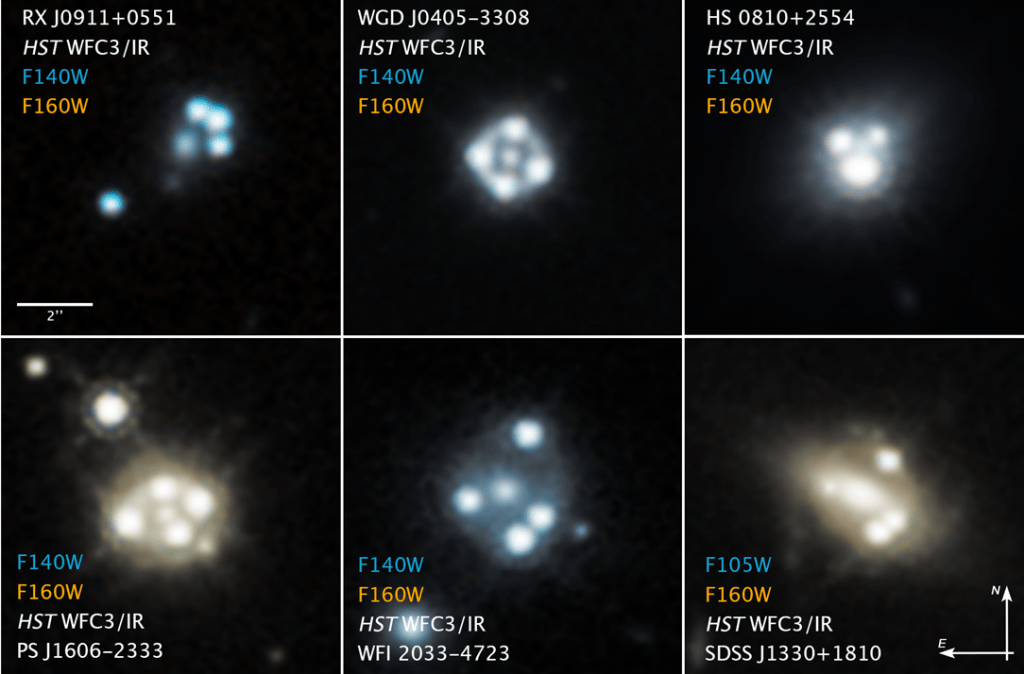
As hoped, the Hubble images showed that light coming from these eight quasars was subject to a lensing effect that is consistent with the presence of small clumps along the telescope’s line of sight and in and around the foreground lensing galaxies. The eight quasars and galaxies were aligned so precisely that the warping effect produced four distorted images of each quasar.
Using elaborate computing programs and intensive reconstruction techniques, the team then compared the level of distortion with predictions of how the quasars would appear without the influence of the Dark Matter. These measurements were also used to calculate the masses of the dark matter concentrations, which indicated that they were 1/10,000th to 1/100,000th times the mass of the Milky Way’s own Dark Matter halo.
In addition to being the first time that small concentrations have been observed, the team’s results confirm one of the fundamental predictions of the “Cold Dark Matter” theory. This theory postulates that since Dark Matter is slow-moving (or “cold”), that it is able to form structures ranging from tiny concentrations to tremendous ones that are several times the mass of the Milky Way.
This theory also states that all galaxies in the Universe formed within clouds of Dark Matter known as “haloes” and became embedded within them. In lieu of evidence of small-scale clumps, some researchers have suggested that Dark Matter might actually be “warm” – i.e. fast-moving – and therefore too quick to form smaller concentrations.
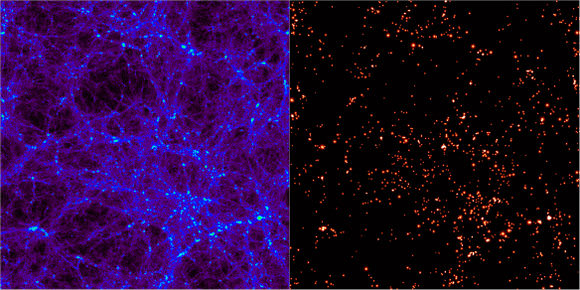
However, the new observations offer definitive proof that the theory of Cold Dark Matter and the cosmological model it supports – the Lambda Cold Dark Matter (?CDM) model – is correct. As team member Prof. Tommaso Treu of the University of California, Los Angeles (UCLA), explained, these latest Hubble observations yield new insights into the nature of dark matter and how it behaves.
“We made a very compelling observational test for the cold dark matter model and it passes with flying colors,” he said. “It’s incredible that after nearly 30 years of operation, Hubble is enabling cutting-edge views into fundamental physics and the nature of the universe that we didn’t even dream of when the telescope was launched.”
Anna Nierenberg, a researcher with the NASA Jet Propulsion Laboratory who led the Hubble survey, explained further:
Hunting for dark matter concentrations devoid of stars has proved challenging. The Hubble research team, however, used a technique in which they did not need to look for the gravitational influence of stars as tracers of dark matter. The team targeted eight powerful and distant cosmic “streetlights,” called quasars (regions around active black holes that emit enormous amounts of light). The astronomers measured how the light emitted by oxygen and neon gas orbiting each of the quasars’ black holes is warped by the gravity of a massive foreground galaxy, which is acting as a magnifying lens.

The number of small structures detected in the study offers more clues about the nature of dark matter particles since their properties would affect how many clumps form. However, the type of particle that Dark Matter is made up of remains a mystery for the time being. Luckily, the deployment of next-generation space telescopes in the near future is expected to help in that regard.
These include the James Webb Space Telescope (JWST) and the Wide Field Infrared Survey Telescope (WFIRST), both of which are infrared observatories that are scheduled to go up this decade. With their sophisticated optics, spectrometers, large field of view, and high-resolution, these telescopes will be able to observe entire regions of space affected by massive galaxies, galaxy clusters, and their respective haloes.
This ought to help astronomers determine the true nature of Dark Matter and how its constituent particles look like. At the same time, astronomers plan to use these same instruments to learn more about Dark Energy, another great cosmological mystery that can only be studied indirectly for now. Exciting times lie ahead!
Further Reading: Hubblesite







