

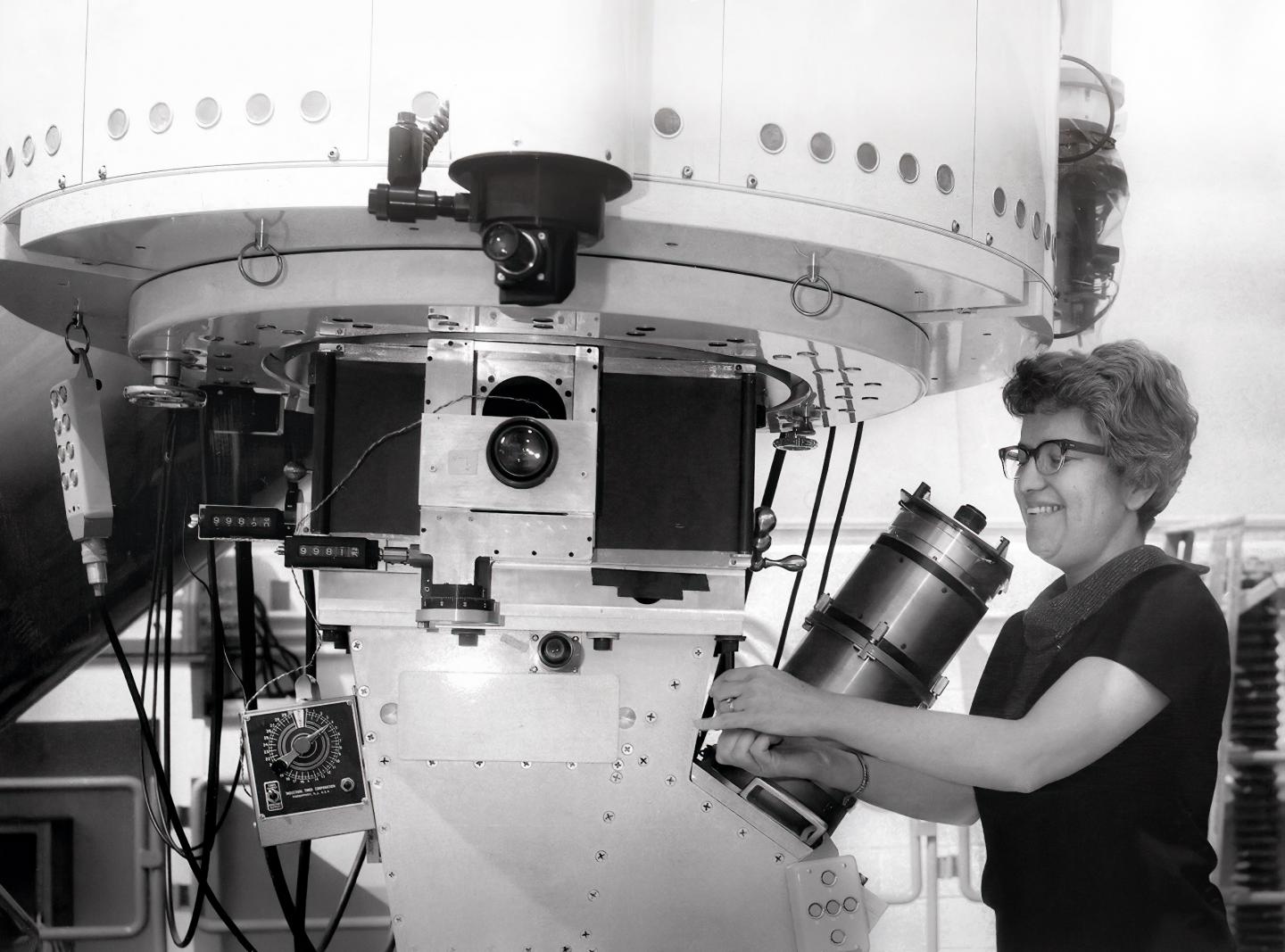

IMAGE: Vera Rubin operated the 2.1-meter telescope at Kitt Peak National Observatory. The Kent Ford’s spectrograph is attached to the telescope.
view more
Credit: NSF’s National Optical-Infrared Astronomy Research Laboratory/KPNO/AURA
It was announced today that the upcoming Large Synoptic Survey Telescope (LSST), which will conduct a vast astronomical survey for unprecedented discovery of the deep and dynamic Universe, will now be named the NSF (National Science Foundation) Vera C. Rubin Observatory (Rubin Observatory or VRO). The announcement was made today by Ralph Gaume, Director of the NSF Division of Astronomical Sciences; Kathy Turner, DOE (Department of Energy) Office of High Energy Physics program manager; and Steve Kahn, LSST Director during the LSST Open House at the 235th American Astronomical Society meeting in Honolulu, Hawai’i, USA. The construction and operations of the Rubin Observatory and the DOE LSST Camera is a U.S. federal partnership of the NSF and DOE, with private and international contributors. This initiative was started on June 11, 2019, by Chairwoman Eddie Bernice Johnson and Congresswoman Jenniffer González-Colón and enacted into law on December 20, 2019.
“Named after an astronomer who provided important evidence of the existence of dark matter, the NSF Vera C. Rubin Observatory seems destined to make science history with its extraordinary capabilities that will come to bear in the next few years,” said France Córdova, director of NSF. “Congress has helped make this inspiring commemoration a reality. The Rubin Observatory is expected to significantly advance what we know about dark matter and dark energy, so the Rubin name will have yet another way to inspire women and men eager to investigate.”
“It is fitting for this major new observatory, which includes the study of dark matter and dark energy as one of the major research topics, to be named for a pioneering astronomer whose observations were so critical to our understanding of this area,” said Paul Dabbar, Under Secretary for Science of the DOE. The 3200 megapixel camera is DOE’s primary contribution to LSST. “Dr. Rubin’s life and singular achievements as a scientist remain a model for all those seeking to satisfy humanity’s unceasing curiosity about our Universe.”
In partnership with the U.S., Chile provides important support to the Rubin Observatory and other astronomical observatories. The Rubin Observatory features facilities currently under construction in Chile with headquarters in Tucson, AZ, USA. It consists of an integrated system featuring a wide field ground-based telescope with an 8.4-meter mirror.
During 10 years of operations starting late 2022, the Rubin Observatory together with the 3200 megapixel DOE LSST Camera and the data facility will carry out an unprecedented optical survey of the visible sky named the Legacy Survey of Space and Time (LSST). The survey’s design is driven by four main science themes: probing dark energy and dark matter, taking an inventory of the solar system, exploring the transient optical sky, and mapping the Milky Way.
Rubin Observatory Director Steve Kahn said, “We are deeply honored to have our observatory named after Vera Rubin. Through her discovery of dark matter, Vera made one of the most important contributions to science in the past century, not only for astronomy, but also for fundamental physics. When construction is completed in 2022, the Rubin Observatory and the LSST Camera will help build on her pioneering work to dramatically improve our understanding of the Universe on many different scales.”
Vera Rubin’s career spanned several areas in observational astronomy but she is most recognized for uncovering the discrepancy between the observed and predicted motions of matter in galaxies. This discrepancy is interpreted as evidence for dark matter, which exerts gravitational force but does not emit light as ordinary matter does. “We are proud that this next-generation observatory will be named in recognition of Vera’s contributions 50 years after she published her landmark work,” said Carnegie Institution for Science President Eric D. Isaacs. Her work was confirmed using numerous observational techniques and it had a major impact on cosmology.
Rubin Observatory Deputy Director Zeljko Ivezic commented, “Starting with this survey, the Rubin Observatory and LSST Camera will shed new light on the distribution of dark matter in our galaxy, the Milky Way, as well as throughout the Universe, and thus will significantly contribute to Vera’s scientific legacy.”
Although Vera Rubin received many scientific honors, such as the National Medal of Science award and she was voted into the National Academy of Sciences, she experienced gender-based resistance in her career. “We are pleased that LSST has now been named the Vera C. Rubin Observatory,” said Allan Rubin, David Rubin, and Karl Rubin. “We believe that this is a great way to honor our mother’s achievements in astronomy and her work for equal rights for women in science.” Vera Rubin was an outspoken advocate for women in the sciences; she was recognized for paving the way for other women in astronomy, and for achieving remarkable success while facing challenges that her male colleagues did not have to overcome. Both as a scientist and a as woman, she improved the field for those who came after.
“Vera Rubin’s research transformed our understanding of galaxies by observationally showing that they grow up inside dark matter halos. Not only did her work set the basis for my own research, speaking with her at my first big astronomy conference empowered my confidence that women could succeed in the field. Naming the observatory in her honor is a fitting tribute, an important statement about visibility and inclusivity in astronomy, and makes me proud to be involved in such an extraordinary project,” said Amanda Bauer, Interim Deputy Director of Operations at the Rubin Observatory.
“It is exciting that this wonderful observing system will be named after Vera Rubin. Dr. Rubin was a strong advocate of public facilities for science as a means to ensure the best ideas got to see the light of day (or night). Much of her astronomy research was accomplished on NSF funded, national facilities open to all astronomers, so having her name on this new NSF facility is appropriate and a great way to honor her work and impact on our field,” said Robert Blum, Acting Director of Operations at the Rubin Observatory.
In addition, the telescope at the Rubin Observatory has been named the Simonyi Survey Telescope in recognition of a significant private donation made early in the construction phase that was utilized to design, develop, and fabricate the telescope’s primary mirror.
###
Contacts
PIO Contact:
Ranpal Gill
AURA/LSST
+1 520 309 6195
[email protected]
Science Contact:
Zeljko Ivezic
University of Washington
+1 206 403 6132
[email protected]
This Federal project is jointly funded by the National Science Foundation (NSF) and the Department of Energy (DOE) Office of Science, with early construction funding received through private donations through the LSST Corporation. The NSF-funded LSST Project Office for construction was established as an operating center under management of the Association of Universities for Research in Astronomy (AURA). The DOE-funded effort to build the LSST camera is managed by the SLAC National Accelerator Laboratory (SLAC).
NSF and DOE will continue to support the Rubin Observatory in its Operations phase to carry out the Legacy Survey of Space and Time. They will also provide support for scientific research with the data. During operations NSF funding is managed by the Association of Universities for Research in Astronomy (AURA) under a cooperative agreement with NSF and DOE funding is managed by SLAC under contract by DOE. The Rubin Observatory and DOE LSST Camera are operated by NSF’s Optical-Infrared Astronomy Research Laboratory and SLAC.
Rubin Observatory Promotional Video: https:/
Disclaimer: AAAS and EurekAlert! are not responsible for the accuracy of news releases posted to EurekAlert! by contributing institutions or for the use of any information through the EurekAlert system.







