

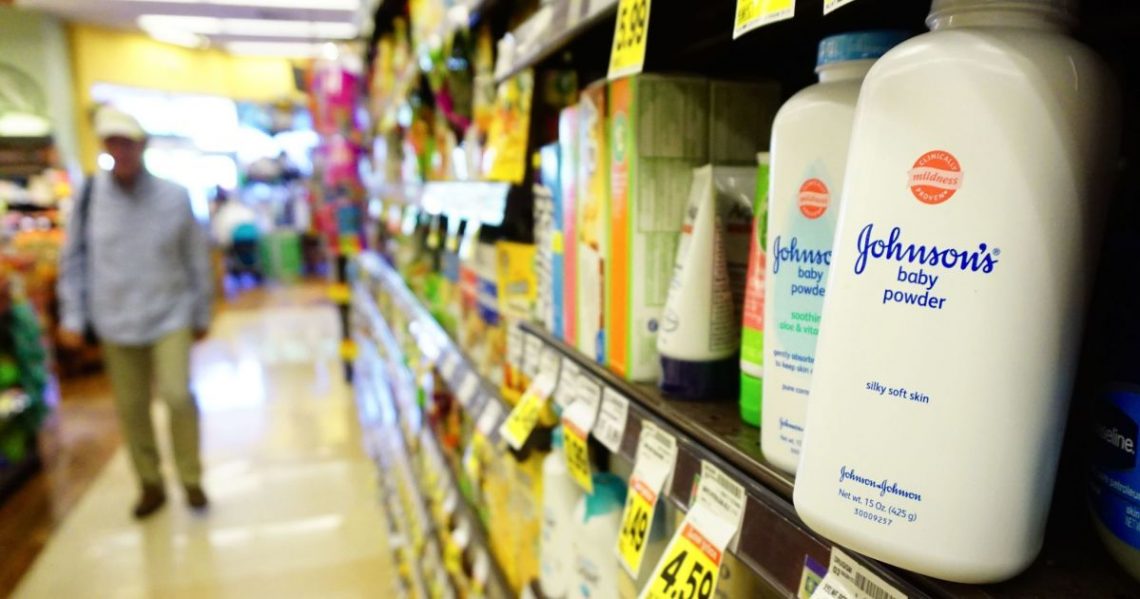
In the largest such study ever, researchers examining data from more than 252,000 women have determined that there is no statistically significant link between the use of talc-based baby powder and ovarian cancer.
One might think that such results would crimp the tide of lawsuits accusing talc manufacturers, particularly Johnson & Johnson of responsibility for their customers’ cancer.
One would be wrong. Plaintiffs lawyers have cited other scientific studies they say establish the connection sufficiently for juries to assign blame, so the courtroom battle of data and experts will go on.
“The study doesn’t change the landscape in terms of the data we’re dealing with,” Lynn O’Dell, a leading plaintiffs lawyer in cases naming Johnson & Johnson, told me.
More than 12,000 such lawsuits have been filed across the country in state and federal courts, blaming Johnson & Johnson’s products for ovarian cancer and mesothelioma. Some have yielded eye-catching monetary verdicts while testing the ability of juries and judges to assess the conflicting scientific presentations.
The study doesn’t change the landscape in terms of the data we’re dealing with.
Plaintiff attorney Lynn O’Dell
In August 2017, a Los Angeles jury hit Johnson & Johnson for $417 million in damages in the case of Eva Echeverria, who alleged that she contracted ovarian cancer after nearly lifelong, daily applications of the company’s baby powder in to her genital areas. But last year a state appeals court ordered a new trial in the case. Echeverria died after the original verdict.
The latest study, which was published Tuesday in the Journal of the American Medical Assn., underscores the murkiness of the science in those cases. Let’s take a look at the scientific battlefield.
Epidemiological studies fall into two main categories and, in the case of talc and ovarian cancer, two divergent results.
One category encompasses case-control studies, which are retrospective — the researchers select subjects who have contracted a disease, and search into their histories to determine what may have caused it. The case-control studies seeking the link between baby powder and ovarian cancer would ask women with cancer whether and how much they used baby powder over their lifetimes, among other things.
The oft-identified flaw in that process is that the subjects’ responses could be marred by poor recollection or the desire to pinpoint a cause of disease, which is known as “recall bias.”
The second category is cohort studies, in which researchers follow a group of subjects over time, tracking their life experiences and their health conditions and seeking correlations and, it’s hoped, cause-and-effect relationships.
In general, case-control studies show stronger links between ovarian cancer and baby powder use than cohort studies.
“We’ve convincingly shown that there’s a causal relationship,” Daniel W. Cramer, a Harvard epidemiologist whose case-control studies have been a mainstay of the plaintiffs bar in the Johnson & Johnson cases and has often served as an expert witness for the plaintiffs, told me.
The cohort studies generally have found no statistically significant connection. That’s true of the latest study, which didn’t involve new research but rather reanalyzed data from four prior cohort studies — two studies of nurses totaling more than 143,000 subjects; about 40,000 subjects of the federally funded “Sister Study,” which follows women whose sisters had breast cancer but did not have the disease themselves; and more than 73,000 subjects of the federally funded Women’s Health Initiative Observational Study, which follows postmenopausal women.
Of the more than 252,000 women in the study group, 2,168 developed ovarian cancer. The researchers found that women who had ever used powder developed ovarian cancer more frequently than those who never had, but the difference fell below statistical significance.
Indeed, according to an editorial comment published by JAMA along with the study, the difference is so small that it “should not be selectively highlighted by the statistically unsophisticated reader as evidence of a relationship.”
The editorial did point to an important obstacle in the search for a connection between powder and ovarian cancer: The disease is relatively rare, making it difficult to detect “small increases or decreases in cancer rates.”
The researchers reported, furthermore, that they could detect “no clear dose-response trends for duration and frequency of powder use in the genital area.” In other words, they found no changes in the risk of ovarian cancer based on how long or regularly women used the powder — a marker typically sought by epidemiologists trying to identify cause and effect.
The journal advocated focusing future research on the timing and duration of powder use by women with intact reproductive tracts — that is, who have not undergone hysterectomies or tubal ligations — who might be more susceptible to talc-related ovarian cancer. But as the editorialists also pointed out, such studies would take years and, since the use of talc has dropped sharply among younger generations, they “may not be feasible.”
That returns us to the question of how much we can really know about the links between baby powder and ovarian cancer. The disease is rare, its possible causes various and the role of talc still conjectural at best.
Yet the message of verdicts at the $400-million level is that the facts are incontrovertible.
Jury verdicts in cases in which the scientific data point to a draw are based not on scientific evidence as such, but on juries’ assessments of the defendant companies’ behavior. As we’ve pointed out before, that places companies such as Johnson & Johnson at a great disadvantage in the courtroom, especially when the plaintiff is an innocent individual suffering from a terminal disease.
O’Dell yields no ground in her conviction that the verdicts against Johnson & Johnson are warranted by the evidence. But she also alluded to the nonscientific factor in juries’ big punitive damage awards.
“Juries recognize that we’re talking about a product with no therapeutic benefit,” she told me. “It’s a cosmetic. Juries see that and they see the failure of Johnson & Johnson to warn consumers or remove the product from the market, and I think they’re outraged.”






