
GLOBAL RESEARCH SYNDICATE
No Result
View All Result
  • Login
  • Latest News
  • Consumer Research
  • Survey Research
  • Marketing Research
  • Industry Research
  • Data Collection
  • More
    • Data Analysis
    • Market Insights
  • Latest News
  • Consumer Research
  • Survey Research
  • Marketing Research
  • Industry Research
  • Data Collection
  • More
    • Data Analysis
    • Market Insights
No Result
View All Result
globalresearchsyndicate
No Result
View All Result
Home Data Collection

Astronomers Identify Farthest Galaxy Group To Date

globalresearchsyndicate by globalresearchsyndicate
January 6, 2020
in Data Collection
0
Astronomers Identify Farthest Galaxy Group To Date
0
SHARES
10
VIEWS
Share on FacebookShare on Twitter

KEY POINTS

  • Astronomers found the fathest galaxy group identified to date
  • EGS77 dates back to the time when the universe was just 680 million years old
  • Observations show the trio’s participation during the universe’s reionization 

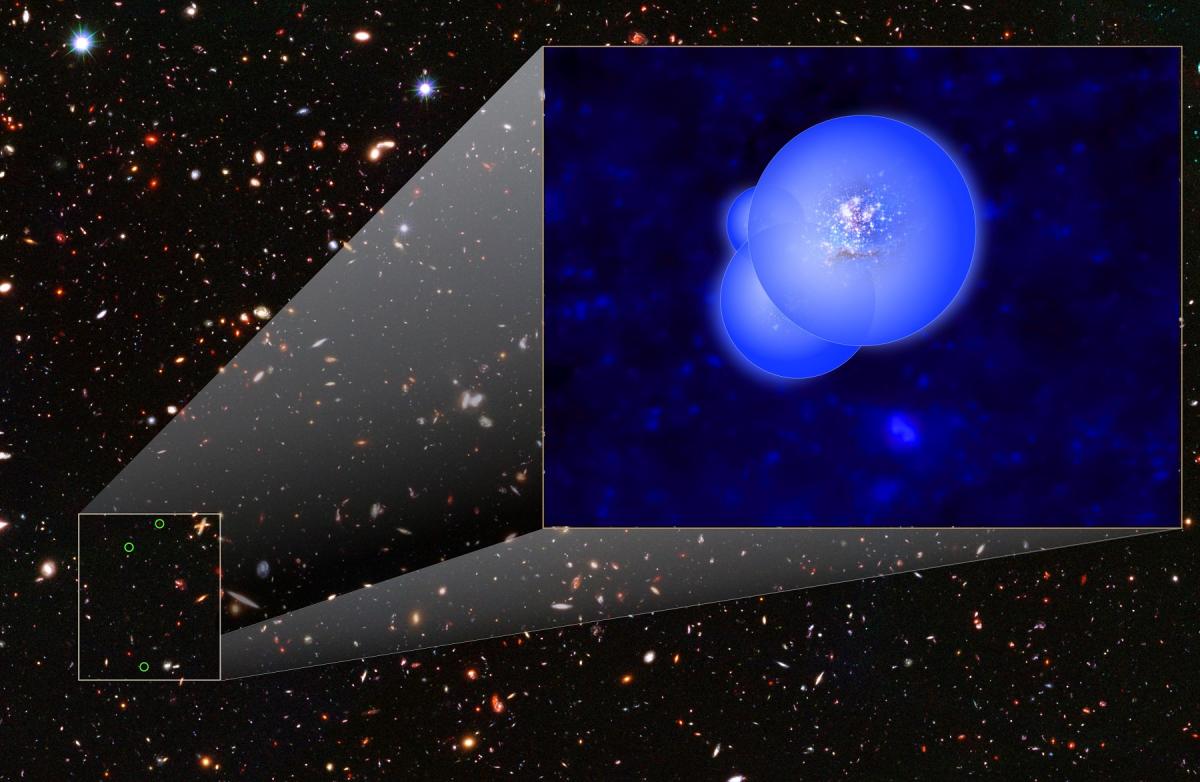
An international team of astronomers has found the farthest galaxy group identified to date. The trio EGS77 dates back to when the universe was still just 680 million years old, and observations show their participation during the reionization.

Cosmic Makeover

The universe was extremely hot and dense during its earliest phase. At the time, atoms could not exist and the universe was in an ionized state. After the universe cooled and expanded for a period of about 380,000 years, the particles combined to make the first atoms, over 90 percent of which were hydrogen, and the first galaxies and stars were formed some hundreds of millions of years later.

During this time, intense ultraviolet light from the first stars and galaxies gradually split apart the hydrogen atoms, thereby creating bubbles of ionized gas. Such bubbles grew around all galaxies, and in time, the bubbles grew and the cosmic fog was lifted.

This cosmic makeover is known as the reionization period in which the universe was beginning to move from the dark ages to the cosmic dawn, and it is the focus of the Cosmic Deep And Wide Narrowband (Cosmic DAWN) survey.

Cosmic DAWN Survey

As part of the Cosmic DAWN survey, an international team of researchers imaged an area in the Bootes constellation using the National Optical Astronomy Observatory’s Extremely Wide-Field InfraRed Imager (NEWFIRM) attached to the Mayall telescope in Tucson, Arizona.

Upon comparing their images with other images taken of the region, the astronomers were able to tag the galaxies appearing in near-infrared images as candidates for the survey while those that appeared in visible light were rejected for being too close.

Here, they detected far-ultraviolet light known as Lyman alpha emissions from galaxy trio EGS77 at near-infrared wavelengths, making it a very viable candidate for the survey.

EGS77

EGS77 dates back to the time when the universe was very young at 680 million years old. Using the Keck I telescope in Hawaii, the team also confirmed the galaxies’ slightly different wavelengths, suggesting a separation between them of about 2.3 million light-years or just a little closer than the distance between our Milky Way and its closest spiral galaxy neighbor, Andromeda.

“The young universe was filled with hydrogen atoms, which so attenuate ultraviolet light that they block our view of early galaxies,” James Rhoads said, presenting the findings at the 235th meeting of the American Astronomical Society. “EGS77 is the first galaxy group caught in the act of clearing out this cosmic fog.”

Simply put, even though other more distant individual galaxies have been previously observed, EGS77 is the farthest galaxy group to date, with each member prominently showing the specific wavelengths of far-ultraviolet light from the reionization.

New Telescopes

Such reionization bubbles from the cosmic makeover era are expected to be rare and difficult to find, but with the upcoming James Webb Space Telescope, which is sensitive to Lyman alpha emission, as well as the planned Wide Field Infrared Survey Telescope, the hope is to find more of such galaxies that can give clues to the all-important period in the universe’s history.


Galaxy Group EGS77 Picture: An illustration of galaxy group EGS77 surrounded by overlapping bubbles of ionized hydrogen. Photo: NASA, ESA and V. Tilvi (ASU)

Related Posts

How Machine Learning has impacted Consumer Behaviour and Analysis
Consumer Research

How Machine Learning has impacted Consumer Behaviour and Analysis

January 4, 2024
Market Research The Ultimate Weapon for Business Success
Consumer Research

Market Research: The Ultimate Weapon for Business Success

June 22, 2023
Unveiling the Hidden Power of Market Research A Game Changer
Consumer Research

Unveiling the Hidden Power of Market Research: A Game Changer

June 2, 2023
7 Secrets of Market Research Gurus That Will Blow Your Mind
Consumer Research

7 Secrets of Market Research Gurus That Will Blow Your Mind

May 8, 2023
The Shocking Truth About Market Research Revealed!
Consumer Research

The Shocking Truth About Market Research: Revealed!

April 25, 2023
market research, primary research, secondary research, market research trends, market research news,
Consumer Research

Quantitative vs. Qualitative Research. How to choose the Right Research Method for Your Business Needs

March 14, 2023
Next Post
Global Yoga Apparel Market 2019-2023 | 6% CAGR Projection Through 2023

Global Yoga Apparel Market 2019-2023 | 6% CAGR Projection Through 2023

Categories

  • Consumer Research
  • Data Analysis
  • Data Collection
  • Industry Research
  • Latest News
  • Market Insights
  • Marketing Research
  • Survey Research
  • Uncategorized

Recent Posts

  • Ipsos Revolutionizes the Global Market Research Landscape
  • How Machine Learning has impacted Consumer Behaviour and Analysis
  • Market Research: The Ultimate Weapon for Business Success
  • Privacy Policy
  • Terms of Use
  • Antispam
  • DMCA

Copyright © 2024 Globalresearchsyndicate.com

Welcome Back!

Login to your account below

Forgotten Password?

Retrieve your password

Please enter your username or email address to reset your password.

Log In
This website uses cookies to improve your experience. We'll assume you're ok with this, but you can opt-out if you wish. Cookie settingsACCEPT
Privacy & Cookies Policy

Privacy Overview

This website uses cookies to improve your experience while you navigate through the website. Out of these cookies, the cookies that are categorized as necessary are stored on your browser as they are essential for the working of basic functionalities of the website. We also use third-party cookies that help us analyze and understand how you use this website. These cookies will be stored in your browser only with your consent. You also have the option to opt-out of these cookies. But opting out of some of these cookies may have an effect on your browsing experience.
Necessary
Always Enabled
Necessary cookies are absolutely essential for the website to function properly. This category only includes cookies that ensures basic functionalities and security features of the website. These cookies do not store any personal information.
Non-necessary
Any cookies that may not be particularly necessary for the website to function and is used specifically to collect user personal data via analytics, ads, other embedded contents are termed as non-necessary cookies. It is mandatory to procure user consent prior to running these cookies on your website.
SAVE & ACCEPT
No Result
View All Result
  • Latest News
  • Consumer Research
  • Survey Research
  • Marketing Research
  • Industry Research
  • Data Collection
  • More
    • Data Analysis
    • Market Insights

Copyright © 2024 Globalresearchsyndicate.com




