


Scientific communities often struggle to find consensus on how to achieve the next big leap in technology, methods, or understanding in their fields. Geothermal energy development is no exception. Here we describe a methodological approach to combining qualitative input from the geothermal research community with technical information and data. The result of this approach is a road map to overcoming barriers facing this important field of research.
Geothermal energy accounts for merely 0.4% of U.S. electricity production today, but the country has vast, untapped geothermal energy resources—if only we can access them. The U.S. Geological Survey has found that unconventional geothermal sources could produce as much as 500 gigawatts of electricity—roughly half of U.S. electric power generating capacity. These sources have sufficient heat but insufficient fluid permeability to enable extraction of this heat [U.S. Geological Survey, 2008]. One approach to tapping these resources is to construct enhanced geothermal systems (EGS), in which techniques such as fluid injection are used to increase the permeability of the subsurface to make a reservoir suitable for heat exchange and extraction (Figure 1).
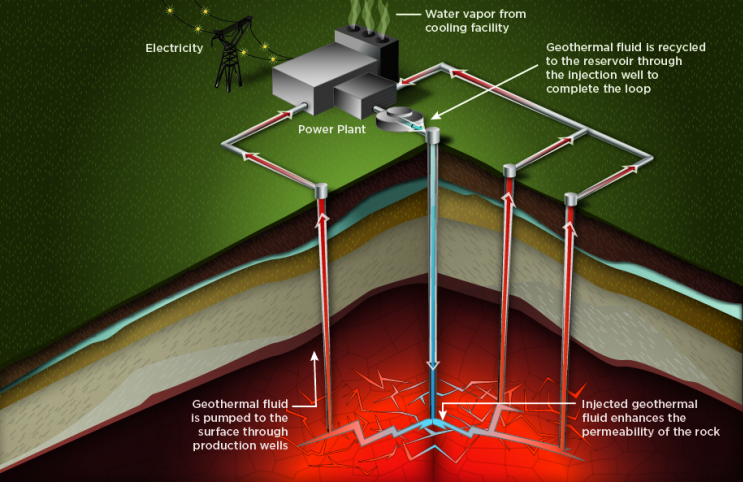
The United States and other countries have conducted experimental EGS projects since the 1970s. However, engineering a successful heat exchange reservoir in the high temperatures and pressures characteristic of EGS sites remains a significant technical challenge, one that must be overcome to enable commercial viability [Ziagos et al., 2013].
Because of the great potential of this technology, the U.S. Department of Energy (DOE) is driving an ambitious initiative called the Frontier Observatory for Research in Geothermal Energy (FORGE) to accelerate research and development in EGS. The FORGE initiative will provide $140 million in funding over the next 5 years (subject to congressional appropriation) for cutting-edge research, drilling, and technology testing at a field laboratory and experimental EGS site in Milford, Utah, operated by the University of Utah [U.S. Department of Energy, 2018].
Assessing Challenges of Enhanced Geothermal Systems
DOE’s Geothermal Technologies Office (GTO) asked the Science and Technology Policy Institute (STPI) to develop a methodology for collecting input from the EGS community to produce a FORGE road map with strategic guidance for the managers and operators of the site. STPI is a federally funded research and development center established by Congress and operated by the nonprofit Institute for Defense Analyses, which provides analyses of scientific issues important to the White House Office of Science and Technology Policy and to other federal agencies.
EGS faces numerous technical challenges. These include developing drilling equipment that can withstand the heat, pressure, and geology of the EGS environment; improving the ability to isolate specific targets in the subsurface for stimulation (called zonal isolation); and learning to better mitigate the risk of induced seismicity during operations. The EGS community has a variety of ideas for how FORGE can address these challenges and for the balance needed between conducting research that is novel, though potentially risky, and efforts that will maintain a functioning site for continued use.
The time frame for FORGE is also relatively short, about 5 years, especially given the substantial effort required simply to drill and establish an EGS reservoir. In light of this, STPI designed and conducted a process to capture the community’s ideas for how FORGE can advance EGS, process this information methodically and impartially, and distill it into a document that is reflective of the community’s input and useful for planning research at FORGE.
STPI’s process was designed specifically for the FORGE road map, but the general approach described here, or specific elements of it, could prove valuable for other efforts seeking to leverage collective community feedback to move a research field forward. Using this approach, a community struggling to make progress can prioritize research and technology needs without focusing on the individual approaches of different researchers or organizations.
A Road Map for Geothermal Research
The FORGE road map, published in February 2019, is intended to offer input from the EGS research community to help the managers of FORGE craft funding opportunities, operate the site in Utah, and work toward achieving DOE’s mission for FORGE: a set of rigorous and reproducible EGS technical solutions and a pathway to successful commercial EGS development.
The document outlines discrete research activities—and highlights the most critical of these activities—that the EGS research community proposed for FORGE to address technical challenges. The road map also categorizes all research activities into three overarching areas of focus: stimulation planning and design, fracture control, and reservoir management.
Engaging the Community
In developing the road map, STPI, in coordination with DOE, first determined categories of information that could serve as building blocks for the road map. They did this by analyzing U.S. and foreign EGS road maps and vision studies from the past 2 decades. These categories included the major technical challenges facing EGS, such as developing optimal subsurface fracture networks, and the specific areas of research that could be investigated at FORGE to address those challenges, such as testing different zonal isolation methods.
Higher-level questions included determining how progress or success could be recognized in these research areas and what accomplishments could serve as milestones for the FORGE project. Examples of potential milestones include drilling a well to a predetermined depth and measuring subsurface properties to a target resolution.
STPI then conducted semistructured interviews with 24 stakeholders from DOE, national laboratories, industry, and academia to validate and expand the initially identified technical challenges, understand the barriers that researchers were facing when trying to address these challenges, and discuss technology that could overcome these barriers.
STPI summarized the results of these interviews, including technical challenges and potential research activities for FORGE, in an informal memorandum. This memorandum served as a preliminary, skeletal draft of the road map, and it provided the starting point for discussion in a community workshop.
In August 2018, STPI hosted a FORGE Roadmap Development Workshop at the National Renewable Energy Laboratory in Golden, Colo. Nearly 30 EGS subject matter experts from across academia, national laboratories, industry, and government attended and provided input. In a series of breakout sessions, attendees reviewed the technical challenges and research activities identified in STPI’s interviews, generated a list of technical milestones for FORGE’s 5 years of operation, discussed the dependencies among the research activities and milestones on the FORGE timeline, and produced qualitative and quantitative criteria to measure progress in each of the research activities.
The steps in this process—a literature review, interviews with subject matter experts, and a stakeholder workshop—represent a progression of inputs that helped elucidate EGS community perspectives on current challenges to commercial EGS development and research activities that would help FORGE solve those challenges.
After this information had been collected, STPI worked with DOE on the technical content of the road map in preparation for its publication last February. STPI and DOE consolidated, structured, and prioritized this content to provide the greatest utility to the FORGE managers and operators.
The Way Ahead
Clean, geothermal energy has the potential to make up a much larger share of the U.S. energy portfolio than it does at present, but to get there, the field of EGS will have to make substantial progress. The FORGE road map is designed to help the FORGE initiative move toward this goal as effectively as possible, especially given the variety of viewpoints on what research is most important with the limited funding and time available.
The fundamental difficulties faced by the EGS community in charting a path forward are hardly unique, and so the successful process used in developing this road map could be applicable to other research communities. Collaborative processes such as the one described here look beyond literature reviews and individual research projects, and they build on themselves as they progress. Such processes can incorporate diverging viewpoints to bring out the common challenges and potential solutions that might help a research community gain consensus on how to move forward. Although a community may not agree on the exact path to success, having a common end point and a set of research priorities can help everyone forge ahead.







