
GLOBAL RESEARCH SYNDICATE
No Result
View All Result
  • Login
  • Latest News
  • Consumer Research
  • Survey Research
  • Marketing Research
  • Industry Research
  • Data Collection
  • More
    • Data Analysis
    • Market Insights
  • Latest News
  • Consumer Research
  • Survey Research
  • Marketing Research
  • Industry Research
  • Data Collection
  • More
    • Data Analysis
    • Market Insights
No Result
View All Result
globalresearchsyndicate
No Result
View All Result
Home Data Analysis

Scaling up screening and treatment for elimination of hepatitis C among men who have sex with men in the era of HIV pre-exposure prophylaxis

globalresearchsyndicate by globalresearchsyndicate
January 1, 2020
in Data Analysis
0
Scaling up screening and treatment for elimination of hepatitis C among men who have sex with men in the era of HIV pre-exposure prophylaxis
0
SHARES
5
VIEWS
Share on FacebookShare on Twitter

1. Introduction

Globally, men who have sex with men (MSM) experience a high burden of HIV [

1

  • Beyrer C.
  • Baral S.D.
  • van Griensven F.
  • et al.
Global epidemiology of HIV infection in men who have sex with men.

], with elevated levels of hepatitis C (HCV) co-infection occurring among HIV-positive MSM in high-income countries [

2

  • Platt L.
  • Easterbrook P.
  • Gower E.
  • et al.
Prevalence and burden of HCV co-infection in people living with HIV: a global systematic review and meta-analysis.

], but much lower transmission occurring among HIV-negative MSM [

  • Platt L.
  • Easterbrook P.
  • Gower E.
  • et al.
Prevalence and burden of HCV co-infection in people living with HIV: a global systematic review and meta-analysis.

,

3]

  • Ghisla V.
  • Scherrer A.U.
  • Nicca D.
  • Braun D.L.
  • Fehr J.S
Incidence of hepatitis C in HIV positive and negative men who have sex with men 2000–2016: a systematic review and meta-analysis.

. This recent MSM HCV epidemic has been associated with sexual and drug-related behaviours [

4

  • Danta M.
  • Brown D.
  • Bhagani S.
  • et al.
Recent epidemic of acute hepatitis C virus in HIV-positive men who have sex with men linked to high-risk sexual behaviours.

], with the polarised pattern of HCV in HIV-infected MSM likely due to heterogeneity in risk behaviours and HIV sero-adaptive behaviours [

5

  • MacGregor L
  • Martin NK
  • Mukandavire C
  • et al.
Behavioural, not biological, factors drive the HCV epidemic among HIV-positive MSM: HCV and HIV modelling analysis including HCV treatment-as-prevention impact.

]. Over 2012–2017, HIV incidence has halved in the UK [

6

  • Nash S
  • Desai S
  • Croxford S
  • et al.

] mainly due to the UK achieving very high levels of antiretroviral therapy (ART) coverage and HIV viral suppression [

6

  • Nash S
  • Desai S
  • Croxford S
  • et al.

].

HIV pre-exposure prophylaxis (PrEP) is a pre-emptive anti-retroviral medication, which has high efficacy for preventing HIV acquisition [

  • Molina J.M.
  • Capitant C.
  • Spire B.
  • et al.
On-Demand preexposure prophylaxis in men at high risk for HIV-1 infection.

,

8]

  • McCormack S.
  • Dunn D.T.
  • Desai M.
  • et al.
Pre-exposure prophylaxis to prevent the acquisition of HIV-1 infection (PROUD): effectiveness results from the pilot phase of a pragmatic open-label randomised trial.

. Many countries are expanding the availability of PrEP among MSM [

11

  • Kojima N.
  • Davey D.J.
  • Klausner J.D
Pre-exposure prophylaxis for HIV infection and new sexually transmitted infections among men who have sex with men.

]. However, as occurred with the expansion of ART [

9

  • Bezemer D.
  • de Wolf F.
  • Boerlijst M.C.
  • et al.
A resurgent HIV-1 epidemic among men who have sex with men in the era of potent antiretroviral therapy.

], there are concerns that PrEP use could result in increased sexual risk taking, thus increasing the transmission of sexually transmitted infections (STIs), including HCV [

7

  • Molina J.M.
  • Capitant C.
  • Spire B.
  • et al.
On-Demand preexposure prophylaxis in men at high risk for HIV-1 infection.

]. Recent studies have confirmed this, giving a consistent picture that the incidence of STIs increases following initiation of PrEP [

1

  • Traeger M.W.
  • Cornelisse V.J.
  • Asselin J.
  • et al.
Association of HIV preexposure prophylaxis with incidence of sexually transmitted infections among individuals at high risk of HIV infection.

,

11]

  • Kojima N.
  • Davey D.J.
  • Klausner J.D
Pre-exposure prophylaxis for HIV infection and new sexually transmitted infections among men who have sex with men.

.

Although PrEP is freely available in Wales and Scotland [], it has limited availability in England, with PrEP being restricted to individuals enrolled in the IMPACT trial []. In all these settings, PrEP is only available to individuals meeting specific eligibility criteria. In England, this mainly involves reporting on-going condomless sex or other factors posing similar HIV-risk []. The full IMPACT trial eligibility criteria is included in the Supplementary material, with there being similar eligibility criteria in Scotland and Wales [].
The World Health organisation (WHO) recently developed a Global Health Strategy to eliminate HCV, aiming to reduce HCV incidence by 90% by 2030 [

14

World Health Organization (WHO). Combating hepatitis B and C to Reach Elimination by 2030. 2016.

]. Elimination initiatives are attempting to achieve this goal among MSM, mainly targeting HIV-diagnosed MSM [

15

  • National Health Service (NHS) England
Eliminating Hepatitis C in England.

–

16

  • Kracht P.A.M.
  • Arends J.E.
  • van Erpecum K.J.
  • et al.
Strategies for achieving viral hepatitis C micro-elimination in the Netherlands.

,

17

  • Boerekamps A.
  • van den Berk G.E.
  • Lauw F.N.
  • et al.
Declining hepatitis C virus (HCV) incidence in Dutch human immunodeficiency virus-positive men who have sex with men after unrestricted access to HCV therapy.

]. In the UK, HIV-diagnosed MSM are advised to be screened for HCV each year [], while HIV-negative MSM are rarely tested [] and there are no HCV testing guidelines for MSM using PrEP.

Previous modelling has considered what is required to eliminate HCV among HIV-diagnosed MSM [

20

  • Martin N.K.
  • Boerekamps A.
  • Hill A.M.
  • Rijnders B.J.A
Is hepatitis C virus elimination possible among people living with HIV and what will it take to achieve it.

,

21

  • Martin N
  • Jansen K
  • van der Heiden M
  • et al.
Can HCV be eliminated among HIV-infected MSM in Berlin? Modeling a setting with increasing incidence and high treatment rates.

], but none have accounted for the HCV transmission dynamics among HIV-negative MSM. In this study, we use modelling to determine what HCV testing and treatment strategies are needed to reduce the overall incidence of HCV among MSM by 90% by 2030 in the UK. We assess how PrEP and any associated changes in condom use may affect the impact achieved, and determine the need for HCV screening among PrEP users and other HIV-negative MSM to help inform future policy and guidelines.

2. Methods

2.1 Model derivation

We adapt a previous model of HIV and HCV transmission among MSM [

5

  • MacGregor L
  • Martin NK
  • Mukandavire C
  • et al.
Behavioural, not biological, factors drive the HCV epidemic among HIV-positive MSM: HCV and HIV modelling analysis including HCV treatment-as-prevention impact.

] to include PrEP use (details in Supplementary material). The model (Supplementary Fig. S1) stratifies MSM by: HIV and PrEP status (susceptible on/off PrEP, acute HIV infection on/off PrEP, undiagnosed or diagnosed chronic HIV infection); HCV-status (susceptible, acute HCV infection, undiagnosed and diagnosed chronic HCV infection); and either low- or high-risk sexual behaviour, defined by the annual number of anal sex partners (high-risk defined as  ≥ 15). Individuals are not assumed to change their risk.

Individuals enter the model susceptible to HIV and HCV, not using PrEP, and either low- or high-risk. HIV and HCV transmission occurs at rates related to an individuals’ sexual risk and prevalence of HIV and HCV among their sexual partners. HCV infectivity is elevated for HIV-HCV co-infected individuals based on evidence for vertical HCV transmission (details in Supplementary materials) [

22

  • Benova L.
  • Mohamoud Y.A.
  • Calvert C.
  • Abu-Raddad L.J
Vertical transmission of hepatitis C virus: systematic review and meta-analysis.

]. MSM also mix preferentially, more commonly choosing partners of the same sexual risk and HIV-status (see Supplementary materials).

Depending on the PrEP scenario being modelled, HIV-negative individuals may initiate using PrEP, which confers protection to acquiring HIV [

  • Molina J.M.
  • Capitant C.
  • Spire B.
  • et al.
On-Demand preexposure prophylaxis in men at high risk for HIV-1 infection.

,

8

  • McCormack S.
  • Dunn D.T.
  • Desai M.
  • et al.
Pre-exposure prophylaxis to prevent the acquisition of HIV-1 infection (PROUD): effectiveness results from the pilot phase of a pragmatic open-label randomised trial.

,

23]

  • Marcus J.L.
  • Glidden D.V.
  • Mayer K.H.
  • et al.
No evidence of sexual risk compensation in the iPrEx trial of daily oral HIV preexposure prophylaxis.

. PrEP was assumed to scale-up from 2018, with the coverage of PrEP reaching 12·5% of HIV-negative MSM by 2020 with the average duration on PrEP being 8·2 months [

24

  • Spinelli M.A.
  • Scott H.M.
  • Vittinghoff E.
  • et al.
Missed visits associated with future preexposure prophylaxis (PrEP) discontinuation among prep users in a municipal primary care health network.

]. PrEP users are screened quarterly for HIV and upon a positive diagnosis stop using PrEP. This frequent HIV-testing means PrEP users are diagnosed before reaching chronic HIV infection [

25

NHS England. Clinical Commissioning Policy Proposition: Pre-Exposure Prophylaxis (PrEP) to Prevent the Acquisition of HIV in Adults. 2016.

]. Non-PrEP users who acquire acute HIV infection, firstly transition to undiagnosed HIV infection and are then diagnosed at current UK HIV-testing rates (2·3 years between infection and diagnosis) [

26

  • Ong K.J.
  • Desai S.
  • Field N.
  • et al.
Economic evaluation of HIV pre-exposure prophylaxis among men-who-have-sex-with-men in England in 2016.

]. Acute HIV is assumed to have elevated HIV transmission risk (26-fold) [

27

  • Hollingsworth T.D.
  • Anderson R.M.
  • Fraser C
HIV-1 transmission, by stage of infection.

]. A proportion of HIV-diagnosed MSM are on ART, which increases survival 3·4-fold, with a proportion being virally supressed and having negligible HIV transmission risk (see Supplementary materials).

Newly HCV-infected individuals develop acute HCV infection, following which they either develop chronic HCV infection or spontaneously clear their infection and become susceptible again. The baseline model assumes HIV-negative MSM are diagnosed for HCV based upon symptomatic presentation after 5–15 years. Conversely, undiagnosed HIV-positive MSM receive testing for HCV following HIV diagnosis, with 88% of HIV-diagnosed MSM being screened annually in the UK [

28

  • Martin NK
  • Thornton A
  • Hickman M
  • et al.
Can hepatitis C virus (HCV) direct-acting antiviral treatment as prevention reverse the HCV epidemic among men who have sex with men in the United Kingdom? Epidemiological and modeling insights.

]. At baseline, we assume 2.2 years from diagnosis to completing HCV treatment, consistent with UK data for pre-DAA treatments [

28

  • Martin NK
  • Thornton A
  • Hickman M
  • et al.
Can hepatitis C virus (HCV) direct-acting antiviral treatment as prevention reverse the HCV epidemic among men who have sex with men in the United Kingdom? Epidemiological and modeling insights.

]. Before 2015, we assume different cure rates for HIV-positive (sustained viral response or SVR of 35–42%) [

29

  • Davies A.
  • Singh K.P.
  • Shubber Z.
  • et al.
Treatment outcomes of treatment-naive hepatitis C patients co-infected with HIV: a systematic review and meta-analysis of observational cohorts.

] and HIV-negative MSM (SVR of 59–69%) [

30

  • Borroni G.
  • Andreoletti M.
  • Casiraghi M.A.
  • et al.
Effectiveness of pegylated interferon/ribavirin combination in ‘real world’ patients with chronic hepatitis C virus infection.

] based on pre-DAA treatments, but then assume higher cure rates from 2015 for DAA therapies (SVR of 90–100%) [

28

  • Martin NK
  • Thornton A
  • Hickman M
  • et al.
Can hepatitis C virus (HCV) direct-acting antiviral treatment as prevention reverse the HCV epidemic among men who have sex with men in the United Kingdom? Epidemiological and modeling insights.

]. From 2018, we then consider the impact of various scenarios of improved HCV screening with faster linkage-to-treatment following diagnosis (6 months to treatment completion); more consistent with current treatment rates [

17

  • Boerekamps A.
  • van den Berk G.E.
  • Lauw F.N.
  • et al.
Declining hepatitis C virus (HCV) incidence in Dutch human immunodeficiency virus-positive men who have sex with men after unrestricted access to HCV therapy.

]. This assumes a 3-month waiting time and an HCV treatment duration of 8–12 weeks. MSM failing treatment are retreated at the same rate as initial HCV treatment.

2.2 Parameterization of sexual risk behaviour

Sexual risk behaviours were parameterized using data from the UK component of the European MSM Internet Survey (EMIS-UK);[

5

  • MacGregor L
  • Martin NK
  • Mukandavire C
  • et al.
Behavioural, not biological, factors drive the HCV epidemic among HIV-positive MSM: HCV and HIV modelling analysis including HCV treatment-as-prevention impact.

,

31

  • Weatherburn P
  • Schmidt AJ
  • Hickson F
  • et al.
The European men-who-have-sex-with-men internet survey (EMIS): design and methods.

] EMIS was a pan-European internet survey on interventions, needs, behaviours and morbidities regarding HIV and STI transmission among MSM. Individuals could complete the survey online during Summer 2010. Over 180,000 men took part from 38 countries, including 18,000 in the UK [

31

  • Weatherburn P
  • Schmidt AJ
  • Hickson F
  • et al.
The European men-who-have-sex-with-men internet survey (EMIS): design and methods.

]. From EMIS, we calculated the level of preferential mixing by HIV-status; proportion of MSM in the low and high-risk groups; prevalence of chem-sex; and levels of condom use stratified by the assumed HIV sero-concordancy. These model parameters are detailed in Supplementary Table S3, and summarised in Table 1. Briefly, EMIS data suggests 17·4% of MSM are high-risk, amongst whom the prevalence of chem-sex in last year is higher than among low-risk MSM (22.6% versus 11.5%). The baseline model assumed that MSM have sex more often with others of the same perceived HIV-status, with perceived HIV-positive concordant partnerships having lower condom use (13%) than other partnerships (68%) [

5

  • MacGregor L
  • Martin NK
  • Mukandavire C
  • et al.
Behavioural, not biological, factors drive the HCV epidemic among HIV-positive MSM: HCV and HIV modelling analysis including HCV treatment-as-prevention impact.

].

Table 1Key model parameters with ranges and details of estimation included. (For the full version see Supplementary Table S3.)

2.3 Baseline model calibration

Assuming historic levels of HCV screening and pre-DAA SVR rates with no PrEP, the model was firstly calibrated to give a stable HIV and HCV epidemic in 2012, in line with prevalence data from the UK Collaborative HIV Cohort (UK CHIC) study [

28

  • Martin NK
  • Thornton A
  • Hickman M
  • et al.
Can hepatitis C virus (HCV) direct-acting antiviral treatment as prevention reverse the HCV epidemic among men who have sex with men in the United Kingdom? Epidemiological and modeling insights.

]. UK CHIC involved a collaboration of UK centres providing care for people living with HIV (PLHIV). The study gathered data relating to clinical care of PLHIV since 1996, including data on HCV incidence and prevalence among HIV-diagnosed MSM.

To calibrate the model, we firstly randomly sampled parameter sets from their uncertainty ranges in Table S3. We then used non-linear least-squares fitting (see Supplementary) to estimate transmission parameters for HIV and HCV that result in each model run giving an overall HIV prevalence within the range 4·3–5·3% [

32

  • Aghaizu A
  • Brown AE
  • Nardone A
  • et al.

] and a chronic HCV prevalence within the range 9·6–10·2% for HIV-infected MSM at equilibrium [

28

  • Martin NK
  • Thornton A
  • Hickman M
  • et al.
Can hepatitis C virus (HCV) direct-acting antiviral treatment as prevention reverse the HCV epidemic among men who have sex with men in the United Kingdom? Epidemiological and modeling insights.

]. Model runs were only accepted if they also projected a prevalence of HCV among HIV-negative MSM within the range of 0·6–2·1% [

34

  • Price H
  • Gilson R
  • Mercey D
  • et al.
Hepatitis C in men who have sex with men in London – a community survey.

]. In total, we performed 668 runs to obtain 500 fits (75% acceptance rate). For our results, we present the 2·5% to 97·5% percentile range from these 500 model fits, denoted as the 95% central range (95% CR).

For each model fit, we then assume that over 2012–2017 there is an increase in: (1) proportion of HIV-diagnosed MSM on ART from 85% [

32

  • Aghaizu A
  • Brown AE
  • Nardone A
  • et al.

] to 98% [

6

  • Nash S
  • Desai S
  • Croxford S
  • et al.

]; (2) proportion of those on ART that are virally suppressed from 72% to 97%; and (3) HIV testing frequency from every 3·2 years [

33

  • Birrell P.J.
  • Gill O.N.
  • Delpech V.C.
  • et al.
HIV incidence in men who have sex with men in England and Wales 2001–10: a nationwide population study.

] to 2·3 years [

26

  • Ong K.J.
  • Desai S.
  • Field N.
  • et al.
Economic evaluation of HIV pre-exposure prophylaxis among men-who-have-sex-with-men in England in 2016.

]. The resulting model projections (Supplementary Figs. S7–S12) were then validated against data suggesting a 55·5% (95% CI 34·4–72·7%) decrease in the annual rate of new HIV infections among MSM over 2012–2017 in the UK [

6

  • Nash S
  • Desai S
  • Croxford S
  • et al.

]. HCV prevalence and incidence also decrease over this period due to an increase to DAA SVR rates from 2015 [

3

  • Scotto R
  • Buonomo AR
  • Moriello NS
  • et al.
Real-world efficacy and safety of pangenotypic direct-acting antivirals against hepatitis C virus infection.

,

36]

Treatment of hepatitis C: results in real life.

. Despite being not fit to this data, our model projections for HCV incidence among HIV-diagnosed MSM and HIV-negative MSM off PrEP for 2012 are comparable to UK data estimates from that period, as shown in Supplementary Figs. S7–S12 [

37

  • Jin F.
  • Matthews G.V.
  • Grulich A.E
Sexual transmission of hepatitis C virus among gay and bisexual men: a systematic review.

].

2.4 PrEP intervention scenarios

The calibrated model was used to estimate the impact of initiating a PrEP programme, with the coverage of PrEP scaling-up to 12·5% of HIV-negative MSM over the period 2018–2020 while assuming the average duration on PrEP was 8.2 months [

24

  • Spinelli M.A.
  • Scott H.M.
  • Vittinghoff E.
  • et al.
Missed visits associated with future preexposure prophylaxis (PrEP) discontinuation among prep users in a municipal primary care health network.

]. This coverage assumption was based on NHS-eligibility criteria, where only MSM recently participating in unprotected sex are eligible for PrEP. The relative coverage of PrEP among low- and high-risk MSM reflects this eligibility criteria (see Supplementary materials). The efficacy of PrEP for reducing the risk of HIV acquisition was assumed to be 91.5% (86–97%) [

  • Molina J.M.
  • Capitant C.
  • Spire B.
  • et al.
On-Demand preexposure prophylaxis in men at high risk for HIV-1 infection.

,

8

  • McCormack S.
  • Dunn D.T.
  • Desai M.
  • et al.
Pre-exposure prophylaxis to prevent the acquisition of HIV-1 infection (PROUD): effectiveness results from the pilot phase of a pragmatic open-label randomised trial.

,

23]

  • Marcus J.L.
  • Glidden D.V.
  • Mayer K.H.
  • et al.
No evidence of sexual risk compensation in the iPrEx trial of daily oral HIV preexposure prophylaxis.

.

PrEP driven risk compensation was also modelled. However, because of inconclusive data on how sexual behaviours may change [

  • Molina J.M.
  • Capitant C.
  • Spire B.
  • et al.
On-Demand preexposure prophylaxis in men at high risk for HIV-1 infection.

,

8

  • McCormack S.
  • Dunn D.T.
  • Desai M.
  • et al.
Pre-exposure prophylaxis to prevent the acquisition of HIV-1 infection (PROUD): effectiveness results from the pilot phase of a pragmatic open-label randomised trial.

,

23

  • Marcus J.L.
  • Glidden D.V.
  • Mayer K.H.
  • et al.
No evidence of sexual risk compensation in the iPrEx trial of daily oral HIV preexposure prophylaxis.

,

38]

  • Traeger MW
  • Schroeder SE
  • Wright EJ
  • et al.
Effects of pre-exposure prophylaxis for the prevention of HIV infection on sexual risk behavior in men who have sex with men: a systematic review and meta-analysis.

, we only considered reductions in condom use among MSM using PrEP. In our modelling, we either assume no risk compensation (Scenario S0) or that all PrEP users halve their consistency of condom use from 68% to 34% with all partners (Scenario S1). This assumption is varied in our sensitivity analyses.

2.5 Model analyses

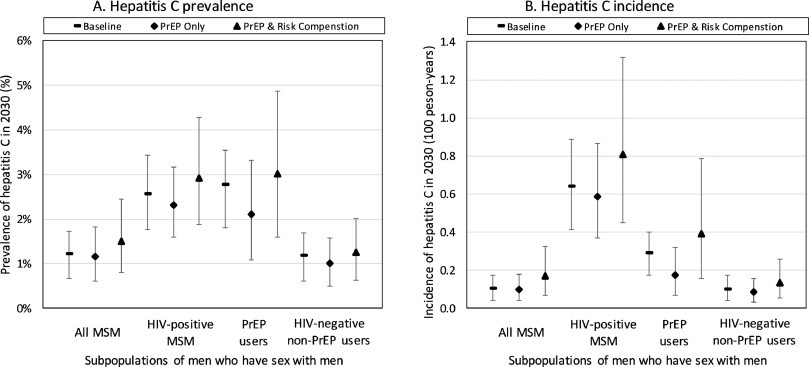
The main aim of the analysis is to determine what level of HCV screening and treatment is needed among different MSM sub-populations to eliminate HCV in all MSM, while incorporating the possible effects of PrEP scale-up. However, we firstly considered the possible impact of using DAAs as the new standard of care from 2015, and the effect that PrEP alone could have on the number of new HIV and HCV infections, as well as HCV prevalence and incidence in 2030 compared to 2018 levels.

We then evaluated the impact of different HCV screening and treatment scenarios initiated from 2020, to see what is needed to achieve the WHO elimination target. We firstly evaluated the impact of more frequent HCV screening for HIV-diagnosed MSM or PrEP users, with PrEP users otherwise having the same low level of HCV screening as HIV-negative MSM. The impact on HCV incidence among MSM using PrEP was estimated, with the relative change being compared to what the incidence was in those MSM in 2018. Similarly, the impact on HCV incidence in other groups was estimated. For these scenarios, we also assumed improved linkage-to-treatment for those MSM sub-groups with enhanced screening, with MSM completing treatment within 6 months of diagnosis. Lastly, we considered whether improved screening and linkage-to-treatment for HIV-negative MSM not using PrEP was needed to reach the elimination targets. For MSM using PrEP and HIV-diagnosed MSM, 3, 6 or 12-monthly screening were considered, while the screening frequency for HIV-negative MSM not using PrEP was fitted to give an overall 90% reduction in HCV incidence by 2030.

2.6 Uncertainty analysis

To ascertain which parameters are important for determining variability in the impact projections across the 500 baseline model fits, a linear regression analysis of covariance (ANCOVA) was performed on the projected decrease in overall HCV incidence (2018–2030) of undertaking 6-monthly screening among HIV-diagnosed MSM and MSM using PrEP (no risk compensation). The proportion of the sum of squares contributed by each parameter was calculated to determine each parameters’ importance to the variability in our projections.

We also performed a series of sensitivity analyses where we varied the following: (1) 4 versus 6 months between HCV diagnosis and treatment completion; (2) 25% versus 12·5% coverage of PrEP; (3) condom use among PrEP users decreases to 13% instead of 34% with risk compensation; (4) PrEP is distributed evenly between high and low-risk MSM, or to (5) just low-risk MSM or (6) just high-risk MSM; (7) no increased infectiousness of HCV with HIV co-infection; (8) 50% less mixing by HIV-status following PrEP introduction; (9) no increased risk associated with chem-sex; (10) HCV transmission rate decreased by 20% from 2012 to simulate a decreasing HCV epidemic before the introduction of DAA treatments, or conversely (11) increased by 20% to simulate an increasing HCV epidemic.

4. Discussion

Our results highlight that PrEP users as well as HIV-diagnosed MSM are important and convenient groups for targeting HCV screening and treatment initiatives because of their higher risk and frequent health check-ups, which are normally every 3 and 6 months, respectively [

25

NHS England. Clinical Commissioning Policy Proposition: Pre-Exposure Prophylaxis (PrEP) to Prevent the Acquisition of HIV in Adults. 2016.

]. Indeed, with 12·5% coverage of PrEP among HIV-negative MSM, yearly HCV screening of MSM on PrEP with rapid linkage-to-treatment could reduce the overall HCV incidence among MSM by up to 67·3% (95%CR 52·7–79·2%) over 2018 to 2030, with this increasing to 79·6% (95% CR 64·6–91·0%) if HIV-diagnosed MSM also receive equivalent screening and treatment. However, although considerable impact is possible from just reaching these groups, at this lower PrEP coverage (12.5%) the WHO HCV elimination targets cannot be reached without also improving screening (and linkage-to-treatment) among HIV-negative MSM not on PrEP to every 3–8 years. This changes, though, at higher PrEP coverage (25·0%), where only HIV-diagnosed MSM and PrEP users will require improved screening to reach the elimination target. Importantly, the required HCV screening frequencies in all MSM groups for achieving elimination are less than their average frequency of HIV testing in the UK [

2

NHS England. Clinical Commissioning Policy Proposition: Pre-Exposure Prophylaxis (PrEP) to Prevent the Acquisition of HIV in Adults. 2016.

,

26]

  • Ong K.J.
  • Desai S.
  • Field N.
  • et al.
Economic evaluation of HIV pre-exposure prophylaxis among men-who-have-sex-with-men in England in 2016.

, suggesting that these increases in HCV testing should be feasible if done at the same time as existing HIV testing using the same blood samples.

Our projections also highlight the importance of maintaining condom use among PrEP users, possibly through including counselling on STI and HCV risk for PrEP users as part of routine healthcare visits. Otherwise, reductions in condom use among PrEP users will increase HCV and STI transmission, especially among PrEP users and HIV-diagnosed MSM. Importantly, though, enhanced HCV screening in PrEP users may offset these additional HCV risks with our modelling suggesting similar impact can be achieved from our screening activities irrespective of the level of risk compensation.

The strength of our analysis is in modelling the full epidemic of HIV and HCV among MSM in the UK, while accounting for heterogeneities in sexual risk, patterns of mixing by HIV-status, and using detailed UK data. Despite these strengths, there are limitations.

Firstly, because the model is UK-specific, it may have limited generalisability to other settings. Although most developed countries have a similar predominance of HCV in HIV-diagnosed MSM, some epidemics were increasing or decreasing before the introduction of DAAs [

3

  • Ghisla V.
  • Scherrer A.U.
  • Nicca D.
  • Braun D.L.
  • Fehr J.S
Incidence of hepatitis C in HIV positive and negative men who have sex with men 2000–2016: a systematic review and meta-analysis.

], while it was relatively stable in the UK in 2012 [

28

  • Martin NK
  • Thornton A
  • Hickman M
  • et al.
Can hepatitis C virus (HCV) direct-acting antiviral treatment as prevention reverse the HCV epidemic among men who have sex with men in the United Kingdom? Epidemiological and modeling insights.

]. Our sensitivity analyses suggest that it will be harder to control an increasing HCV epidemic, with a greater frequency of HCV screening being needed among HIV-negative MSM not on PrEP to reach the elimination targets than for a stable or decreasing HCV epidemic. Unfortunately, more precise parameterisation to specific settings is needed to form more detailed conclusions about the impact of our interventions’ in other settings. Additionally, our projections should not be generalised to lower and middle-income country settings which have different patterns of HIV and HCV prevalence among MSM [

2

  • Platt L.
  • Easterbrook P.
  • Gower E.
  • et al.
Prevalence and burden of HCV co-infection in people living with HIV: a global systematic review and meta-analysis.

].

Secondly, to simplify our modelling we did not attempt to recreate the entire historical HCV epidemic among MSM in the UK [

2

  • Martin NK
  • Thornton A
  • Hickman M
  • et al.
Can hepatitis C virus (HCV) direct-acting antiviral treatment as prevention reverse the HCV epidemic among men who have sex with men in the United Kingdom? Epidemiological and modeling insights.

,

33]

  • Birrell P.J.
  • Gill O.N.
  • Delpech V.C.
  • et al.
HIV incidence in men who have sex with men in England and Wales 2001–10: a nationwide population study.

; rather we assumed a stable HCV epidemic until 2012 (before the introduction of DAA treatments) as approximated by data from around that time. We also did not explicitly model the role of chem-sex; which we simplified by assuming a factor increase in transmission risk, reflective of what is found in the literature (see Supplementary materials). MSM were also assumed to have similar risk behaviour over their entire lifetime [

39

  • Basten M.
  • Heijne J.C.M.
  • Geskus R.
  • Den Daas C.
  • Kretzschmar M.
  • Matser A
Sexual risk behaviour trajectories among MSM at risk for HIV in Amsterdam, the Netherlands.

] due to insufficient data to parameterise transitions between risk groups over time.

Lastly, uncertainty exists in the data used by the model which propagates to uncertainty in our model projections. For instance, as with all large MSM datasets which include detailed sexual behavioural data, the EMIS dataset is likely to be biased towards more highly educated and higher risk MSM due to the need to perform convenience sampling to obtain a large number of respondents [

40

  • Prah P
  • Hickson F
  • Bonell C
  • et al.
Men who have sex with men in Great Britain: comparing methods and estimates from probability and convenience sample surveys.

]. However, because EMIS was widely distributed and undertaken by 18,000 men in UK, these biases should be less than for much smaller surveys undertaken in gay venues [

40

  • Prah P
  • Hickson F
  • Bonell C
  • et al.
Men who have sex with men in Great Britain: comparing methods and estimates from probability and convenience sample surveys.

]. Our uncertainty analyses show the model is most sensitive to the increased infectiousness of HCV among HIV co-infected MSM and the level of heterogeneity in risk in the two risk groups. Better data on these parameters would improve our model projections. Importantly, we also cannot be certain of the exact scale-up of PrEP, nor the level of risk compensation that may occur among PrEP users. Our model projections suggest that uncertainty in the coverage of PrEP could have a large effect on our findings, while encouragingly, uncertainty in levels of risk compensation has little effect on the impact of large increases in screening.

Several modelling studies have projected the impact of HCV treatment among HIV-diagnosed MSM, but none have modelled the full HCV transmission dynamics and HCV treatment elimination requirements for all MSM [

2

  • Martin N.K.
  • Boerekamps A.
  • Hill A.M.
  • Rijnders B.J.A
Is hepatitis C virus elimination possible among people living with HIV and what will it take to achieve it.

,

21

  • Martin N
  • Jansen K
  • van der Heiden M
  • et al.
Can HCV be eliminated among HIV-infected MSM in Berlin? Modeling a setting with increasing incidence and high treatment rates.

,

41

  • Scott N.
  • Stoove M.
  • Wilson D.P.
  • et al.
Eliminating hepatitis C virus as a public health threat among HIV-positive men who have sex with men: a multi-modelling approach to understand differences in sexual risk behaviour.

,

42]

  • Salazar-Vizcaya L.
  • Wandeler G.
  • Fehr J.
  • et al.
Impact of direct-acting antivirals on the burden of HCV infection among persons who inject drugs and men who have sex with men in the Swiss HIV cohort study.

. Our analysis builds on these previous studies by evaluating the level of HCV screening and treatment needed in all MSM sub-groups. Our analysis is novel in considering the effect of PrEP on HCV elimination targets, and the additional screening opportunities this provides. Our work compliments recent modelling from the US showing the beneficial impact that PrEP scale-up could have on STI transmission through more frequent STI screening at routine PrEP check-ups [

43

  • Jenness S.M.
  • Weiss K.M.
  • Goodreau S.M.
  • et al.
Incidence of gonorrhea and chlamydia following human immunodeficiency virus preexposure prophylaxis among men who have sex with men: a modeling study.

].

In the era of PrEP scale-up, our modelling suggests that at low PrEP coverage, 12, 6 or 3-monthly HCV screening of HIV-diagnosed MSM and PrEP users, alongside less frequent screening (every 3–8 years) of HIV-negative non-PrEP users, could achieve the WHO elimination target for decreasing HCV incidence by 2030 in the UK. At higher PrEP coverage, this may be achievable with just increased screening in HIV-diagnosed MSM and PrEP users. Importantly, these elimination targets are not possible through only screening HIV-diagnosed MSM (as most elimination initiatives are doing), with the scale-up of PrEP providing a valuable opportunity for increasing HCV-screening among higher-risk MSM. Importantly, though, this added impact of screening PrEP users relies on the assumption that PrEP users are in regular contact with care, which may not be the case if MSM acquire PrEP through unofficial channels. This emphasises the importance of making PrEP freely available through formal channels to ensure that HCV and other STIs can be tested and treated effectively.

Lastly, our study has direct implications for the NHS-England commitment to eliminate HCV through giving specific screening targets for achieving this goal. For other countries with similar HCV epidemics in MSM [

3

  • Ghisla V.
  • Scherrer A.U.
  • Nicca D.
  • Braun D.L.
  • Fehr J.S
Incidence of hepatitis C in HIV positive and negative men who have sex with men 2000–2016: a systematic review and meta-analysis.

], our findings highlight the need to look beyond just screening HIV-diagnosed MSM, to also screening PrEP users and HIV-negative non-PrEP users.

Partial presentation of results in meetings

N/A.

Financial support

Engineering and Physical Sciences Research Council (EPSRC) studentship for the Ph.D. studies of Louis MacGregor. This work was also partly funded by the Health Protection Research Unit in Evaluation of Interventions.

Acknowledgements

EMIS was funded by a grant of the European Commission under the EU Health Programme 2008-2013, as stipulated in Grant Agreement 2008 12 14 of the Executive Agency for Health and Consumers (EAHC). Further funding was received from CEEISCat (Centre d’Estudis Epidemiològics sobre les ITS/HIV/SIDA de Catalunya, Spain); Department of Health for England; Maastricht University (The Netherlands); Regione del Veneto (Italy); and Robert Koch Institute (Germany). Further funding was provided by: German Ministry of Health for the participation of men living in Ukraine and Moldova; Finnish Ministry of Health for Finland; Norwegian Institute of Public Health for Norway; Swedish Board of Health and Welfare for Sweden; and Bundeszentrale für gesundheitliche Aufklärung (BzGA) for German resident men.

MH and PV would also like to acknowledge support from the NIHR funded Health Protection Research Unit in Evaluation of Interventions. PV would also like to acknowledge the NIHR funded Health Protection Research Unit in STIs and BBVs. NM was supported by the National Institute for Drug Abuse [grant number R01 DA037773 ] and the University of California San Diego Center for AIDS Research (CFAR), a National Institute of Health (NIH) funded program [grant number P30 AI036214 ].


Related Posts

How Machine Learning has impacted Consumer Behaviour and Analysis
Consumer Research

How Machine Learning has impacted Consumer Behaviour and Analysis

January 4, 2024
Market Research The Ultimate Weapon for Business Success
Consumer Research

Market Research: The Ultimate Weapon for Business Success

June 22, 2023
Unveiling the Hidden Power of Market Research A Game Changer
Consumer Research

Unveiling the Hidden Power of Market Research: A Game Changer

June 2, 2023
7 Secrets of Market Research Gurus That Will Blow Your Mind
Consumer Research

7 Secrets of Market Research Gurus That Will Blow Your Mind

May 8, 2023
The Shocking Truth About Market Research Revealed!
Consumer Research

The Shocking Truth About Market Research: Revealed!

April 25, 2023
market research, primary research, secondary research, market research trends, market research news,
Consumer Research

Quantitative vs. Qualitative Research. How to choose the Right Research Method for Your Business Needs

March 14, 2023
Next Post
Notable Books for 2019: A Brief Survey of Some of Last Year’s Best Christian Books | The Exchange

Notable Books for 2019: A Brief Survey of Some of Last Year’s Best Christian Books | The Exchange

Categories

  • Consumer Research
  • Data Analysis
  • Data Collection
  • Industry Research
  • Latest News
  • Market Insights
  • Marketing Research
  • Survey Research
  • Uncategorized

Recent Posts

  • Ipsos Revolutionizes the Global Market Research Landscape
  • How Machine Learning has impacted Consumer Behaviour and Analysis
  • Market Research: The Ultimate Weapon for Business Success
  • Privacy Policy
  • Terms of Use
  • Antispam
  • DMCA

Copyright © 2024 Globalresearchsyndicate.com

Welcome Back!

Login to your account below

Forgotten Password?

Retrieve your password

Please enter your username or email address to reset your password.

Log In
This website uses cookies to improve your experience. We'll assume you're ok with this, but you can opt-out if you wish. Cookie settingsACCEPT
Privacy & Cookies Policy

Privacy Overview

This website uses cookies to improve your experience while you navigate through the website. Out of these cookies, the cookies that are categorized as necessary are stored on your browser as they are essential for the working of basic functionalities of the website. We also use third-party cookies that help us analyze and understand how you use this website. These cookies will be stored in your browser only with your consent. You also have the option to opt-out of these cookies. But opting out of some of these cookies may have an effect on your browsing experience.
Necessary
Always Enabled
Necessary cookies are absolutely essential for the website to function properly. This category only includes cookies that ensures basic functionalities and security features of the website. These cookies do not store any personal information.
Non-necessary
Any cookies that may not be particularly necessary for the website to function and is used specifically to collect user personal data via analytics, ads, other embedded contents are termed as non-necessary cookies. It is mandatory to procure user consent prior to running these cookies on your website.
SAVE & ACCEPT
No Result
View All Result
  • Latest News
  • Consumer Research
  • Survey Research
  • Marketing Research
  • Industry Research
  • Data Collection
  • More
    • Data Analysis
    • Market Insights

Copyright © 2024 Globalresearchsyndicate.com



