GLOBAL RESEARCH SYNDICATE
No Result
View All Result
  • Login
  • Latest News
  • Consumer Research
  • Survey Research
  • Marketing Research
  • Industry Research
  • Data Collection
  • More
    • Data Analysis
    • Market Insights
  • Latest News
  • Consumer Research
  • Survey Research
  • Marketing Research
  • Industry Research
  • Data Collection
  • More
    • Data Analysis
    • Market Insights
No Result
View All Result
globalresearchsyndicate
No Result
View All Result
Home Data Collection

One Year Ago, NASA’s New Horizons Made the Most Distant Flyby in Space History

globalresearchsyndicate by globalresearchsyndicate
January 1, 2020
in Data Collection
0
One Year Ago, NASA’s New Horizons Made the Most Distant Flyby in Space History
0
SHARES
6
VIEWS
Share on FacebookShare on Twitter

In the early hours of 2019, NASA’s New Horizons zipped past the Kuiper Belt Object 2014 MU69, making the most distant spacecraft flyby ever performed. Over the last 12 months, researchers have teased a lot of information out of the images captured over the few hours leading up to and after the exploration of one of the most primordial objects in the solar system.

“It seems like it was just yesterday—time flies!” New Horizons co-investigator Fran Bagenal, a researcher at the University of Colorado Boulder, told Space.com by email.

Team member Kelsi Singer, a planetary scientist at the Southwest Research Center in Colorado, echoed the sentiment. “I can’t believe it was already a year ago,” Singer said.

Within the first week, researchers knew that MU69, now officially named Arrokoth, was made up of two flattened lobes, more like joined pancakes than a space snowman. In the intervening months, they determined the precise sizes of the lobes and their densities, measuring surface brightness and crater scars.

Video:
Relive NASA’s Historic Kuiper Belt Flyby of New Horizons
Related:
New Horizons’ Arrokoth Flyby in Pictures

A year of images
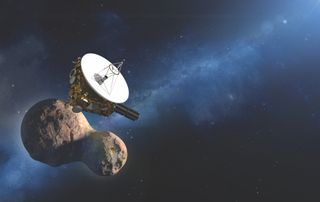
Image 1 of 7

NASA's New Horizons spacecraft flies by the Kuiper Belt object Ultima Thule on Jan. 1, 2019 in this artist's illustration. It's the furthest planetary flyby in history.

NASA’s New Horizons spacecraft flies by the Kuiper Belt object Ultima Thule on Jan. 1, 2019 in this artist’s illustration. It’s the furthest planetary flyby in history. (Image credit: Adrian Mann/All About Space)
Image 2 of 7

New Horizons principal investigator Alan Stern (center) celebrates with school children at the moment the spacecraft was planned to reach its closest approach to Kuiper Belt object Ultima Thule on Jan. 1, 2019 at the Johns Hopkins University Applied Physics Laboratory. It is the furthest flyby in history.

New Horizons principal investigator Alan Stern (center) celebrates with school children at the moment the spacecraft was planned to reach its closest approach to Kuiper Belt object Ultima Thule on Jan. 1, 2019 at the Johns Hopkins University Applied Physics Laboratory. It is the furthest flyby in history. (Image credit: Bill Ingalls/NASA)
Image 3 of 7

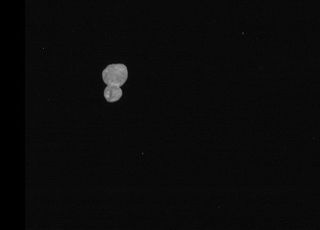
If you prefer Kuiper Belt objects appearing to dance across your screen, New Horizons has you covered there, too.

If you prefer Kuiper Belt objects appearing to dance across your screen, New Horizons has you covered there, too. (Image credit: NASA/Johns Hopkins University Applied Physics Laboratory/Southwest Research Institute/National Optical Astronomy Observatory)
Image 4 of 7

A new map produced by the New Horizons team appears to show the many different lumps of rock that converged to form the object nicknamed Ultima Thule.

A new map produced by the New Horizons team appears to show the many different lumps of rock that converged to form the object nicknamed Ultima Thule. (Image credit: NASA/Johns Hopkins University Applied Physics Laboratory/Southwest Research Institute/ESA)
Image 5 of 7

This composite image of the small Kuiper Belt object 2014 MU69, now officially named Arrokoth, was compiled from data obtained by NASA's New Horizons spacecraft as it flew by the object on Jan. 1, 2019. The image combines enhanced color data (close to what the human eye would see) with detailed high-resolution panchromatic pictures. 

This composite image of the small Kuiper Belt object 2014 MU69, now officially named Arrokoth, was compiled from data obtained by NASA’s New Horizons spacecraft as it flew by the object on Jan. 1, 2019. The image combines enhanced color data (close to what the human eye would see) with detailed high-resolution panchromatic pictures.  (Image credit: NASA/Johns Hopkins University Applied Physics Laboratory/Southwest Research Institute//Roman Tkachenko)
Image 6 of 7

NASA's New Horizons spacecraft flew by the distant Kuiper Belt object Ultima Thule (2014 MU69) on Jan. 1, 2019.

NASA’s New Horizons spacecraft flew by the distant Kuiper Belt object Ultima Thule (2014 MU69) on Jan. 1, 2019. (Image credit: NASA/Johns Hopkins University Applied Physics Laboratory/Southwest Research Institute/National Optical Astronomy Observatory)
Image 7 of 7

(Image credit: NASA/Johns Hopkins University Applied Physics Laboratory/Southwest Research Institute)

New Horizons flew past 2014 MU69 on January 1, 2019 at 12:33 am EST, buzzing only 2,200 miles (3,538 km) above the object’s surface. When the spacecraft  approached Arrokoth, all researchers had was a measurement of the object’s size and orbit and a rough understanding of its reddish color and relatively unchanging brightness. The first few moments put much of that uncertainty to rest.

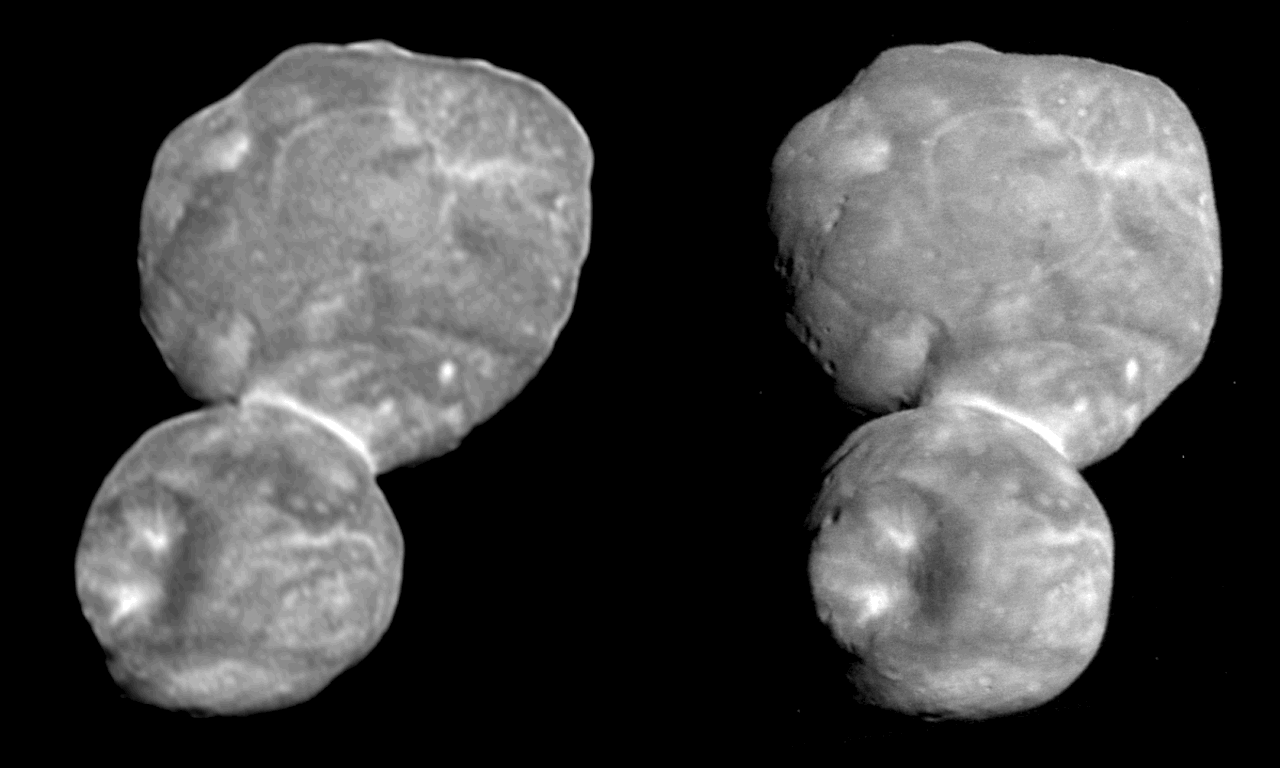
Arrokoth consists of two lobes. The larger lobe, nicknamed Ultima, is approximately 13.5 miles (22 kilometers) long, 12 miles (20 km) wide, and 4 miles (7 km) thick. The smaller lobe, Thule, is more circular, roughly 8.5 miles (14 km) by 8.5 miles (14 km) with a thickness of 6 miles (10 km).

According to observations, the two lobes most likely formed at about the same time more than 4.5 billion years ago, at the dawn of the solar system. While they experienced some light cratering—including a massive blow that left Maryland, an extensive crater on Ultima that stretches 4.3 miles (7 km) across the surface—Arrokoth remains relatively unscathed since its birth. Scientists expect that impacts came early in Arrokoth’s lifetime, then tapered off, making it one of the most pristine bodies in the solar system.

“I find it fascinating that Arrokoth is so lightly cratered,” Singer said. The dearth of scars suggests that the Kuiper Belt Object (KBO) changed very little since its early birth. Most of the craters are surprisingly large, with few mid-sized or small craters scarring Arrokoth. “That tells us that there are not a lot of small objects out there,” Singer said.
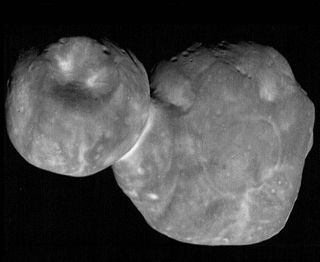
The most detailed image of Arrokoth, captured just minutes before New Horizons made its closest approach on Jan. 1, 2019.

The most detailed image of Arrokoth, captured just minutes before New Horizons made its closest approach on Jan. 1, 2019. (Image credit: NASA/Johns Hopkins Applied Physics Laboratory/Southwest Research Institute, National Optical Astronomy Observatory)

Its early origin was one of the primary reasons Arrokoth was selected for exploration. Scientists had hoped that they would be able to catch a glimpse of the building blocks of early solar system formation in the KBO, a hope that Arrokoth more than fulfilled. The lack of scarring around the neck, where the two lobes joined, suggest a gentle collision. This led researchers to surmise that Ultima and Thule likely formed separately at about the same time, then slowly spiraled into one another to create a single object.

“I think it’s really interesting that people can look at the two parts of the object and estimate that they must have come together so slowly, almost equivalent to walking pace,” Bagenal said.

Arrokoth rotates on its axis once every 16 hours as it makes its 293-Earth-year orbit around the sun. Unlike Earth, whose rotation axis is roughly perpendicular to its orbit, Arrokoth keeps its north pole pointed towards the sun, resulting in long polar days and nights when regions may receive decades of daylight or darkness.
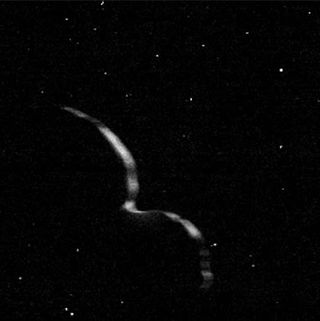
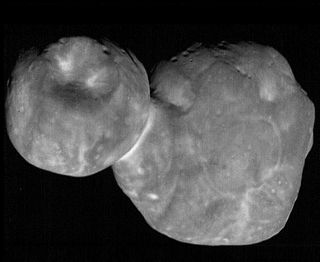
The crescent of Arrokoth, captured when New Horizons looked back at the object after the historic New Horizons flyby of Jan. 1, 2019.

The crescent of Arrokoth, captured when New Horizons looked back at the object after the historic New Horizons flyby of Jan. 1, 2019. (Image credit: NASA/Johns Hopkins Applied Physics Laboratory/Southwest Research Institute, National Optical Astronomy Observatory)

New Horizons also mapped the features of Arrokoth, charting its composition, bright spots, and fractures across the surface. The most volatile ices long ago escaped from the tiny object, but methanol, acetylene, ethane and hydrogen cyanide would have been retained. As radiation from the distant sun and other stars hit Arrokoth, hydrogen would have slowly been released, turning the ices into material known as tholins. On Pluto’s moon Charon, an earlier target of New Horizons, tholins create the reddish cap at the north pole. They may also be responsible for the reddish color of Arrokoth.

Not all of New Horizons’ data has been returned to Earth. 

Although Singer said that all of the images from closest approach have returned to Earth, the spacecraft will continue to send home data until the mid-2020s at a speed of only a few bits per minute. Once it has all returned to Earth, the team hopes to begin the hunt for the next target using telescopes back on Earth.

“The team has made a ton of progress on interpreting Arrokoth and what it means for solar system formation,” Singer said. “It is still amazing to me that humanity now has pictures of one of the most primordial objects in our solar system.”

And New Horizons’s work may not be finished. 

Alan Stern, the principal investigator of New Horizons, has said the mission team is still looking for other flyby targets that may arise in the Kuiper Belt. 

“So as we look forward to the 2020s, our team is planning the next few years for New Horizons,” he said in a blog post earlier this month, adding that the search won’t start until this summer. “We don’t know how many KBOs we will discover or whether any will be within our fuel supply to reach for a final close flyby, but that’s what these searches, in 2020 and again in 2021, will reveal.”

Follow Nola on Facebook and on Twitter at @NolaTRedd. Follow us on Twitter @Spacedotcom and on Facebook. 

All About Space Holiday 2019

Need more space? Subscribe to our sister title “All About Space” Magazine for the latest amazing news from the final frontier! (Image credit: All About Space)

Related Posts

How Machine Learning has impacted Consumer Behaviour and Analysis
Consumer Research

How Machine Learning has impacted Consumer Behaviour and Analysis

January 4, 2024
Market Research The Ultimate Weapon for Business Success
Consumer Research

Market Research: The Ultimate Weapon for Business Success

June 22, 2023
Unveiling the Hidden Power of Market Research A Game Changer
Consumer Research

Unveiling the Hidden Power of Market Research: A Game Changer

June 2, 2023
7 Secrets of Market Research Gurus That Will Blow Your Mind
Consumer Research

7 Secrets of Market Research Gurus That Will Blow Your Mind

May 8, 2023
The Shocking Truth About Market Research Revealed!
Consumer Research

The Shocking Truth About Market Research: Revealed!

April 25, 2023
market research, primary research, secondary research, market research trends, market research news,
Consumer Research

Quantitative vs. Qualitative Research. How to choose the Right Research Method for Your Business Needs

March 14, 2023
Next Post
Baby steps to a brand new you: Life coach on how to find new resolution in 2020

Baby steps to a brand new you: Life coach on how to find new resolution in 2020

Categories

  • Consumer Research
  • Data Analysis
  • Data Collection
  • Industry Research
  • Latest News
  • Market Insights
  • Marketing Research
  • Survey Research
  • Uncategorized

Recent Posts

  • Ipsos Revolutionizes the Global Market Research Landscape
  • How Machine Learning has impacted Consumer Behaviour and Analysis
  • Market Research: The Ultimate Weapon for Business Success
  • Privacy Policy
  • Terms of Use
  • Antispam
  • DMCA

Copyright © 2024 Globalresearchsyndicate.com

Welcome Back!

Login to your account below

Forgotten Password?

Retrieve your password

Please enter your username or email address to reset your password.

Log In
This website uses cookies to improve your experience. We'll assume you're ok with this, but you can opt-out if you wish. Cookie settingsACCEPT
Privacy & Cookies Policy

Privacy Overview

This website uses cookies to improve your experience while you navigate through the website. Out of these cookies, the cookies that are categorized as necessary are stored on your browser as they are essential for the working of basic functionalities of the website. We also use third-party cookies that help us analyze and understand how you use this website. These cookies will be stored in your browser only with your consent. You also have the option to opt-out of these cookies. But opting out of some of these cookies may have an effect on your browsing experience.
Necessary
Always Enabled
Necessary cookies are absolutely essential for the website to function properly. This category only includes cookies that ensures basic functionalities and security features of the website. These cookies do not store any personal information.
Non-necessary
Any cookies that may not be particularly necessary for the website to function and is used specifically to collect user personal data via analytics, ads, other embedded contents are termed as non-necessary cookies. It is mandatory to procure user consent prior to running these cookies on your website.
SAVE & ACCEPT
No Result
View All Result
  • Latest News
  • Consumer Research
  • Survey Research
  • Marketing Research
  • Industry Research
  • Data Collection
  • More
    • Data Analysis
    • Market Insights

Copyright © 2024 Globalresearchsyndicate.com