


TWH – The Pew Research Center has released a report, “Religion and Living Arrangements Around the World.” Living arrangements refer to types of households. These include extended families, two-parent families, living alone, single-parent families etc.
The Pew Center only examined religions with more than 500,000 people within a country. That limited their research to Buddhists, Christians, Hindus, Jews, Muslims, and the “Nones.” The term “Nones” refers to the growing number of people without a religious identity.
The Center did not examine the types of living arrangements reflective of Pagan culture(s). Considering the variation in Pagan practices and beliefs about gender, procreation, and sexuality, it would be difficult to identify their impact.
Besides religious belief, other factors influence living arrangements. These other factors include epidemics, migration, wars, and economics. The Pew Center found that as countries become more “developed” and wealthy, the size of households decreased. The average number of people in a household varied from 2.7 people in Germany to 13.8 people in The Gambia.
Among all six identified religious groups with the exception of Jews, most people lived in either extended families or two-parent households.
Hindus
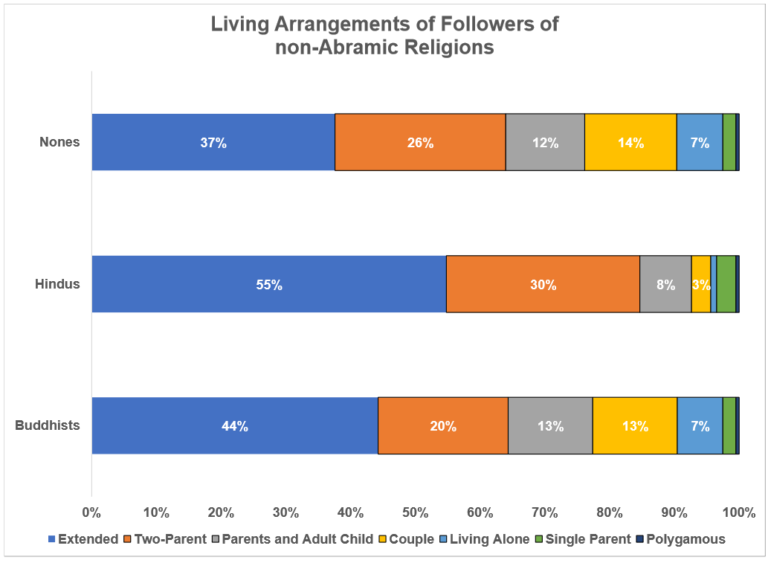
This group showed the least variation among all six identified religious groups. About 85% of all Hindus lived in either extended families (55%) or two-parent households (30%). About 90% of all Hindus live in India. This concentration conflates Indian issues with those of Hinduism as a whole.
Buddhists and Nones
More Buddhists (44%) live in extended families than do Nones (37%). Both groups show surprising similarities. They have almost identical rates of parents living with adult children (13% and 12%), childless couples (13% and 14%), and people living alone (7% and 7%). China has a great impact because of its huge populations. China has large numbers of Buddhists and of the Nones. From 1979 to 2016, China had a one-child-per-family policy. This policy contributed to the small family size among both Buddhists and the Nones.
Muslims
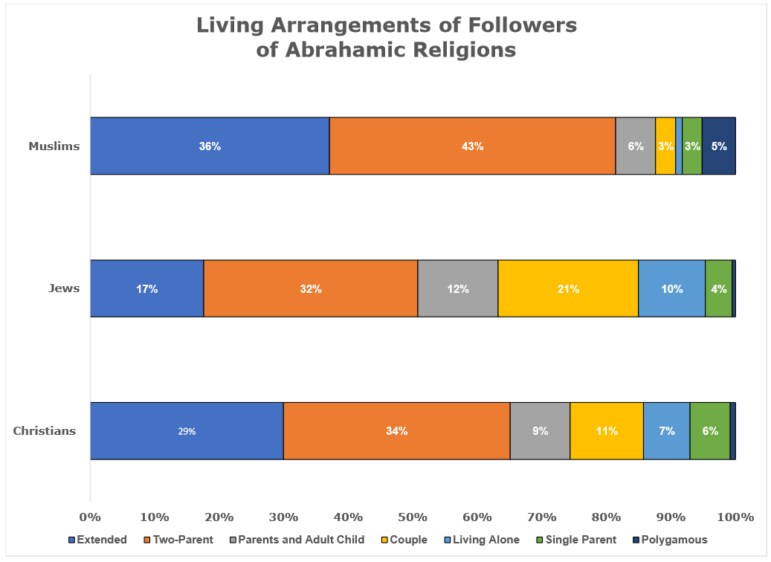
Among Abrahamics, Muslims show the least variation in living arrangements. About 79% of Muslims live in either extended families (36%) or two-parent households (43%). Muslims averaged the highest number of individuals per household (6.4) of all groups. Only 59% of countries in the heavily Muslim Middle East/North Africa (MENA) region provided data. This lack of data introduces a level of uncertainty into statements about Muslims.
Jews
In most groups, the majority live in either an extended family or a two-parent household. This differs among Jews. Only 49% do. About 17% of Jews live in an extended family. Another 32% live in a two-parent household. Jews also have the highest rates for living as a couple (21%) or living alone (10%). Most Jews live in either Israel or the US, both “developed” countries. This follows the pattern of more “development” leading to smaller households.
Christians
This group has the largest percentage of its followers living as single parents (6%). About 60% of Christians live in the Americas and Europe. However, only two-thirds of countries in Latin America had available data. If more Latin countries had available data, this figure might differ.
Polygamy
About 11% of people living south of the Sahara live in polygamous households. In that area, about a quarter of the Muslims from this region live in polygamous households. Some African folk religions encourage polygamy. The MENA (Middle East/North Africa) region could have higher rates of male-dominated polygamy, but only 59% of MENA countries had available data. For example, Saudi Arabia did not. If more MENA countries had provided data, the percent living in polygamy might be different and likely higher. The Arabian Gulf region could plausibly be another center for polygamy.
Gender issues
Around the world, independent of religion and geography, women are more likely than men to be single parents. Among people 60 and older, more women than men tend to live alone. This may be partly due to younger death rates for men and older men tending to marry younger women. The percent of older women living alone varies by religion. While 33% of Christian and Jewish women over 60 live alone, only 6 percent of Hindu women do.
How the Pew Center collected this data
Pew obtained data on religion and living arrangements from 130 countries, representing 91% of the world’s population. That missing 9%, however, includes Australia and New Zealand/Aotearoa. It also includes one-third of Latin American countries and 41% of MENA countries. In Africa, that missing 9% includes Tanzania, Burundi, South Sudan, Sudan, Western Sahara, and Morocco.
Cultural factors, like religion, do have some influence on living arrangements. Economics, however, appears to have a greater influence. Generally, the more a society has become “economically developed,” the more people will live in smaller groups.







