

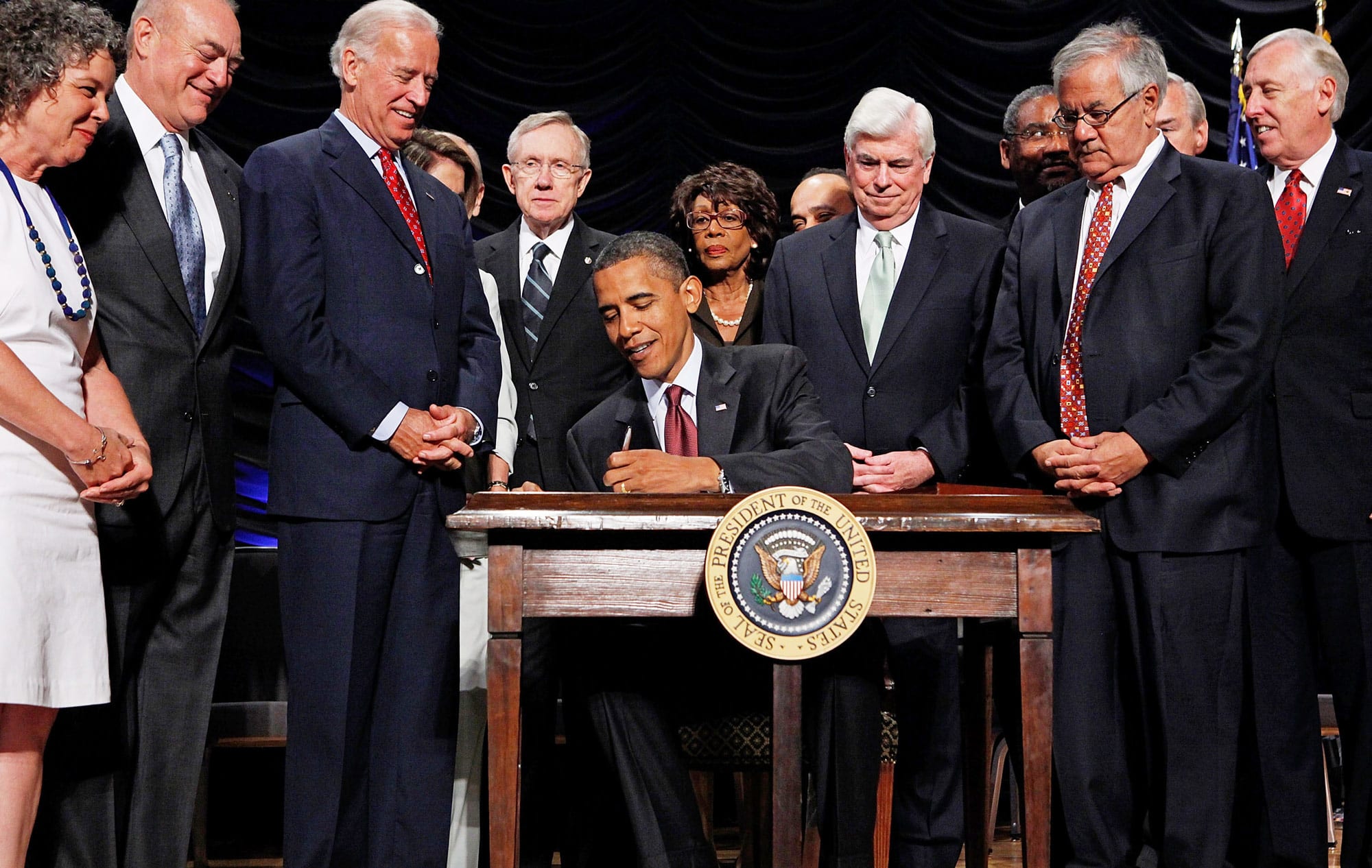
President Barack Obama signs the the financial reform bill into law July 21, 2010.
Getty Images
To sum up the past decade, you could call it a tale of two presidents.
For evidence of that, look no further than the Dodd-Frank Wall Street Reform and Consumer Protection Act.
The financial overhaul legislation was signed into law by then-President Barack Obama on July 21, 2010.
On the heels of the financial crisis, it was intended to help rein in banks. The law also paved the way for tougher consumer protections.
It ordered the SEC to evaluate how the industry provides investment advice to retail customers. In 2011, the agency released a study advocating for the creation of a uniform fiduciary standard for investment advisors and broker-dealers.
The measure also called for the creation of the Consumer Financial Protection Bureau, a government body specifically devoted to serving as a consumer watchdog.
Fast forward: On May 24, 2018, President Donald Trump signed a rollback of a number of banking regulations that were included in that law.
After signing, U.S. President Donald Trump holds up an executive order rolling back regulations from the 2010 Dodd-Frank law on Wall Street reform at the White House in Washington February 3, 2017.
Kevin Lamarque | Reuters
And while that didn’t affect the two big consumer protections, it is up for debate whether consumers are in a better position almost a decade later.
Aaron Klein, a fellow in economic studies at Brookings Institution who helped craft the Dodd-Frank Act, said the answer is a definitive no.
“The Trump administration took over,” Klein said. “They told the police to take a break, and they stopped recording crime.”
“Ultimately, consumers will lose billions of dollars as a result of purposeful neglect,” he said.
Fiduciary failure?
One of the big misses this decade, investor advocates argue, is the failure to establish a fiduciary rule.
The regulation was aimed at getting brokers and investment advisors to adhere to a higher standard when providing advice for clients.
Many advocates consider the fiduciary standard to be better protection, because it requires financial professionals to put their clients’ best interests ahead of their own.
Investment advisors, for example, have traditionally been held to that. Brokers, meanwhile, have answered to something known as the suitability rule, which means brokers were free to sell clients any investment as long as it was “suitable” for the client at the time, even if cheaper alternatives were available.
Efforts to put together a joint fiduciary rule created an ongoing saga over the past decade.
Despite the SEC’s authority to issue a fiduciary rule, the panel mostly didn’t take action following its 2011 report. It wasn’t until this year that the agency began rolling out a rule called Regulation Best Interest.
While the SEC stalled, the Department of Labor and even some states moved to establish their own fiduciary rules. The Department of Labor’s efforts were squashed when the Trump administration took over. But the DOL has said it plans to work on a new rule governing retirement accounts.
While Regulation Best Interest is legally in force, financial firms have until June to comply.
Comedian John Oliver takes a shot at non-fiduciary financial advisors and their spiraling 401(k) fees on a recent segment of “Last Week Tonight.”
Source: Last Week Tonight | HBO | YouTube
The rule, called Reg BI for short, requires brokers to keep retail customers’ best interests in mind when recommending securities. It also requires broker-dealers and investment advisors to provide clients with a new form that summarizes the relationship.
Critics say the rule falls short of providing investors with full fiduciary coverage.
“It, to some degree, made the area more complex and harmful for consumers,” said Jamie Hopkins, director of retirement research at Carson Group and professor at Creighton University Heider College of Business.
“They’ve expanded the use of the language ‘best interest,’ when in my belief that’s really ‘suitability’ plus additional disclosures,” Hopkins said.
Yet many in the financial industry have embraced the rule.
Earlier this month, Kenneth Bentsen Jr., president and CEO of the Securities Industry and Financial Markets Association, an industry trade group that represents securities firms, called Reg BI a “robust and strict standard.”
“It is not a disclosure-only based rule,” Bentsen said. “It is much stricter than that.”
Hopkins argues that the change puts the burden on the consumer to ask financial advisors if they are fiduciaries and to clarify how they get paid and what services they provide.
“If that’s something you want, have the advisor put that in writing that they are a fiduciary,” Hopkins said.
Consumer watchdog: More bark than bite?
As with the fiduciary rule, efforts to develop the Consumer Financial Protection Bureau into a robust watchdog have also taken different turns amid the change in administrations.
For evidence, look no further than to the CFPB’s own shifting leadership.
When Richard Cordray, the first director of the CFPB, announced in November 2017 that he was stepping down, both he and President Trump named a replacement.
Cordray promoted chief of staff Leandra English to the role of deputy director and said she would serve as acting director until the Senate confirmed a successor.
Instead, Trump named his own acting director, Mick Mulvaney.
Consumer advocates complained that the CFPB’s authority was watered down under Mulvaney’s leadership, citing an April New York Times Magazine article, “Mick Mulvaney’s Master Class in Destroying a Bureaucracy from Within.”
Last December, Kathy Kraninger was confirmed by the Senate as the new director. To cap off her one-year anniversary, the CFPB recently put out a release boasting of its accomplishments.
On that list is an item — payday loans — that has sparked criticism. These short-term loans often saddle consumers with high interest rates as they try to cover their cash needs between paychecks.
In 2017, the CFPB issued a rule that would establish stricter regulations for payday lenders. But this year, the agency has proposed delaying compliance and rescinding tougher underwriting requirements that lenders would face.
“The biggest concerns that we see with the CFPB today is they are holding the hands of the payday lenders,” said Linda Jun, senior policy counsel at Americans for Financial Reform.
“That means that the debt trap will continue and people will continue to lose their cars and their bank accounts as a result of the continued destruction of payday loans,” she said.
Klein also criticized the agency for “rewarding the naughty list.”
“They have stuffed the stockings of payday lenders and the people who were convicted or pleaded guilty to financial malfeasance by reducing fines,” he said.
The good news is that Congress has left the CFPB intact, which means a new administration could re-energize it, Klein said.
A woman enters an All American Check Cashing location in Brandon, Miss., May 12, 2017.
Rogelio V. Solis | AP
“A new director would have substantial authority to revive the agency, and elections have consequences,” Klein said. “The CFPB day to day, month to month, needs to be independent.”
However, not everyone agrees that having a separate agency dedicated to consumer protection is necessary.
The Federal Trade Commission already protects consumers against fraud, said Norbert Michel, director for the Center for Data Analysis at the Heritage Foundation, a conservative think tank.
“All you did was give this new agency this vague new power and said we’re going to figure it out later on, which isn’t doing anything to protect anyone against fraud,” Michel said.
The CFPB’s evolution has helped to do one thing: raise public awareness of consumer protection issues, Jun said.
But as with the fiduciary rule, the onus is on the consumer to ask the right questions — and speak up if they are wronged.
Individuals should still turn to the CFPB’s public complaint database to make their voices heard, Jun said. They should also consider talking to a lawyer or reporting egregious practices to their state attorneys general, she said.
“If something doesn’t seem right to you, look into it,” Jun said.







