

While eight reindeer whose names are known to many are presumably resting up from their annual holiday lap around the globe, some of their more anonymous associates — and the communities that depend on them — are increasingly imperiled by climate change, according to a new study co-led by a University of Colorado Boulder researcher.
A new study led by archaeologist William Taylor, an assistant professor of anthropology at CU Boulder, suggests ice patches in the Sayan Mountains of northern Mongolia, as well as the people and animals, including reindeer, it supports, could be at risk because of soaring global temperatures.
The so-called “eternal ice,” known locally as munkh mus, snowy spots that provide people of the region with drinking water and a place to cool down their herds in summer months, is proving to be no less vulnerable to the changing global atmosphere than countless other aspects of Earth’s environment.
Taylor is the lead author of a study highlighting work by he and his colleagues published recently in the journal PLOS ONE.
“If had to pick what’s the bottom line here, what’s the takeaway, I think it’s very clear the takeaway is that this global climate change here is directly and immediately affecting the lives of contemporary people, people who played little to no role in creating the issue,” said Taylor, who also is the curator of archaeology at the University of Colorado Museum of Natural History.
“At the same time, it’s also erasing some of the only clues we have into understanding even entire ways of life and human history, in ways we haven’t fully grasped or integrated into our understanding of our past.”
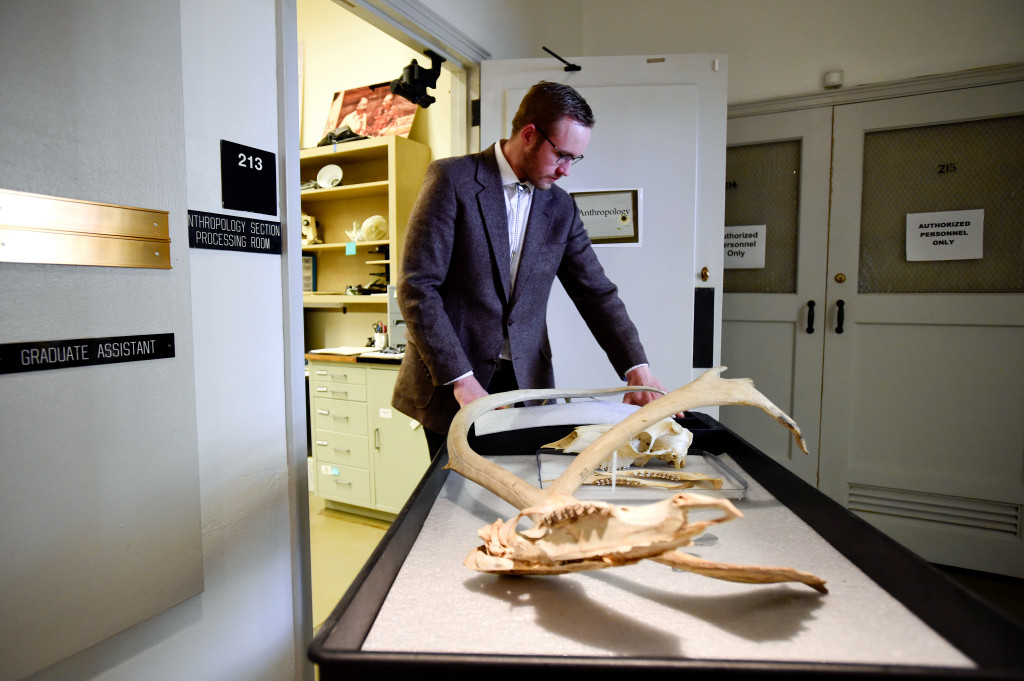
Taylor’s specific discipline is archeozoology, essentially studying the remains from archaeological sites, examining bones as a window into the earliest stages of animal domestication, typically focusing on horses and other large animals. He has been active in research based in Mongolia, he said, since 2011.
In high mountain ice patches — not the same as glaciers, which can be likened more to slow moving rivers of ice, he said — “there is a lot of water, plants animals that congregate, and they accumulate stuff. Some of it is biological, ancient, plant and animals, and even some cultural artifacts.”
Through work in similar environments in Alaska, Taylor said, he learned “some of these areas are now experiencing summer temperatures beyond anything known in recent history. The ice is melting now, in some cases, for the very first time, to an extent not seen in centuries or even millennia. And so, as that’s happening, the material that has been contained within, has started to sort of be kicked out from these features.”
Research on horseback
In the last two decades, temperatures in Mongolia have risen almost 4 degrees Fahrenheit above the 20th Century average. That could spell trouble for northern Mongolia’s reindeer herders, known as the Tsaatan, of whom there are now just about 30 families.
That’s because reindeer, known as caribou in North America, are animals that love the cold and can overheat in warm weather, according to Taylor. Accordingly, the Tsaatan bring their herds to the ice to give them a break from the heat and the tundra’s abundant insects.

When a friend who is a Mongolian reindeer herder extended an invitation to visit, that prompted an initiative by Taylor and his colleagues to learn more about how climate change might threaten such people’s way of life.
He and his team hopped onto horses in 2018 and went into Mongolian tundra to interview Tsaatan herders from eight families. What they learned is that many of the ice patches on which they’d depended weren’t just melting, but were vanishing at summer’s peak, which they could not recall ever happening before.
They also conducted an archaeological survey of 11 melting ice patches. In doing so, they unearthed several artifacts, including two carved branches that may have once been part of a fishing pole. Similar discoveries, the team reported, could vanish forever in the melting ice.
“Archaeology is non-renewable,” Julia Clark, an archaeologist at Flinders University in Australia who led the project alongside Taylor, said in a statement. “Once the ice has melted and these artifacts are gone, we can never get them back.”
Following that 2018 field season, conducted in the Sayan Mountains at about 8,200 feet, Taylor and company conducted a 2019 summer field season at a higher altitude in the Altai range in western Mongolia, where reindeer are not herded — but there are plenty of yaks, sheep and goats.
“We did not get past the first locality that we surveyed at, because there was so much material” coming out of melting ice patches there, he said.
“We had to spend our entire field season at that one corner of the Altai. We found, I think, more than 40 projectiles —arrows and potentially spear shafts. We found completely preserved horsehair rope, melting out. Really, the star find was a completely intact arrow — the arrowhead, the arrow shaft, the sinew used to haft it all together, all of that directly melting out of the ice.”
The arrowhead on that find was bronze, he said, indicating it was probably 2,500 to 3,000 years old.
That indicates he said, ice patches in that region are “melting out for the very first time. We haven’t got a handle on how widespread the melting is, or what scale of artifacts may be exposed, at this point.”
A 2020 summer field campaign is going to attempt to change that, likely requiring an expanded team and expanded field season.
‘We are not exempt’
Taylor sees his work as resonating in the field of anthropology, archaeology, glacial science and more.
“I think what we’re finding in 2019 here is that the things that used to be kind of separate silos in science … you used to be able to classify as, ‘Here’s a story about changes to traditional ways of life,’ or ‘here’s a story about climate change,’ or ‘here’s a story about archaeology’ — this story is about the ways those lines are blurring, as the scope of the problems this world increase,” he said.
“It is definitely a climate change story. It is also a story about the possibility of archaeology telling us things about some of the most important developments in world history. It’s also a story about the loss of cultural heritage. It’s also a story about folks trying to adapt to loss of habitat. It’s all of these things woven together.”
It should not be hard, Taylor said, for people sitting comfortably at home in Boulder County — most of them not herders of large high-altitude animals — to care about what his study is revealing.
“In a general sense, these are data that are critical for the human game plan going forward,” Taylor said. “Another reason though, that’s perhaps a bit more tailored to people living on the eastern flank of the Rocky Mountains, is that we are not exempt from the impacts of climate change on mountain ecosystems.
“The impacts to hydrology that are changing the bottom line for reindeer herders on eastern flank of the Altai mountains are really not at all different from the kinds of processes that are playing out in our corner of the world.”
Craig Lee, a research scientist at CU Boulder’s Institute of Arctic and Alpine Research, also contributed to the new study.
Other coauthors included researchers from the Humboldt University of Berlin; University of Arizona; National Museum of Mongolia; Clearview Animal Hospital; Mongolia’s State Central Veterinary Laboratory; and the University of New Mexico.







