

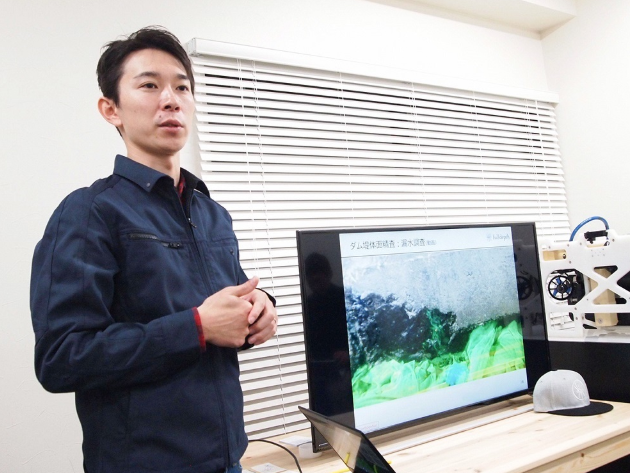
The industrial underwater drone “DiveUnit300” is a new product launched on November 26 by FullDepth (Taito-Ku, Kuramae), a venture company from Tsukuba that handles underwater drone development. It can dive to a maximum depth of 300m and is useful for underwater infrastructure inspection and maintenance. The industrial use of drones is now steadily underwater.

The growing use of underwater drones for industrial use 2019 was a year in which industrial use of flying drones was further accelerated. In a wide range of fields such as logistics, disaster preparedness, inspection, surveying, and agriculture, the use of drones to automatically navigate and acquire various data is progressing, and in June, “ Roadmap for the Industrial Revolution in the Sky 2019 ” was announced. The legal development is also accelerating.
Under such circumstances, industrial use “under the surface” is also steadily progressing. In the past, underwater surveys, which once cost millions of yen in the deep sea with a depth of less than 200m, were costly in the order of 10 million yen to 100 million units, are now being replaced with relatively inexpensive underwater drones. It is getting. FullDepth, a Tsukuba-based startup that develops underwater drones, offers solutions for a wide range of underwater operations.
From industrial use such as inspection of underwater infrastructure such as dams, reservoirs, and power plants, investigation of routes when installing cables in the ocean, inspection of fish reefs which are artificial structures that make it easier for fish to gather, and support for underwater work at fish farms, It covers a wide range of academic sites, such as investigations on coral reef deaths and marine resources.
“Some people do the tough and dangerous work of actually diving and checking. Even at a high cost, ocean surveys often fail to find an object and end up being” missing. ” I want to do it “(Ito)

GPS cannot be used underwater, and it is difficult to use image data if the water is cloudy. There are waves when you go out to the sea. DiveUnit300 seems to be much more difficult to use underwater industrially than a drone flying in the sky, but it seems to solve those problems.
Amazing performance of DiveUnit300
DiveUnit300 is a three-piece set consisting of the main unit, central unit (notebook PC, communication device), and cable. Two thrusters are provided at the front and rear of the main unit, and three thrusters are provided at the top, enabling parallel movement that is important when investigating and inspecting structures. It is said that it can dive to a maximum depth of 300m. The price starts at about 5 million yen and 200,000 yen per month for the subscription.
The biggest feature is the 3.7mm ultra-fine optical fiber cable. Underwater drones are often operated with cables connected to the ship or quay, but there was a problem that the drones would float out of the water when the cables were pushed or pulled by the flow. By making the cables as thin as possible, it is now possible for small and lightweight robots to work underwater.
It also supports “location information grasp” which is indispensable for industrial use. Underwater, GPS and radio waves do not reach, but DiveUnit 300 estimates the self-position by equipping a USBL audio-acquisition device. The position of the ship is obtained by GPS, sound waves are emitted from the ship, the relative position such as the distance and direction of the ship and the underwater drone is determined, and the position information of the underwater drone is measured.
Underwater visibility was poor with a multi-narrow beam sonar. In the suburbs of Kanto, only 3-4m and in Okinawa about 20m, it seems that you can see underwater.
“Even if there is a record that there should be an object in this part of the ocean, it is not necessarily there because it was positional information from a time when GPS was inaccurate. Even if you can understand the status of the outline of the object, such as disappearance, it will lead to cost reduction compared to conducting a field survey with a large investment from the beginning. “(Ito)
By the way, the data that can be acquired by DiveUnit300 are the image, depth, water temperature, and posture information of the robot. When pressed against a structure, the inclination of the structure is known. In addition, an external environment sensor can be mounted with a weight of about 2 kg as a guide.
“Some people say that the body is a box. We are not the manufacturer, but we have the necessary sensors and report the data acquired underwater to the customer as value. (Mr. Ito)
The acquired data can be checked on a notebook PC in real-time, and transmitted to a unique cloud service for remote work. In the future, we will develop solutions according to the project, such as the development of a flight controller equivalent (the name of the human brain, the name corresponding to underwater is under consideration), correspondence to data acquired from external sensors, etc. That. The aim is to develop an underwater robot as a “human extension tool”.
Feelings for developing an “underwater robot”
“We named our company with the idea that we could clarify the deepest part of the deep sea up to 11,000 meters,” said Shohei Ito, FullDepth CEO. Full Depth means deep sea.
“ It’s famous that when you look at the earth from space, ‘Earth was blue’, but while the ocean occupies 70% of the earth’s surface, the only thing you could actually see was a single needle on the tennis court. I really want to know the deep seas that I don’t understand so much. I was purely interested in what was there and how mysterious creatures lived. ” Ito)
Mr. Ito, an engineer who has developed underwater robots as a hobby because he wanted to see the deep sea anyway, switched from contract development to underwater robot development in 2016, in fact, the entrepreneur of the University of Tsukuba The story I heard from the former president of LINE, Mr. Morikawa, heard in the training course.
“Doing what I do best and doing useful things is the best performance.”
Personally, I really want to see the deep sea. Inspection of the needs revealed that there is a lot of demand not only in the deep sea below the seafloor 200m but also in the water at a depth of 2m due to the area where no one can dive.
“There is the word” Japan, a challenge-developed country. First of all, in Japan, where all kinds of infrastructure are aging, not only the underwater robots for inspecting and maintaining the underwater infrastructure but also the applications are polished and refined. I want to go abroad ”(Ito)
At present, in Japan, the technology base is solidified, and FullDepth looks globally. Now, more than half of the world’s electricity generation is switching to wind power. The need for information on the ocean, such as the depletion of rare piles of earth and rare metals and the problem of microplastics, is increasing rapidly from the perspective of the SDGs. I can’t wait for a day when an underwater robot venture from Japan that has the strength of “like and be good” will be active in the world.







